
Feinting
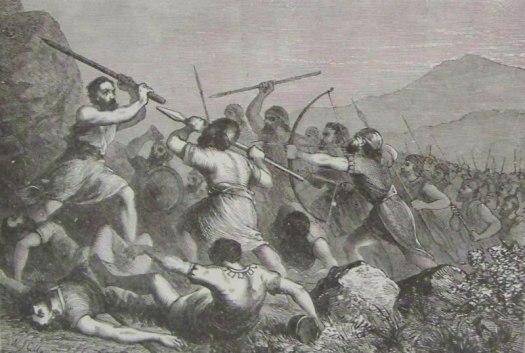
Scythian tactics included feinting or withdrawing from either the battlefield or even the region. An example of feinting comes from a battle mentioned in Part I (Scythian Tactics and Strategy – Part I ), the battle of Carrhae in 53 BCE.
The Roman historian Plutarch mentions that the Parthian horse archers would not engage the Roman forces during battle, but would retreat, luring the Roman forces to follow. The trap was set and the Romans thought victory was in hand. However, the fleeing horse archers turned and loosed arrows upon the pursuing Romans. The Romans in the pursuit soon realized they had made a terrible mistake, but it was too late. Nothing could be done but to make a defensive stand. Withdrawal allowed the feinting tactic to be used with proficiency due to Roman ignorance of their enemy. The Romans would try to advance, but with every attempt, the Parthian horse archers’ constant pelting with what seemed to be an endless supply of arrows would keep them in place.

Parthian horseman. ( Creative Commons )
Parthian camel units resupplied the horse archers by exchanging empty quivers for full ones, then and returning to their position. During this monotonous, never-ending event, the Romans would try to break the horse archer formations, only to be countered by heavy Parthian cavalry known as cataphract, which acted as the anvil to the Parthian hammer (arrows). The Battle of Carrhae was death by pieces for the Romans.

A depiction of Sarmatian cataphracts fleeing from Roman cavalry during the Dacian wars circa 101 AD, at Trajan’s Column in Rome ( Wikimedia Commons ).
Therefore, when it comes to the feinting tactic, do not watch for the visible hand, but rather the invisible one. The Parthians and Scythians were notoriously successful in the feinting technique before the battle of Carrhae. Afterward, the countering measure to this tactic went largely ignored until Alexander the Great demonstrated a reversal.
One could make the argument that the Romans had faulty intelligence before Carrhae, but this would be unfair, although true to a certain extent. The truth of the matter is that the Romans invaded a land they did not know, looking to conquer a people they did not understand. In the end, both Rome and Parthia would continue to bash each other as the years turned into centuries, but neither side truly dominated the other.
Defense in Depth
Defense in Depth is most successful if your nation is rather large and unproductive, as in the case of the Scythians, who valued land and the ability to roam, rather than the luxuries of the cities, like Athens or Nineveh. The Scythians did seem to have cities but mobile villages may be a more accurate description. As for the lazy luxuries of life, some settled, but the majority roamed about.
According to Herodotus: “We Scythians have neither towns nor cultivated lands, which might induce us, through fear of their being taken or ravaged, to be in any hurry to fight with you.” But Herodotus also stated: “Having neither cities nor forts, and carrying their dwellings with them wherever they go; accustomed, moreover, one and all of them, to shoot from horseback; and living not by husbandry but on their cattle, their wagons the only houses that they possess.” The Scythians did have slaves, according to Herodotus, who were blind and whose primary task was being a shepherd. Additionally, Herodotus also mentioned Scythians who grew corn and onions, which indicates that agriculture was common among some of the tribes. Therefore, the notion that the Scythians did not have cities or villages is partially untrue, depending on the Scythic tribe, of course.
The Scythians that Darius the Great attacked did not have cultivated lands or towns that could be beneficial to Darius’ forces. The Scythians conducted a scorched earth policy as Darius’s army marched further inland, following after them. The Scythians understood that an army marches on its belly and so do the animals accompanying them. What Darius could not use would be a weapon against his forces. The strategy would be defense in depth, scorched earth policy the tactic, and the outcome would be starvation. Starvation through burning was the preferred method used to rid of the Persians. The Scythians understood that they could defeat the enemy by allowing the land to swallow them both physically and mentally.
Darius was ignorant of the people he wished to conquer; he showed no knowledge of the people or terrain he was about to invade. Because of this attitude by Darius, his brother, Artabanus, warned that the proposed campaign to conquer the European Scythians was far too risky, and even if it was successful, the economic benefits were limited. Nevertheless, Darius had to learn the hard way. For the Scythians, it was a good way to prevent a possible second invasion.
As mentioned, the Scythians used the land to their advantage, knowing that Darius would follow as long as the bait was present. The Scythians burnt all that grew, causing Darius to follow his enemy across burnt terrain in hopes of finding food for both his men and animals. The Scythians conducted hit and run attacks during mealtime and even at night, preventing the men from eating or even sleeping, irritating them even more. The Scythians knew that as long as Darius followed in pursuit, he would gain nothing, not even an engagement. Psychological and physical attrition would set in by attacking the enemy’s stomach and his need for rest, causing irrationality among the troops and further deteriorating the chain of command.

Scorched earth tactics, or burning anything useful to the enemy while withdrawing, was an effective military strategy. Public Domain
In the end, the Scythians won a great victory by not engaging the enemy in conventional warfare, but beat the Persians through starvation and sleep deprivation, since an army can move only for so long before it needs to fuel up again in both rest and food. By denying both, the Scythians utilized a form of defense in depth that saved them from Persian conquest.

Scythian warriors, drawn after figures on an electrum cup from the Kul’Oba kurgan burial near Kerch. The warrior on the right is stringing his bow, bracing it behind his knee. Hair seems normally to have been worn long and loose, and beards were apparently worn by all adult men. The other two warriors on the left are conversing, both holding spears or javelins. The man on the left is wearing a diadem and therefore is likely to be the Scythian king. Public Domain
Featured image: Detail, decorative comb depicting weapons and dress of Scythian Warriors 5th Century BC. Public Domain
By Cam Rea
References
Ian Morris, Why the West rules–for Now: the Patterns of History, and What They Reveal About the Future (New York: Farrar, Straus and Giroux, 2010), 277-279.
Herodotus, The Histories, 4. 127.
Sean J.A. Edwards, Swarming on the Battlefield: Past, Present, and Future, (Santa Monica: Rand Corporation, 2000), xii.
U.S. Department of Defense, Counterguerrilla Operations, (Washington DC: Department of the Army, FM 90-8, August 1986), Chapter 4, Section III. 4-10.
Polybius. 18.30.6
Plutarch, Crassus, 25.5
Farrokh,133.
John Frederick Charles Fuller, The Generalship of Alexander the Great, (New York and Washington D.C.: Da Capo Press, 2004), 118-120.