Erra and His Magnificent Sibitti (Seven)

A mysterious yet ominous idea—one that leaves the reader asking: Who was Erra?

Over centuries of Mesopotamian syncretism, Erra became closely associated—sometimes virtually interchangeable—with Nergal, the god of war, plague, death, and the underworld.

Through Nergal, the tradition extends even further back into older Mesopotamian religious structures tied to Enlil and the Sumerian world. The names shifted across centuries, but the results remained strikingly familiar.

Yet even Erra required instruments of destruction, which brings us to the Sibitti.

The Sibitti were a minor group of seven divine warlike daemonic beings associated with Erra. In many respects, they functioned as catalysts of destruction itself—personified weapons and agents of chaos bound to Erra’s violent sphere of influence.

Their role within the Epic of Erra is particularly unsettling. The Sibitti incite Erra to leave his peaceful slumber beside his consort and once more embark upon a destructive path against humanity. They are not passive servants awaiting command, but active participants in violence, almost partners in destruction itself.

This is what gives the Sibitti their distinctly daemonic character. Their existence is tied not merely to war, but to the activation of chaos, devastation, terror, and collapse.

“Wherever you go and spread terror, have no equal.”
He said to the second, “Burn like fire, scorch like flame.”
He commanded the third, “Look like a lion; let him who sees you be paralysed with fear.”
He said to the fourth, “Let a mountain collapse when you present your fierce arms.”
He said to the fifth, “Blast like the wind, scan the circumference of the earth.”
He said to the sixth, “Go out everywhere like the deluge and spare no one.”
The seventh he charged with viperous venom: “Slay whatever lives.”
Epic of Erra

The Sibitti are not simply agents of chaos. They are nihilism personified, bound to pressure the world toward destruction through Erra.

The unsettling aspect of the Sibitti is not merely what they destroy, but how they behave. Peace equals boredom. They pressure Erra toward movement, activation, and violence itself.

The duality of civilization is that it must wield destruction to survive while remaining forever vulnerable to destruction itself.

The deepest horror the Sibitti invoke is the suspicion that peace itself may be the illusion, and the restless warriors are the only honest voices in the room.

II. From Mythology to Structure

From Ancient Mesopotamia to the modern world, the mythological gods, demons, and divine weapons of yesterday are now expressed through institutions, technologies, bureaucracies, and systems of organized force. The names have changed. The pressures remain recognizable.

III. MACRO LEVEL — Civilization Organizes Around Latent Destruction

Modern civilization does not merely defend itself when threatened.

Civilization is built to always prepare for massive destruction (war), even and especially when the country is supposed to be at peace. It is not a quick fix for an emergency, but a permanent way of working.

From the second half of the twentieth century onward, the most advanced societies have maintained, refined, and normalized vast architectures of slumbering violence. These systems are not “break when needed” only during emergencies; they are embedded in society itself. They run in the background of daily life.

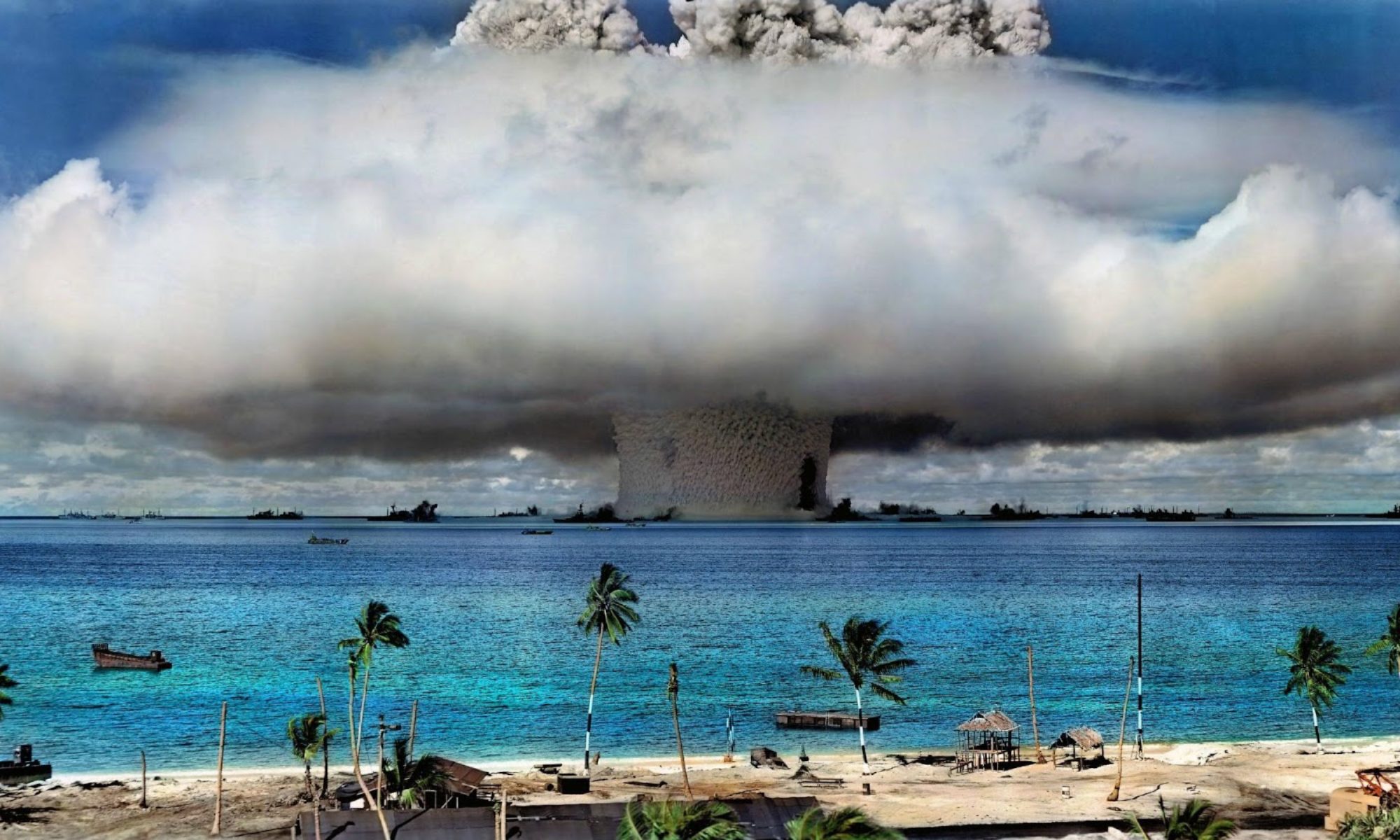
The clearest expression is nuclear deterrence. Thousands of warheads remain on hair-trigger alert or rapid-deployment status decades after the Cold War ended. The doctrine of Mutually Assured Destruction (MAD) is not a dormant relic; it is alive and well. Command-and-control systems are maintained at high readiness year after year. The logic is explicit: A stable civilization became a stable suicide postponed. Peace is the successful management of an apocalypse in real-time rather than the achievement of permanent safety. Sometimes the necessary evil is really tranquility in disguise.

Besides nuclear weapons, every major power sustains a large standing military in peacetime. These forces train and evolve continuously. Billions flow annually to ensure its readiness. Military exercises regularly simulate worst-case scenarios. To think that peace is a return to civility would be an error. Instead, it is a period of continuous costs in preparation for the next conflict, a central tenet of modern “Great Power Competition.”

This logic extends into the digital realm. Modern nations turn vital systems like power grids and transportation into weapons while trying to protect them. To do this, intelligence agencies hide cyber weapons inside enemy networks to prepare for future conflicts, weaponizing the infrastructure. Offensive cyber capabilities are developed and sometimes deployed even while nations proclaim the importance of a stable internet. This dual strategy hides the ongoing digital war between global powers under the guise of peace. These systems treat every citizen and foreign actor as a potential vector in a permanent, low-intensity conflict environment. In other words, everyone becomes an enemy of the state, including the state itself.

The U.S. economy, like most modern nations that exercise power, has been partially reoriented around this reality. The military-congressional-industrial complex consists of the military, corporations, and Congress, all of which depend upon defense contracts for innovation and revenue. Technological progress in dual-use fields is often driven by strategic competition rather than civilian demand. The result is a civilization built on the machinery of destruction for economic and intellectual prosperity.

States engage in political theater to project power through strategic signaling. This results in force posture adjustments within the military congressional industrial complex. Communicating that capability rewards vigilance and punishes perceived weakness without a shot being fired. Leaders must be a visible deterrent in order to appear strong and ready at all times. Together, these elements reveal a profound truth: civilizations throughout history have normalized the organization of latent destruction as a condition of existence. War is not an interruption of the system; it is the system’s ultimate reference point. The “peace” we experience is the managed equilibrium of war. As a nation, we are always armed, always watching, always investing in the next generation of lethality.

This is not a failure of modernity so much as its shadow architecture. In other words, it is the nature of the beast. This shadow architecture organizes the chaos to survive without a global ruler. Understanding this is essential before examining how newer technologies interact with it.

IV. OPERATIONAL LEVEL — Liminal Warfare

At this point, it is important to narrow the lens. The focus is that modern conflict often persists beneath the threshold of declared war.

What I mean is that it directly mirrors the fact that peace equals boredom, because the system increasingly refuses true dormancy.

The core idea is that populations become targets. Targets that can be stressed to produce fear and outrage. The weaponization of confusion causes emotional destabilization and, if effective, can maintain constant activation. Of course, this depends on the participants. The key is that conflict increasingly occurs within perception itself.

The one who controls the flow of information shapes the narrative. See, narratives are strategic terrain; they are, in fact, information ecosystems that can and are manipulated. This keeps the idea of truth continuously contested, allowing for the decentralization and acceleration of propaganda. The point is that control of interpretation becomes operationally valuable.

One way to spread various forms of information is through slogans,

images, and viral narratives, via memes. This memetic algorithmic amplification is an emotional contagion. From an operational perspective, the effects of information spread faster than traditional state messaging ever could. This brings us to cyber attacks.

This connects back to operational pressure. The idea is that the persistent probing of one’s target and the eventual penetration of said infrastructure, particularly during “peace,” will, over time, shape the invisible battlefield conditions for the future. Conflict, whether modern or past, often occurs before formal conflict exists. That is hugely important.

All of the above do, or will at some point, together or in cascading succession, cause economic destabilization. Take sanctions, for instance. Once sanctions are in place, supply chains begin to feel the pressure. This pressure is distributed to the populace, leading the government to perhaps engage in currency manipulation to survive at the cost of the governed through inflation, devaluation, and depletion, to name a few. This effectively creates a critical rift in the technological infrastructure needed for long-term economic and military stability. Economies have always been, and will always be, fair game in the scheme of operational terrain, for they are the lifeblood of systems. Once compromised, the potential to hemorrhage makes it all the more difficult for the system to coagulate.

This is where the fragmentation of society culminates. Let us start with polarization. Polarization breeds distrust among the populace, which, over time, leads to informational exhaustion. Once that occurs, we begin to see the rise of a perpetual crisis culture, in which populations are conditioned to instability because they no longer care about truth or fact. Therefore, destabilization begins within societies rather than invading them conventionally.

V. TECHNOLOGICAL ACCELERATION — AI, Automation, and the Compression of Decision

Overall, it comes down to compressing decision-making, and this is where AI comes in. Machine-assisted targeting enables predictive systems for automated analysis. This is crucial because it shrinks the human reaction window in escalation environments. This type of system is optimized for speed and restraint.

AI systems, in many ways, are perpetual. They monitor continuously, process constantly, and always adapt. This mirrors the idea that the absence of war is equivalent to lethargy, as the system increasingly refuses to maintain equilibrium.

At this point, we begin to see that the further amalgamation of man and machine, where the face of mankind begins to evolve. Algorithmic feeds in AI warfare process massive amounts of data to create a real-time, actionable “Common Operating Picture” that automates target identification and supports decision-making through recommendation systems. This also allows for an AI-generated narrative to produce

deepfakes, synthetic personas, and machine-mediated perception.

Overall, the result is a battlefield that increasingly intersects with cognition, interpretation, and emotional response, eliciting a reaction that justifies the means to an end.

From a philosophical point of view, the delegation of judgment is huge.

It is not that AI becomes conscious. Rather, humans increasingly defer decisions to systems, such as AI, to shape choices. This allows the

algorithm to prioritize the illusion of perception. The automation, in turn, influences the pathways of escalation. Therefore, technological systems will increasingly mediate human judgment itself.

VI. The Burden of Containment

This brings us back to the fact that the burden of containment is that peace increasingly resembles the continuous management of escalation rather than true stillness.

Diplomacy increasingly functions less in peace-making and more as a mechanism or tactic for stalling. This allows negotiations to continue without further adding to the issues at hand, unless one side does something that takes something off the negotiation table or adds to it, making the situation better or worse depending on the event. Treaties are valuable for the moment until something unfavorable happens, in which the treaty is called into question or loses value due to unforeseen circumstances. Summit meetings are a good place to hash out grievances on both sides. However, the real power lies in backchannel communication, where strategic dialogue is crucial to developing a potential deal that benefits both parties.

The core idea of deterrence is to prevent or discourage undesirable actions, as both state actors have recognized the consequences through visible force posturing and strategic ambiguity. In some ways, one could call it a peaceful game of chicken, since both sides are in the dark about each other’s intentions, which leads back to escalation management.

Overall, deterrence does not eliminate destructive capability; it just manages its behavior.

When it comes to de-escalation, modern systems increasingly rely upon friction mechanisms designed to slow escalation. Mechanisms like arms control or communications, where state actors can discuss the rules of engagement, allow both sides and their allies to build conflict-management structures to de-escalate while remaining deterrence-capable of striking.

When it comes to institutional restraint, civilizations build safeguards or structures specifically to delay impulsive activation. This is done within the government or governments through international institutions, where legal frameworks are lobbied, voted on, and tested through a bureaucratic process, usually with oversight.

Mankind remains one of the few remaining sources of friction in systems increasingly optimized for speed. Man understands that judgment can slow issues down for further scrutiny and debate. By throwing caution to the wind, uncertainty can reveal itself without slowing the system.

The tragic dimension is that the Mesopotamian god Ishum, divine watchman of the night, attempts to restrain Erra rather than destroy the Sibitti. In this context, Ishum never permanently defeats the Sibitti.

He delays them. That matters. Civilization often works similarly through nuclear deterrence, diplomacy, treaties, and institutions. They manage and disperse the pressure placed upon them, but can not erase it. Peace in today’s technological civilization resembles continuous containment rather than resolution.

VII. CONCLUSION — The Restlessness Remains

When it comes to civilization and the art of statecraft, one comes to realize sooner or later that it is reflective, cold, and controlled. States and their gods only know one thing, and that is to survive, even at the risk of an unintended suicide.

Erra’s weapons grow impatient during peace. Ours learned to wear human faces. Mankind’s weapons grow impatient during peace. AI learned to wear human faces. We cannot separate the weapon or discern the human face wearing it.

The Sumerian Military: Professionals of Weaponry and Warfare

Between the Tigris and Euphrates Rivers, lies a land once known as Mesopotamia. It was here that humanity found suitable land to rip open and seed. Once the seeds took root, civilization was born.

With food slowly becoming abundant, the population increased and branched out. With prosperity came external threats. Nomadic elements seeking further wealth encountered these communities and pillaged them. In doing so, they spread their parasitic-like sphere of influence, causing instability throughout the regions and cities of Mesopotamia. This instability gave rise to two things: the rise of the city-state and the professional soldier.

Creating a Civilization

Unlike pastoral societies that roam around looking for food, agriculturalists teamed together, settling in one spot and growing their food.  In doing so, they created a village and a society. However, it takes more than farming to create a state.

After a few generations, people slowly began to build upon their knowledge of agriculture, animal husbandry, and writing. With all these skills and many more, villages gained a greater sense of the self. Such awareness allowed for the creation of law, trade, private property, social interest, internal order, and a sense of self-identity. This allowed the Mesopotamian villages that dotted the landscape to evolve into city-states.

Map showing the Tigris–Euphrates river system, which defines Mesopotamia.

Map showing the Tigris–Euphrates river system, which defines Mesopotamia. (CC BY-SA 2.5)

The Sumerians were the first to carve out a civilization in Mesopotamia. By the third millennium BCE, the land of Sumer consisted of a dozen or more city-states. These city-states were walled and surrounded by suburban villages and hamlets.

Map with the locations of the main cities of Sumer and Elam. (Modern Iraq)

Map with the locations of the main cities of Sumer and Elam. (Modern Iraq) (CC BY-SA 3.0)

A reconstruction in the British Museum of headgear and necklaces worn by the women in some Sumerian graves.

A reconstruction in the British Museum of headgear and necklaces worn by the women in some Sumerian graves. (CC BY-SA 3.0)

The city-states of Sumer were centralized. Their centrally controlled society needed an administration to conduct the day-to-day redistribution of resources and to direct all social activity.

During the early period of Sumer’s history, the palace and temple had shared control over resources and social activities. The temple controlled much land and exerted a powerful influence over the people. The palace authority controlled as much, if not more, land than the temple.

This was fine until the palace could wield an even greater influence over the people. In doing so, the king could amalgamate the palace with the temple, where he saw himself as god’s representative on earth. If god chooses the king, then the temple must obey. This placed the temple in a predicament. However, this does not mean there would never be strife between the palace and temple authorities again. So long as they existed side by side, the desire to control and hold a monopoly over the other’s institution was desirable, especially if one wished to control the masses.

Sumerian Military Structure

The earliest known evidence of a professional, organized military comes from the Standard of Ur.  The Sumerian military structure in terms of rank is unknown. However, it is obvious that the king headed the army as depicted in “The Stele of Vultures.” Others who rode in chariots were likely princes, nobles, and wealthy landowners, while the main body was primarily infantry.

Detail from the Standard of Ur – Infantrymen and High ranking chariot riders

Detail from the Standard of Ur – Infantrymen and High ranking chariot riders (Public Domain)

Conscription

The organization of the Sumerian forces is somewhat silent. The conscription of troops comprised corvée (obligated) labor levied by the temple and palace to maintain the city-state. Not only was levied labor used for public works but it was also allocated for military service. The Shulgi inscription indicates that allocating levied labor for military service during times of war was common.

Tablet of Shulgi. This tablet glorifies king Shulgi and his victories on the Lullubi people and it mentions the modern-city of Erbil and the modern-district of Sulaymaniayh. 2111-2004 BCE.

Tablet of Shulgi. This tablet glorifies king Shulgi and his victories on the Lullubi people and it mentions the modern-city of Erbil and the modern-district of Sulaymaniayh. 2111-2004 BCE. (CC BY-SA 4.0)

One inscription from the 21st/20th century BCE, during the Third Dynasty of Ur, also known as the Neo-Sumerian Empire, gives one a glimpse into the recruitment. A king named Shulgi recorded that ‘‘the year the citizens of Ur were conscripted as spearmen.’’ He continues and describes his ‘‘conscription with the bow and arrow; nobody evaded it – the levy being one man per family.’’ Even though this inscription came later in Sumer’s history, it does provide a glimpse into military recruitment.

A half-mina weight (248 g.), bearing the name of king Shulgi.

A half-mina weight (248 g.), bearing the name of king Shulgi. (Public Domain)

The amount of men capable of being conscripted varied. A city-state, including the surrounding territory under the local king’s control, with roughly 30,000 to 35,000 people, could field an army of between 4,000 and 5,000 men during an emergency. However, the men conscripted into service could not fight professionally, and training, organizing, and disciplining the men to enable them to fight as a cohesive unit would have taken far too long. The training of a conscript was very short and rudimentary in both arms and tactics.

The Professional

Summary account of silver for the governor written in Sumerian Cuneiform on a clay tablet. From Shuruppak, Iraq, circa 2500 BCE.

Summary account of silver for the governor written in Sumerian Cuneiform on a clay tablet. From Shuruppak, Iraq, circa 2500 BCE. (Public Domain)

The professional fighting force consisted of infantry and chariots. The Tablets of Shuruppak (2600 BC) is a much earlier Sumerian text, which describes that the kings of the city-states provided for the full-time maintenance of 600 to 700 soldiers. Sumerian city-states were roughly 1,800 square miles (4660 sq km). Such space could sustain a population size between 30,000 to 35,000 people. A population this size could field a fighting force of 4,000 to 5,000. To better understand the Sumerian infantry, look no further than “The Stele of the Vultures” from the Early Dynastic III period (2600–2350 BCE).

Fragment of the Stele of the Vultures showing marching warriors, Early Dynastic III period, 2600–2350 BC

Fragment of the Stele of the Vultures showing marching warriors, Early Dynastic III period, 2600–2350 BC (CC BY-SA 3.0)

The Stele of the Vultures shows a victory celebration of King Eannatum of Lagash over his neighbor Umma. This stele displays a well-organized, professional infantry in the phalanx-like formation. Notice that they wear helmets, large shields that cover the body from chin to ankle, and leather-armored cloaks with what appear to have copper or bronze disks attached. Notice that some infantry carry long spears while others carry axes. The king in front of the formation carries a throwing stick.

Stele of the Vultures detail.

Stele of the Vultures detail.

Sumerian Arms

The basic arms carried were maces, daggers, spears, javelins, throwing sticks, and much more.

The mace is one of the oldest weapons in mankind’s arsenal and a direct descendant of the club. The Sumerian mace was made of stone and often shaped like a pear. The mace was effective in crushing bone, particularly the skull of the enemy. However, the utilization of the mace would fall out of favor as a preferred weapon with donning the helmet.

“This is a variegated red stone, globular mace head. Similar to the piriform mace head, this style was commonly used in Mesopotamia around 2450-1900 BC. These type mace heads would have been attached to a wooden shaft and used as a weapon to strike an enemy.”

“This is a variegated red stone, globular mace head. Similar to the piriform mace head, this style was commonly used in Mesopotamia around 2450-1900 BC. These type mace heads would have been attached to a wooden shaft and used as a weapon to strike an enemy.” (Aaron Newcomer/CC BY-ND 2.0)

The dagger was a double-edged blade weapon used for close combat. The dagger length was between eight to 12 inches (20 to 30 cm). The sword eventually replaced this weapon.

The spear was the same height or slightly smaller than a man. It had a socketed blade, and the spearhead was either bronze or copper. Other spears had blunted ends. The purpose of this weapon was twofold. Its first purpose is not to inflict injury but to push back against the enemy’s shields, thus keeping distance between the two combatants. Its second purpose, and most important, was the hook on the blunted spear, which was used to hook the rim of the enemy’s shield and dislodge it, thus leaving the combatant unprotected, and as such, he could be slain with the dagger or sword.

Javelins were much shorter than spears, with bronze or copper points. Javelins could be thrown by hand, while others had a leather-throwing thong at the butt called an ankle.

Axe heads were made of bronze, which slipped over the end of the shaft and was affixed with rivets. This innovation gave the axe a greater degree of strength. However, after 2500 BCE, the Sumerians developed another type of axe, which was heavier. The axe head had a much narrower blade attached to a much stronger socket, allowing it to penetrate bronze armor. Studies show that this new axe could generate 77.5 foot-pounds of impact energy. It only required 66 foot-pounds to penetrate the armor.

The throwing stick is a club that can be straight or curved and was designed to be thrown. One end of the stick was heavier than the other, but both ends were shaved down into points. That gave the weapon greater momentum when thrown and provided stability during trajectory. This is because when the stick made contact with the intended target, the energy upon impact was concentrated and delivered through the point. An example of this can be found in the Stele of Vultures, which shows King Eannatum carrying an item in his hand that is in dispute.

Detail of the "battle" fragment.

Detail of the “battle” fragment. (CC BY-SA 3.0)

One could say he is represented carrying a mace, scepter, or reins. Upon closer observation, it appears that Eannatum is carrying a throwing stick. Sumerians used sickle swords, but not until the Iron Age.

Sumerian Armor and Chariot

The Sumerian shield appears to be a rectangular body shield, as demonstrated by the Stele of Vultures. Unfortunately, no surviving Sumerian shields exist. The closest resemblance to the Sumerian shield was the discovery of the Mari shield. The Mari shield was made of reeds covered in hide but had no boss in the center, unlike the Sumerian shields depicted in the Stele. The Sumerian shield depicted in the stele appears to have six bosses when, in fact, it only has one. Upon closer examination, each individual is holding the spear with two hands.

Stele of Vultures detail.

Stele of Vultures detail.

However, a shield bearer may be holding the shield. Another alternative, which appears more plausible, is that the spearman uses a neck strap to hold the shield in place.

Detail of Sumerian stele.

Detail of Sumerian stele. (CC BY-SA 2.0)

The Sumerian helmet was a copper hat roughly two to three millimeters thick, fitting over a leather or wool cap, providing another four millimeters of protection. In total, the helmet was a quarter of an inch thick. Some may speculate why the Sumerian soldier was fitted with a copper rather than a bronze helmet. This may be because the Sumerians had not developed the ability due to the difficulty in casting such a mold to fit the shape of a wearer’s head.

The Sumerian cloak depicted in the Stele of the Vultures appears ordinary. On closer inspection, the cloak seems to have been made of cloth or thin leather with metal disks, possibly bronze or copper, sewn into the fabric. The purpose for this is obvious— to thwart spear blows to the torso. More importantly, this is the first depiction of body armor.

When it comes to the chariot, one must be careful when using the word ‘chariot’ when dealing with the Sumerians. What appears to be a chariot is not; it lacks the refinements of a true chariot. To the Sumerians, this vehicle was a “battle car.” Another vehicle brought to battle was a “straddle car.” This straddle car was a cabless platform where the driver had to balance himself by straddling the car. Both vehicles were either four-wheeled or two and required four wild asses to pull them. It was very different from their future replacements, but they did their job for the time.

Detail, Relief of early war wagons on the Standard of Ur, c. 2500 BC

Detail, Relief of early war wagons on the Standard of Ur, c. 2500 BC (Public Domain)

The Sumerian chariot was crude but innovative for its day. In all likelihood, its early use was for the king and nobles. There is an indication later on that Lugalzagesi (or Lugal-Zage-Si), the last Sumerian king, boasted that his vassals could provide him 600 battle cars for war. However, it is recorded that the city-state king of Umma had an elite unit of 60 battle cars at his beck and call. This is the only evidence that details the number of vehicles by any state for war.

The Sumerian battle car, cumbersome and slow as it would have been, was used for shock troops. The arms of the charioteer were the javelin or axe. Moreover, the vehicle likely transported its heavy infantry to the battlefield. Overall, the Sumerian battle car was slow but provided mobility for the infantry and delivered shock to the enemy.

Further information on the Sumerian military’s military organization is somewhat vague. However, understand that the idea of a Sumerian military organization is generic. In other words, the Sumerian civilization was just that—consisting of a series of independent city-states. Some Sumerian kings controlled just one city-state, while others controlled multiple city-states. Therefore, the number of troops a single king could field varied. This also applies to the amount of professional troops under the king’s command. Some kings could afford many, while many more could not.

As for battlefield performance, it would not be unreasonable to think that the conscripted men, who comprised the bulk of the Sumerian fighting force, were primarily used since the professional soldier was far costlier to lose and fewer in number. Not only was the professional crucial in determining the outcome of the battle, but he also was crucial in keeping the peace within the city and, most importantly, needed to protect the king. While increasing the ranks of professionals sounds lucrative from a position of security, it was too expensive. The costs to pay, feed, and equip the professional soldier, especially increasing their numbers, were too much. It was far cheaper to rely on temporary conscription. However, this would not last, for Eannatum, King of Lagash (circa 2455-2425 BCE), established the first Mesopotamian empire through constant warring.

Battle scene with horsemen, Assyrian, about 728 BC, from Nimrud.

Battle scene with horsemen, Assyrian, about 728 BC, from Nimrud. (CC BY-SA 3.0)

Eannatum’s conquest of Elam gave him the resources to provide an army on the march. The lands of Elam were rich in timber, precious metals, and stone. Such lucrative resources brought forth more wealth he could draw to pay his soldiers and expand the ranks to aid in his desires for further conquest. Eannatum would be the first of many in the history of warfare who conquered to confiscate the wealth of those subjugated to grease the wheels of their armies.

One fragment of the victory stele of the king Eannatum of Lagash over Umma. It depicts severed human heads in the beaks of vultures, and a fragment of cuneiform script.

One fragment of the victory stele of the king Eannatum of Lagash over Umma. It depicts severed human heads in the beaks of vultures, and a fragment of cuneiform script. (CC BY-SA 3.0)

Top Image: Standard of Ur, 26th century BC, “War” panel. (Public Domain)

By Cam Rea

References

“Weapons found in the Royal Tombs of Ur”. (2016) SumerianShakespeare.com [Online] Available at:  http://sumerianshakespeare.com/117701/118301.html

Black, Jeremy A. The literature of ancient Sumer. Oxford: Oxford University Press, 2004.

Chew, Sing C. World Ecological Degradation: Accumulation, Urbanization, and Deforestation 3000 B.C. – 2000 A.D. Walnut Greek: AltaMira Press, 2001.

Gabriel, Richard A. The Great Armies of Antiquity. Westport, Conn: Praeger, 2002.

The Ancient World. Westport, Conn: Greenwood Press, 2007.

Howard, Dan. Bronze Age Military Equipment. Barnsley: Pen & Sword Military, 2011.

Matossian, Mary Kilbourne. Shaping World History: Breakthroughs in Ecology, Technology, Science, and Politics. Armonk, N.Y.: M.E. Sharpe, 1997

Smithsonian Institution. Military History: The Definitive Visual Guide to the Objects of Warfare. New York: DK Publishing, 2012.

Woolley, Leonard. The Sumerians. New York: W.W. Norton, 1965.