
I. Erra and the Sibitti
“Humanity. You never had it from the beginning.”
— Charles Bukowski
Erra’s weapons grow impatient during peace. Ours learned to wear human faces.
A mysterious yet ominous idea—one that leaves the reader asking: Who was Erra?
Over centuries of Mesopotamian syncretism, Erra became closely associated—sometimes virtually interchangeable—with Nergal, the god of war, plague, death, and the underworld.
Through Nergal, the tradition extends even further back into older Mesopotamian religious structures tied to Enlil and the Sumerian world. The names shifted across centuries, but the results remained strikingly familiar.
Yet even Erra required instruments of destruction, which brings us to the Sibitti.
The Sibitti were a minor group of seven divine warlike daemonic beings associated with Erra. In many respects, they functioned as catalysts of destruction itself—personified weapons and agents of chaos bound to Erra’s violent sphere of influence.
Their role within the Epic of Erra is particularly unsettling. The Sibitti incite Erra to leave his peaceful slumber beside his consort and once more embark upon a destructive path against humanity. They are not passive servants awaiting command, but active participants in violence, almost partners in destruction itself.
This is what gives the Sibitti their distinctly daemonic character. Their existence is tied not merely to war, but to the activation of chaos, devastation, terror, and collapse.
The Sibitti are not simply agents of chaos. They are nihilism personified, bound to pressure the world toward destruction through Erra.
The unsettling aspect of the Sibitti is not merely what they destroy, but how they behave. Peace equals boredom. They pressure Erra toward movement, activation, and violence itself.
The duality of civilization is that it must wield destruction to survive while remaining forever vulnerable to destruction itself.
The deepest horror the Sibitti invoke is the suspicion that peace itself may be the illusion, and the restless warriors are the only honest voices in the room.
II. From Mythology to Structure
From Ancient Mesopotamia to the modern world, the mythological gods, demons, and divine weapons of yesterday are now expressed through institutions, technologies, bureaucracies, and systems of organized force. The names have changed. The pressures remain recognizable.
III. MACRO LEVEL — Civilization Organizes Around Latent Destruction
Modern civilization does not merely defend itself when threatened.
Civilization is built to always prepare for massive destruction (war), even and especially when the country is supposed to be at peace. It is not a quick fix for an emergency, but a permanent way of working.
From the second half of the twentieth century onward, the most advanced societies have maintained, refined, and normalized vast architectures of slumbering violence. These systems are not “break when needed” only during emergencies; they are embedded in society itself. They run in the background of daily life.
Nuclear Deterrence as Perpetual Posture
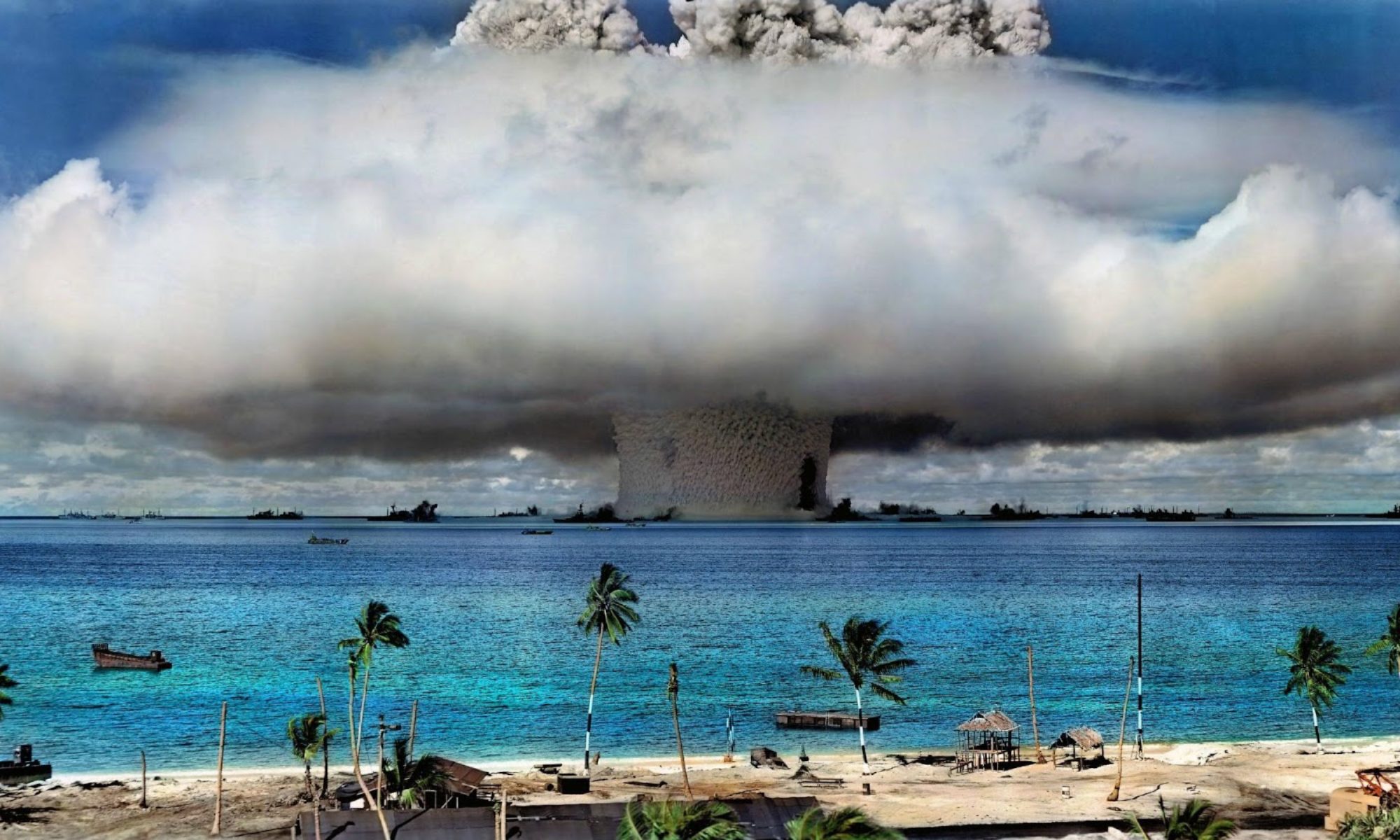
The clearest expression is nuclear deterrence. Thousands of warheads remain on hair-trigger alert or rapid-deployment status decades after the Cold War ended. The doctrine of Mutually Assured Destruction (MAD) is not a dormant relic; it is alive and well. Command-and-control systems are maintained at high readiness year after year. The logic is explicit: A stable civilization became a stable suicide postponed. Peace is the successful management of an apocalypse in real-time rather than the achievement of permanent safety. Sometimes the necessary evil is really tranquility in disguise.
Standing Militaries and Perpetual Readiness
Besides nuclear weapons, every major power sustains a large standing military in peacetime. These forces train and evolve continuously. Billions flow annually to ensure its readiness. Military exercises regularly simulate worst-case scenarios. To think that peace is a return to civility would be an error. Instead, it is a period of continuous costs in preparation for the next conflict, a central tenet of modern “Great Power Competition.”
Cyber Infrastructure and Intelligence Systems
This logic extends into the digital realm. Modern nations turn vital systems like power grids and transportation into weapons while trying to protect them. To do this, intelligence agencies hide cyber weapons inside enemy networks to prepare for future conflicts, weaponizing the infrastructure. Offensive cyber capabilities are developed and sometimes deployed even while nations proclaim the importance of a stable internet. This dual strategy hides the ongoing digital war between global powers under the guise of peace. These systems treat every citizen and foreign actor as a potential vector in a permanent, low-intensity conflict environment. In other words, everyone becomes an enemy of the state, including the state itself.
Military-Industrial Integration
The U.S. economy, like most modern nations that exercise power, has been partially reoriented around this reality. The military-congressional-industrial complex consists of the military, corporations, and Congress, all of which depend upon defense contracts for innovation and revenue. Technological progress in dual-use fields is often driven by strategic competition rather than civilian demand. The result is a civilization built on the machinery of destruction for economic and intellectual prosperity.
Strategic Signaling and the Theater of Power
States engage in political theater to project power through strategic signaling. This results in force posture adjustments within the military congressional industrial complex. Communicating that capability rewards vigilance and punishes perceived weakness without a shot being fired. Leaders must be a visible deterrent in order to appear strong and ready at all times. Together, these elements reveal a profound truth: civilizations throughout history have normalized the organization of latent destruction as a condition of existence. War is not an interruption of the system; it is the system’s ultimate reference point. The “peace” we experience is the managed equilibrium of war. As a nation, we are always armed, always watching, always investing in the next generation of lethality.
This is not a failure of modernity so much as its shadow architecture. In other words, it is the nature of the beast. This shadow architecture organizes the chaos to survive without a global ruler. Understanding this is essential before examining how newer technologies interact with it.
IV. OPERATIONAL LEVEL — Liminal Warfare
At this point, it is important to narrow the lens. The focus is that modern conflict often persists beneath the threshold of declared war.
What I mean is that it directly mirrors the fact that peace equals boredom, because the system increasingly refuses true dormancy.
Psychological Warfare
The core idea is that populations become targets. Targets that can be stressed to produce fear and outrage. The weaponization of confusion causes emotional destabilization and, if effective, can maintain constant activation. Of course, this depends on the participants. The key is that conflict increasingly occurs within perception itself.
Information / Narrative Warfare
The one who controls the flow of information shapes the narrative. See, narratives are strategic terrain; they are, in fact, information ecosystems that can and are manipulated. This keeps the idea of truth continuously contested, allowing for the decentralization and acceleration of propaganda. The point is that control of interpretation becomes operationally valuable.
Memetic Conflict
One way to spread various forms of information is through slogans,
images, and viral narratives, via memes. This memetic algorithmic amplification is an emotional contagion. From an operational perspective, the effects of information spread faster than traditional state messaging ever could. This brings us to cyber attacks.
Cyber Attacks
This connects back to operational pressure. The idea is that the persistent probing of one’s target and the eventual penetration of said infrastructure, particularly during “peace,” will, over time, shape the invisible battlefield conditions for the future. Conflict, whether modern or past, often occurs before formal conflict exists. That is hugely important.
Economic Destabilization
All of the above do, or will at some point, together or in cascading succession, cause economic destabilization. Take sanctions, for instance. Once sanctions are in place, supply chains begin to feel the pressure. This pressure is distributed to the populace, leading the government to perhaps engage in currency manipulation to survive at the cost of the governed through inflation, devaluation, and depletion, to name a few. This effectively creates a critical rift in the technological infrastructure needed for long-term economic and military stability. Economies have always been, and will always be, fair game in the scheme of operational terrain, for they are the lifeblood of systems. Once compromised, the potential to hemorrhage makes it all the more difficult for the system to coagulate.
Social Fragmentation
This is where the fragmentation of society culminates. Let us start with polarization. Polarization breeds distrust among the populace, which, over time, leads to informational exhaustion. Once that occurs, we begin to see the rise of a perpetual crisis culture, in which populations are conditioned to instability because they no longer care about truth or fact. Therefore, destabilization begins within societies rather than invading them conventionally.
V. TECHNOLOGICAL ACCELERATION — AI, Automation, and the Compression of Decision
Overall, it comes down to compressing decision-making, and this is where AI comes in. Machine-assisted targeting enables predictive systems for automated analysis. This is crucial because it shrinks the human reaction window in escalation environments. This type of system is optimized for speed and restraint.
Perpetual Responsiveness
AI systems, in many ways, are perpetual. They monitor continuously, process constantly, and always adapt. This mirrors the idea that the absence of war is equivalent to lethargy, as the system increasingly refuses to maintain equilibrium.
Human-Machine Integration
At this point, we begin to see that the further amalgamation of man and machine, where the face of mankind begins to evolve. Algorithmic feeds in AI warfare process massive amounts of data to create a real-time, actionable “Common Operating Picture” that automates target identification and supports decision-making through recommendation systems. This also allows for an AI-generated narrative to produce
deepfakes, synthetic personas, and machine-mediated perception.
Overall, the result is a battlefield that increasingly intersects with cognition, interpretation, and emotional response, eliciting a reaction that justifies the means to an end.
Delegation of Judgment
From a philosophical point of view, the delegation of judgment is huge.
It is not that AI becomes conscious. Rather, humans increasingly defer decisions to systems, such as AI, to shape choices. This allows the
algorithm to prioritize the illusion of perception. The automation, in turn, influences the pathways of escalation. Therefore, technological systems will increasingly mediate human judgment itself.
VI. The Burden of Containment
This brings us back to the fact that the burden of containment is that peace increasingly resembles the continuous management of escalation rather than true stillness.
Diplomacy
Diplomacy increasingly functions less in peace-making and more as a mechanism or tactic for stalling. This allows negotiations to continue without further adding to the issues at hand, unless one side does something that takes something off the negotiation table or adds to it, making the situation better or worse depending on the event. Treaties are valuable for the moment until something unfavorable happens, in which the treaty is called into question or loses value due to unforeseen circumstances. Summit meetings are a good place to hash out grievances on both sides. However, the real power lies in backchannel communication, where strategic dialogue is crucial to developing a potential deal that benefits both parties.
Deterrence
The core idea of deterrence is to prevent or discourage undesirable actions, as both state actors have recognized the consequences through visible force posturing and strategic ambiguity. In some ways, one could call it a peaceful game of chicken, since both sides are in the dark about each other’s intentions, which leads back to escalation management.
Overall, deterrence does not eliminate destructive capability; it just manages its behavior.
De-escalation Mechanisms
When it comes to de-escalation, modern systems increasingly rely upon friction mechanisms designed to slow escalation. Mechanisms like arms control or communications, where state actors can discuss the rules of engagement, allow both sides and their allies to build conflict-management structures to de-escalate while remaining deterrence-capable of striking.
Institutional Restraint
When it comes to institutional restraint, civilizations build safeguards or structures specifically to delay impulsive activation. This is done within the government or governments through international institutions, where legal frameworks are lobbied, voted on, and tested through a bureaucratic process, usually with oversight.
Human Delay Mechanisms
Mankind remains one of the few remaining sources of friction in systems increasingly optimized for speed. Man understands that judgment can slow issues down for further scrutiny and debate. By throwing caution to the wind, uncertainty can reveal itself without slowing the system.
The Tragic Dimension
The tragic dimension is that the Mesopotamian god Ishum, divine watchman of the night, attempts to restrain Erra rather than destroy the Sibitti. In this context, Ishum never permanently defeats the Sibitti.
He delays them. That matters. Civilization often works similarly through nuclear deterrence, diplomacy, treaties, and institutions. They manage and disperse the pressure placed upon them, but can not erase it. Peace in today’s technological civilization resembles continuous containment rather than resolution.
VII. CONCLUSION — The Restlessness Remains
When it comes to civilization and the art of statecraft, one comes to realize sooner or later that it is reflective, cold, and controlled. States and their gods only know one thing, and that is to survive, even at the risk of an unintended suicide.
Erra’s weapons grow impatient during peace. Ours learned to wear human faces. Mankind’s weapons grow impatient during peace. AI learned to wear human faces. We cannot separate the weapon or discern the human face wearing it.