The Iron Army: Assyria – Terrifying Military of the Ancient World – Part I


Before the famed Persian Empire, whose borders spanned from India to Thrace, there was another empire—the Assyrians. The Assyrian Empire, while much smaller than the future Persian Empire to come, made up for its lack of territorial mass with a well-greased, organized fighting machine.

In the book of Nahum 3:1, the prophet Nahum made it clear that Assyria was a “city of blood, full of lies, full of plunder, never without victims! The crack of whips, the clatter of wheels, galloping horses and jolting chariots! Charging cavalry, flashing swords and glittering spears!”

What made the Assyrian Empire one of the most terrifying militaries in the ancient world was that they were organized, well led, well fed, well supplied, and had the tools to crack into just about any city they so desired. When it comes to warfare, sieges dominate the vast array of Assyrian reliefs. The siege we will focus on is that of Lachish in 701 BCE.

In order to understand how the Neo-Assyrian military organization functioned one must first focus on the head of the army, the king. From there, we can gather the role of the nobility in military affairs and finally those who formed the bulk of the army.

King: Despotic Commander in Chief

Sargon II and dignitary. Palace of Sargon II at Dur Sharrukin in Assyria (now Khorsabad in Iraq), c. 716–713 BC. (Public Domain)

The Assyrian king wasn’t just directly involved with state affairs on all levels; he was the state. Every aspect of state affairs, whether international, political, military, and religious, was directly linked to him. The king was absolute, but even he had limitations. The Assyrian king, unlike the pharaoh of Egypt, was not divine but despotic. He was a mediator between the gods and his subjects through his ritual purification by both divine and human attendants. Besides the day-to-day domestic and foreign affairs dealt with by the king, he was commander and chief of the Assyrian army. Middle Assyrian inscriptions attest to this, as the Assyrian king on his coronation would swear an oath that they would lead their armies, in person, on annual campaigns of conquest to extend their borders. Even though he was the head of his army, he was a figurehead to a certain degree, for his military duties were diffused and delegated to lesser officials.

Turtānu: Leader of Armies

This lesser official, who would lead armies, was the turtanu. The turtanu was second in military command right under the king. While the king was in fact the commander in chief of the army, the real responsibility executing his majesty’s orders lay in the hands of the turtanu. Assyrian kings did participate in campaigns but when unable, the turtanu was firmly in charge. Eventually either Tiglath-Pileser III or Sargon II reorganized the office of the turtanu. In the past, one man held the position. However, this changed. Instead of having one man take charge of the military forces there was be two. One man was in charge “of the left” and the other “of the right.” While not definitive in all cases, the post of the turtanu were assigned to eunuchs. The reason for this was to limit power by ensuring that the man in charge could not pass his office down to his son through inheritance, which in turn limited the power of the office and avoided the possibility of a coup.

Army Organization and Officers

Information on the military organization of the Assyrian army is fragmented and murky. But a word of caution before proceeding: what is about to be presented is based on what is known and what can be considered from what information survives.

The Assyrians do provide some history concerning the framework of their military apparatus. During the eighth century BCE the Assyrian king could mobilize a force of between 150,000-200,000 men and in extreme cases, 1,000,000. This seems a bit farfetched but was not impossible. In times of war, the Assyrians could field between 20,000-50,000 troops, which would be the equivalent of two or five modern American divisions. Each division consisted of 120 officers. Therefore, two divisions would consist of 240 officers while five divisions consisted roughly of 416 officers. When further broken down, a squad of ten men was under the control of a noncommissioned officer. Five or twenty squads were formed into a “company” (kirsu) under the command of a “captain” (rab kisri or rab hanle). The amount of men in an Assyrian company probably was made up of five squads totaling 250 men and would take at least four of them to form a battalion. A regiment possibly consisted of and three battalions totaling 3,000 men, which seems possible based on the Urartian system, similar to that of Assyria, and it was under the command of a prefect, or what would be today the equivalent of a modern colonel. As for the size of an Assyrian division, it would seem possible that one division consisted of three if not more regiments.

By the time of Sargon, they had become a truly iron army. Sargon reorganized and integrated the fighting force, starting with the conventional units such as infantry, chariots, cavalry, and siege machinery. Next were specialized units to aid support to the conventional, such as scouts, engineers, intelligence officers, and sappers (soldiers for building, demolitions, general construction). To support and supply such an army with the amount of iron needed, Sargon constructed a single weapons room called Dur-Sharrukin (Fort Sargon) which contained 200 tons of weapons and body armor.

Plan of Dur-Sharrukin, 1867.  Victor Place excavated Khorsabad (Iraq) from 1852 to 1855. The Palace of Sargon is represented at North East. (Public Domain)

Reconstructed model of Palace of Sargon at Khorsabad, 1905. (Public Domain)

Soldiers and Engines of War

The Assyrian military consisted of four main units: cavalry, charioteers, infantry, and archers.

When it came to mobility, the Assyrians relied on charioteers like most Near Eastern nations. However, during the reign of Ashurbanipal II in the ninth century BCE, reliefs depict the Assyrians as already having cavalry but in small numbers; they were light by standard and their only function was to ward off other horse archer units during an engagement. What the Assyrians did to combat this was to take regular foot archers and place them on horseback. The Assyrians now had their own version of a horse archer, but the problem was they wore little or no armor. This made the Assyrian horse archer vulnerable to attacks from other horse archers better armored and trained in the rudiments of archery from horseback.

Ashurbanipal II meets a high official after a successful battle.

Ashurbanipal II meets a high official after a successful battle. (Public Domain)

Tiglath-pileser III took note of what is already in use pertaining to his own force and admired what could be adopted and improved upon into his own cavalry units. Tiglath-pileser invested in developing better cavalry units whereas their enemies later on (such as the Cimmerians and Scythians) continued to evolve into much better fighting forces that adapted to the natural conditions and to the conduct of their enemies— in other words, to improvise, adapt, overcome.

After conquering a portion of western Media, Tiglath-pileser incorporated Median cavalry into his own army and from then on, effectively changed the nature of the Assyrian cavalry from charioteer teams to mounted warriors armed with bow and spear. The days of the chariot as master of the battlefield were nearing an end but were not yet over. Over time, the Assyrian army had three types of cavalry. The first type was light cavalry, which consisted of Medes and other nomads who were quick and who primarily used the bow and javelin. Next were the Assyrian heavy archers. This unit consisted of men in heavy scale body armor. Finally, the heavy cavalrymen were fully armored and designed for fighting heavy infantry. However, the Assyrian use of heavy cavalry for shock is uncertain. Cavalry under Tiglath-pileser III on through to Sargon II seem to be primarily skirmishers. There is, however, cavalry depicted during the time of Sargon II on reliefs which are shown to be carrying spears and charging into battle, which may suggest the evolution of the Assyrian shock cavalry was well underway. Tiglath-pileser III and his successors loved the new cavalry so much that they replaced most of the chariot units with elite cavalry units over time. To put this into perspective, the king, his nobles, and the warrior elite were the only ones permitted to use the chariot.

Assyrian artwork from ninth century BC at British Museum. (CC BY 2.0)

Assyrian infantry can be divided into three types: spearmen, archers, and slingers. Spearmen were well armored and are the foundation of the Assyrian army. Their primary function was to provide defense and offense. When on the defensive it was the spearmen’s job to support the skirmishing and cavalry units, to maneuver around them and find targets that could be softened up, which would take pressure off the lines and allow the infantry to go on the offensive. These Spearmen were armed with a shield, spear, and a dagger or short sword.

Assyrian Soldier with Standing Shield, Soldier with Small Shield, Archer. (Public Domain)

Archers were also well armored and used a recurve bow. In some reliefs, Assyrian archers are accompanied by a shield bearer who provided protection as the archer discharged his arrow. Archers in battle were usually placed in front of the heavy infantry ranks to shower arrows down upon the enemy before retreating behind the spearmen once the enemy was too close for comfort. Assyrian archers in the reliefs also appear to be wearing short swords as well.

Another skirmishing unit utilized to harass the enemy was slingers. Slingers, as their name applies, slung well-rounded rocks at the enemy. While the distance was not as great as an archer, the power generated upon release caused tremendous damage as it was meant to crush, unlike the arrow, which was used to pierce. Slingers, like archers, would be out in front of the spearmen harassing the enemy infantry or, engaging the enemy skirmishing detachments.

Sling Stones, Tel Lachish, 701 BCE. (CC BY-SA 3.0)

However, Assyrian horse archers and those carrying javelins could and did act as skirmishing detachments who could, with the right covering fire from the archers, could quickly ride up on the enemy lines, whether infantry or skirmishers, and discharge their projectiles before riding off.

The Siege of Lachish will be our Example

Once they set up camp outside their intended target, the Assyrian military force, when arrayed, occupied roughly an area of 2,500 yards across and 100 yards deep. The supplies for such a force would have been massive. The number of calories and amount of water a single Assyrian soldier would need to function comes to 3,402 calories a day and nine quarts of water. This does not include the amount of food needed to feed the pack animals haul the equipment. Once the Assyrian army was finally in place before the walls of an enemy city, the consuming and waste began and the need to finish the job quickly set in.

Assyrian War Camp Relief.

Assyrian War Camp Relief. (CC BY-SA 2.0)

So how did the Assyrians deploy for a siege? An Assyrian siege begins with a messenger. According to 2 Kings 18:17-37 they would send a messenger to deliver the ultimatum, which was ‘surrender or die’. However, it seems most cities chose to fight than give in to the attacker.

Once the Assyrian army had isolated the city, they would begin to construct siege works on the spot. At the siege of Lachish in 701 BCE, Sennacherib’s siege crew deployed prefabricated battering rams, which required assembly on the spot. While the construction of siege engines was underway, the Assyrian infantry would begin to build earthen ramps leading to the weakest point in the city walls. The men building the ramps were likely under the protection of Assyrian archers and slingers.

Assyrian archers during a siege would push forward, wearing a long coat of mail and carrying a man-sized reed shield with a bent back to protect him from enemy fire. The Archer would carry an Assyrian composite bow, which required two to string. These heavy bowmen could easily get into position and pelt the enemy on the walls, thus negating interference with the men below who were constructing the siege ramps.

The same goes for the Assyrian slingers, who also were good at harassing the enemy with projectiles as the ramp drew closer to the city walls as they could hit high-angled targets who hid behind the parapets.

Assyrian attack on a town with archers and a wheeled battering ram, 865–860 BC. (Public Domain)

Chariots were deployed as light mobile artillery that could aid in hitting targets on the walls. In one sense, they were a great addition to keeping the defenders from firing back too often, for each volley the archers and slingers could fire, the charioteer archers could deliver another volley and quickly get out of harm’s way.

After the earthen ramps were finished, teams of infantry, aided with the protection of archers to cover their approach, began to push the heavy siege machines forward into position. One such siege engine that was very effective against enemy fortification was the Assyrian battering ram. During the siege of Lachish, King Sennacherib (704-681 BCE) deployed several battering rams simultaneously towards the weakest points of the walls. One of the big differences when comparing these rams with those of the past is that Sennacherib had the battering pole extended. This allowed a greater degree of reach and leverage. When looking at the reliefs depicting the siege of Lachish, one will notice archers atop the device as it moves forward. There are two likely reasons for this. First, as the battering ram is moved forward, enemy along the wall could possibly throw an incendiary device, which could cause the ram to catch fire. Placing archers atop the vehicle allows them to pick off those wishing to set the ram a blaze. The second reason is to protect the infantry moving behind the ram.

Assyrian troops attacking a besieged city using a battering ram on a siege ramp. Enemy archers are returning fire. Headless corpses lie at the foot of the city walls. (Public Domain)

While the ram attempted to smash and loosen the rocky walls, Assyrian assault teams with scaling ladders would try to breach walls. The ram, while effective, was also vulnerable to enemy defenders dropping chains to pull the battering pole aside. Because of this issue, the Assyrians deployed men who counter this by hooking the chains with iron grapples. The prophet Joel gives a description of the Assyrian wall scaling:

 They charge like warriors;

    they scale walls like soldiers.

They all march in line,

    not swerving from their course.

They do not jostle each other;

    each marches straight ahead.

They plunge through defenses

    without breaking ranks.

They rush upon the city;

    they run along the wall.

They climb into the houses;

    like thieves they enter through the windows. – Joel 2:7-9.

Top Image: Assyrian relief of horsemen with spears. Bodies fly in their wake. From Nimrud, now in the British Museum (CC BY-SA 3.0)

By Cam Rea

References

Archer, Christon I. World History of Warfare. Lincoln: University of Nebraska Press, 2002.

Campbell, Duncan B. Besieged: Siege Warfare in the Ancient World. Oxford: Osprey, 2006.

Carey, Brian Todd, Joshua B. Allfree, and John Cairns. Warfare in the Ancient World. Barnsley, South Yorkshire: Pen & Sword Military, 2005.

David, Richard, Barnett and Margarete Falkner. The sculptures of Aššur-nasir-apli II, 883-859 B.C., Tiglath-pileser III, 745-727 B.C. [and] Esarhaddon, 681-669 B.C., from the central and south-west palaces at Nimrud. (London: Trustees of the British Museum, 1962.

Eadie, John W., “The Development of Roman Mailed Cavalry” The Journal of Roman Studies, Vol. 57, No. 1/2 (1967), 161-173.

Fagan, Garrett G., and Matthew Trundle. New Perspectives on Ancient Warfare. Leiden: Brill, 2010.

Gabriel, Richard A. Great Captains of Antiquity. Westport, Conn: Greenwood Press, 2001.

Gabriel, Richard A. The Culture of War: Invention and Early Development. New York: Greenwood Press, 1990.

Gabriel, Richard A. The Military History of Ancient Israel. Westport, Conn: Praeger, 2003.

Soldiers’ Lives through History – The Ancient World. Westport, Conn:    Greenwood Press, 2006.

Healy, Mark, and Angus McBride. The Ancient Assyrians. London: Osprey, 1991.

Kern, Paul Bentley. Ancient Siege Warfare. Bloomington: Indiana University Press, 1999.

Nosov, K., and V. Golubev. Ancient and Medieval Siege Weapons: A Fully Illustrated Guide to Siege Weapons and Tactics. Guilford, Conn: Lyons Press, 2005.

Oded, Bustenay. Mass Deportations and Deportees in the Neo-Assyrian Empire. Wiesbaden: Reichert, 1979.

Rawlinson, George, Ancient Monarchies of the Ancient Eastern World Vol I, (New York: Lovell, Coryell & CO, 1881.

Roberts, Janet “Centering the World”: Trees as Tribute in the Ancient Near East.” Transoxiana Journal Libre de Estudios Orientales.http://www.transoxiana.com.ar/11/roberts-near_east_trees.html (accessed August 11, 2016, 2011).

Saggs, H. W. F. The Might That Was Assyria. London: Sidgwick & Jackson, 1984.

Vuksic, V. & Z. Grbasic, Cavalry: The History of a Fighting Elite, (London: Cassell, 1993

Soldier of Fortune: Glory Days for Sir John Hawkwood, King of Mercenaries


Sir John Hawkwood was born into a life on the English countryside that was business and rebellion. From an early age, he sought power and influence outside of England’s borders. He showed off his battle skills in the Hundred Years War and won a knighthood from England’s king.

Hawkwood the man was indeed an interesting character: a brilliant tactician, and an equally brilliant politician, but in his life, he would terrorize Italy with armies and bands of mercenaries, amass a great fortune, and cement his place in history as the most famous Anglo-Italian mercenary.

Engraving representing John Hawkwood.

Engraving representing John Hawkwood. (Public Domain)

Beginnings of Business

Hawkwood was born around 1320, in the parish of Hinckford, Essex, which is located in the north-central region of the county. Essex County was known for its farming and sheep; it had a thriving business sector that produced cloth and exported raw wool. Essex also produced anti-authoritarianism. In 1381, the people revolted against the crown in a large social uprising. The county of Essex in the 14th century was indeed a business class society that did not take well to authority. This attitude harbored by the locals may have influenced the young Hawkwood early on in his life.

John was the youngest child of Gilbert de Hawkwood, but he shared the same name as his older brother. John’s social situation is contrary to what past historians claimed, said to have come from a low ranking family, and was himself a poor soldier later on in his life. This, however, is not true, for John grew up in a wealthy business family. His father was supposedly a tanner who owned land, and even had a maidservant to take care of the day-to-day chores around the house.

In 1340, John’s father died. The will Gilbert left behind divided the share each child of his received. The elder John got the largest of the share and stayed at home to run the business, while the younger John left home with his share.

Hawkwood The Military Man

The younger John Hawkwood took his share and moved to London. Once Hawkwood made it to London, he worked as a tailor or a tailor in training, an apprentice. However true this story is about Hawkwood working and training to be a tailor remains in dispute. It is also said that tailors during this period were looked down upon in terms of serving in the military. However, it did not stop Hawkwood, for when Edward III began to recruit men for his army (which he planned on taking to France in order to claim the French throne), Hawkwood tossed the needle for the sword and joined the army along with his neighbors back home – one of whom happened to be John de Vere, his lord back in Essex, and wealthy families such as the Listons, Coggeshales and Bourchiers.

John de Vere assembled an army of 40 men-at-arms, 10 knights, 29 esquires and 30 mounted archers to serve Edward III.  Wool was provided to the men as pay; a total 56 sacks of wool was to be brought with them. As for Hawkwood’s role in John de Vere’s army, this remains uncertain. However, it is said that he may have started in 1342 as an archer.

Hawkwood and the Hundred Years War

He may have had humble beginnings in the army, but Hawkwood’s ambitious goal was to one day retire to these lands and that goal would start with the battle of Crecy in 1346.

Battle of Crécy between the English and French in the Hundred Years' War. 15th century.

Battle of Crécy between the English and French in the Hundred Years’ War. 15th century. (Public Domain)

Hawkwood’s archery skills are said to have started when Edward banned games such as football, cricket, hockey, cockfighting and so on. King Edward wanted his men to focus on archery, particularly using the English longbow. Hawkwood must have been a good pupil when it came to master the bow, for at the battle of Crecy in 1346, he held the rank of captain on the battlefield and commanded a company of 250 archers led by de Vere. After the battle of Crecy in 1346, Hawkwood seems to have disappeared.

Village sign at Crécy-en-Ponthieu, Picardy commemorating the Battle of Crécy, 26 August 1346.

Village sign at Crécy-en-Ponthieu, Picardy commemorating the Battle of Crécy, 26 August 1346. (CC BY-SA 3.0)

Between Crecy and the battle of Poitiers, Hawkwood appears to be only mentioned twice, but in a negative light, so it seems. The first known record tells us he and another beat a man almost to death in a place called Finchingfield in 1350, and then he committed theft a year later. Hawkwood’s life outside the military seemed to be like that on the battlefield. In other words, Hawkwood was broke and in need of booty.

These two unflattering events are all that is known about Hawkwood outside the military, for he again disappears in the historical record and it is speculated that he returned to France and rejoined de Vere’s forces and maybe even married one of de Vere’s daughters. Nevertheless, Hawkwood’s case will always have speculation, but one can gather that he did return to France, was married, did have a daughter, and is recorded to have been at the battle of Poitiers in 1356.

In 1356, at the Battle of Poitiers, Hawkwood is said to have distinguished himself in the field of battle by winning his spurs. In other words, John Hawkwood was not just John Hawkwood anymore; he was Sir John Hawkwood, for the spurs he won made him a knight. The recommendation of knighthood that be awarded to Hawkwood was by the Earl of Oxford. After Poitiers, Hawkwood was involved in the raids on Gascony province, particularly raiding the city of Pau. Nevertheless, all well ends well or so we think, for in 1360, the treaty of Brétigny was signed between England and France, thus ending the Hundred Years War in theory.

A few historians mention Hawkwood’s status by the end of the war. The historian Philip Morant from Essex says that Hawkwood was “the poorest of knight,” while Froissart calls him “a poor knight.” Overall, Hawkwood was rich in title, but lacked the wealth to be noble. This is where his life as a mercenary was about to begin.

Hawkwood the Mercenary

John Hawkwood had only two options in his life; return home as a commoner, or stay in France and become a mercenary. This second option was preferred, as he could make money that would help him climb the ladder of nobility and service.

In 1360, Hawkwood joined up as a freebooter or mercenary group that was called “Les Tart-Venus”, which means ‘Late-Comers’. Men in positions like John Hawkwood were allowed to stay in France and conduct war. The reason is that once Edward III signed the Brétigny Treaty, he gave the order for his men to pull out of France and return to English soil. However, Edward III allowed raids to take place in France unofficially. The reason Edward allowed this was to see if he could gain a much greater deal from the French king. So how did the English soldiers stay? According to medieval author Jean Froissart, King Edward had high-ranking men encourage those seeking to return home to stay in France and continue on their destructive path—and why not? If the English soldiers returned home, they returned to nothing, for they were at the moment unemployed. However, if they turned to face the French countryside, they would soon notice that money was abundant and opportunity for warfare never-ending. All these men had to do was claim no country, as was the case of Hawkwood.

The Great Company and Heaven over Money

In December 1360, Hawkwood and his men arrived at, and captured the French town of Pont-Saint-Esprit, along with the help of other mercenaries, and together they became known as “The Great Company.”

Hawkwood had a much bigger prize in mind, however: the town of Avignon. Avignon was the capital where the Pope, himself lived.  Hawkwood saw Avignon as prime pickings, for if the Pope lived there then money was there, for the money that flowed to and from the Papacy was linked with all the major kingdoms of Christendom. Hawkwood and many others saw a great investment in harassing Pope Innocent.

The city of Avignon was surrounded and cut off by the various bands of mercenaries, including Hawkwood’s men. The city had no way of getting food, and the population was slowly beginning to starve, not to mention that the plague was back in France again. The Pope was all but powerless. He ordered the mercenaries to disperse and go home, but the mercenaries said no, so the Pope excommunicated them, but the mercenaries could care less. This left Pope Innocent with one last option. He announced a crusade to come and defeat the mercenaries that surround Avignon.

The Pope was able to summon seven thousand men to go and besiege Pont-Saint-Esprit in early February 1361. However, it failed, and Froissart mentions that the reason why the crusaders lifted the siege on Pont-Saint-Esprit was due to not being paid. The Pope had promised Heaven over money.

Despite the ‘heavenly’ offer, many of the crusaders packed up and returned home while others went over to the “Free or Great Company Side.” Because of this, the Pope and the cardinals debated as to what to do with the mercenaries. In the end, they summoned for a man by the name of Marquis of Monferrato. Monferrato was the Imperial Vicar of Piedmont as well as Lord of Turin. It was his job to hire the mercenaries and to take them back to Northern Italy to fight against Milan. Thus, the Pope paid Monferrato a huge sum of money to decontaminate the land around Avignon of plague, but also to fight Milan. Hawkwood signed up.

It is recorded that Hawkwood was sending money back home to his older brother John to make the investments for him, which in turn made the family wealthy, even during the plague years, which seemingly did not hinder their economic growth.  This could be true, for the Pope is said to have paid one hundred thousand florins to the companies: thirty thousand went to the men, while Monferrato paid the men sixty thousand more florins to hire them. This would have given each man 15 florins apiece, maybe more, for the men in charge of the bands, like Hawkwood, may have been paid more due to rank, but it is not known for certain.

White Company

Hawkwood returned to France in 1361 to fight the French as a part of the Great Company. Hawkwood finally returned and stayed permanently in Italy with a group of Anglo-German mercenaries called ‘condottieri’, effectively ‘contractors’.

Bartolomeo d'Alviano, a Condottieri.

Bartolomeo d’Alviano, a Condottieri. (Public Domain)

A man named Albert Sterz led the condottieri until December 1363.  Hawkwood took over the condottieri band of Pisa and reorganize them into the famous English mercenaries, called “White Company.” From then on Hawkwood’s fame grew ever-increasingly due to his men’s military professionalism as seasoned veterans.

In 1365, a man named Egidio Albornoz approached Hawkwood with a war chest of 200,000 florins provided by the Pope. The payment was intended for Hawkwood to attack the Visconti who had been molesting church lands in central Italy for some time. He took the battlefield and did well until he began to lose to Visconti, and Hawkwood made the decision to retreat to the castle of San Mariano.

Modern photograph of San Mariano, Perugia, Umbria, Italy.

Modern photograph of San Mariano, Perugia, Umbria, Italy. (CC BY-SA 3.0)

Hawkwood and his men held out for some time, but due to thirst, they begged for peace. The besiegers led by Albert Sterz (who was once Hawkwood’s friend), knew that it was better to keep these men alive than to kill them, for they were worth money—not as prisoners, but rather as mercenaries. In the end, 2024 men surrendered and all their belongings they had with them was given over as booty to Albert Sterz.

Sterz had won the day and was showered with glory from the people of Perugia. However, Sterz was about to betray everything he had achieved with the Perugian’s. Hawkwood and his men were now in prison, but that was not going to last long. Hawkwood managed to escape along with many of his knights. How Hawkwood did it remains unknown, but when Sterz had found out, he pursued Hawkwood.  Hawkwood and his men were on the run looking for money to pay for the men locked up in Perugian prisons. Sterz chased Hawkwood relentlessly until he had to give up. The only problem was that Hawkwood not only escaped Sterz’s grasp, he was now in the arms of the city of Genoa, which happened to seat the most powerful rulers in Italy.

Wealth and Prestige: Glory Days!

Sir John Hawkwood arrived in Milan with open arms to a man named Bernabo. He was the leader of Milan, or co-leader with his brother Galeazzo. Bernabo was a military man who led his men with the sword. So why did Bernabo want Hawkwood to lead his army? He needed an insurance policy.

Bernabò Visconti, lord of Milan.

Bernabò Visconti, lord of Milan. (Public Domain)

Bernabo was eyeing some lands to the south and he needed Hawkwood to lead an army as its general, unofficially, and at the same time mentor a person by the name of Telemachus. Both men rode out of Milan with the newly-created “Army of Saint George” numbering ten thousand in October of 1365.

Battle between condottieri.

Battle between condottieri. (Public Domain)

Their destination was the lands of Siena, where they burned and looted for over twenty miles. They also torched Santa Colomba, Marmoraia, Buonconvento, Roccastrada, Berardenga, and the abbey of San Galgano. In addition, Hawkwood defeated a militia raised by Siena, captured its leader, and ransomed him for 10,000 florins. Later Hawkwood changed his mind and brought the ransom down to 500 florins. Hawkwood left the company of Saint George in 1366.

Bernabò and his wife, Beatrice

Bernabò and his wife, Beatrice (Public Domain)

Hawkwood served the duke of Milan again from 1368 to 1372 and then for the Pope from 1372-1377. Hawkwood’s service to the Pope was one of wealth and prestige, for the mercenary extorted a large sum of money from the raids he conducted on Tuscany, which resulted in about 130,000 florins in 1375.

An Ambassador by the name of Peruzzi wanted the people of Florence to rise up against this marauder, but they would not listen and instead gave Hawkwood an annual pension of 1,200 a year with no taxes attached. One can safely say that Hawkwood bled the bank nearly dry in Florence, sparking one of the most famous wars in Italian history, the “War of the Eight Saints.”

Hawkwood not only made more money and gained some lands in Romagna, but he was also unfortunately involved in the atrocity of killing civilian populations of Faenza and Cesena. Overall, the war allowed Hawkwood to take advantage of the Pope’s money. Florence had paid him an enormous amount of money and now the Pope had to pay up to show his support.

After the war, Hawkwood served the Republic of Florence in 1377, but not exclusively. His contract was to command an army of 800 lances and 500 archers for one year. Hawkwood and his men received a double payment each month, making Hawkwood’s share 3,200 florins every month, while each lance got 42 florins, and his archers received anywhere between 16 and 28 florins. Besides his annual pay, Hawkwood sold the entire city of Faenza for 50,000 or 60,000 florins. The mercenary from Essex was making money hand over fist.

Fresco of Italian soldiers from 1467.

Fresco of Italian soldiers from 1467. (Public Domain)

With all the wealth and prestige gained by his mixed bag of adventures, Hawkwood was presented another prize— Donnina Visconti, the illegitimate daughter of Bernabo, Duke of Milan. Bernabo gave Hawkwood even more in estates and money as well as gifts of jewelry. The wedding was just more than the union of two peoples in holy matrimony; it was a political union, in which Bernabo now had the most powerful man in Italy in his hip pocket through marital ties. Hawkwood was beyond rich for he owned lands throughout Italy, received a huge pension, along with the money he made by raiding and extorting the various provinces in Italy, including the Vatican.

Hawkwood continued his bold ways throughout Italy, for after the wedding he extorted money out of the Bolognese. He then attacked Faenze, the city that he had sold two months earlier!

In 1381, Hawkwood got a request to be King Richard II of England’s ambassador to the Roman court. However, one of his biggest victories came at the battle of Castagnaro in 1387, in which he showed why the use of longbow and dismounted knights in English fighting tactics won the day, but more than that, it was a series of battles that made Sir John Hawkwood a name to be remembered. Nevertheless, all good things must end, and for Hawkwood, so did life. At the height of his power and wealth, he died of a stroke in 1394.

Sir John Hawkwood, however you take him, was a king among mercenaries.

Featured image: Detail of Funerary Monument to Sir John Hawkwood by Paolo Uccello (1436). (CC BY-SA 3.0)

By Cam Rea

References

Bradbury, Jim. The Routledge companion to medieval warfare. New York: Routledge, 2007.

Caferro, William. John Hawkwood: an English mercenary in fourteenth-century Italy. Baltimore: The Johns Hopkins University Press, 2006.

Froissart, Jean. The Chronicles. London: MacMillian and Co, 1895.

Leader, Temple John. Sir John Hawkwood: Story of a Condottiere. London: Urwin, 1880.

Saunders, Frances Stonor. The Devil’s Broker: Seeking Gold, God, and Glory in Fourteenth-Century Italy. New York: Harper Perennial, 2006.

Villalon, L. J. Andrew, and Donald J Kagay. The Hundred Years War: (Part II) Different Vistas (History of Warfare). Leiden: Brill Academic Publishers, 2008.

Wagner, John A. Encyclopedia of the Hundred Years War. New York: Greenwood Press, 2006.

Legendary Riches: Commercial Gains, Trade and Tragedy During the Reign of King Solomon


During the reign of King Solomon, it is said Israel for the first time was at peace with most of its neighbors, according to the Bible. Moreover, peace allowed the United Kingdom of Israel to flourish in commercial activity as well as exploration. This was attributed to Solomon’s nature. Unlike his father King David, who was a man of war, Solomon was believed to be the exact opposite; Solomon was a man of rest or peace, at least when it came to foreign policy. (I Chr 22:7-9)

He was all about building and enterprise, as well as building trustworthy relationships with those around him, such as with his father’s friend King Hiram of Tyre. (I Kings 5.1) King Hiram of Tyre was a Phoenician; the name ‘Phoenician’ was a term the Greeks would use to indicate the people dwelling in what is today the country of Lebanon. During the reigns of David and Solomon, the Phoenicians were known for their trade and the establishment of colonies throughout the Mediterranean Sea and possibly beyond.

Phoenician ship Carved on the face of a sarcophagus. 2nd century AD.

Phoenician ship Carved on the face of a sarcophagus. 2nd century AD. (Elie plus/CC BY SA 3.0)

The United Kingdom of Israel and the city-states of Phoenicia were not only allies but also joint allies in the realm of economics, from here on out and in greater magnitude than before.

Wealthy Lands Unknown

This relationship between the two peoples began after David captured Jerusalem, Hiram “sent envoys to David, along with cedar logs and carpenters and stonemasons, and they built a palace for David.”(2 Sam 5:11) This indicates that before David captured Jerusalem, he was already in a political and economic alliance with Hiram. From this moment, Israel and Phoenicia invested into each other.

Painting illustrating David, King of Israel.

Painting illustrating David, King of Israel. (Public Domain)

The Israelites, along with the Phoenicians had already established trade routes in the Mediterranean Sea; Solomon wanted to expand the routes by building a naval port on the Red Sea at a place called Ezion-geber in the land of Edom. It was here at Ezion-geber that Hiram sent his shipbuilders to construct a merchant fleet for King Solomon, which would be manned by Phoenician sailors and most likely Hebrew ones as well.

The Via Maris (purple), King's Highway (red), and other ancient Levantine trade routes, c. 1300 BCE.

The Via Maris (purple), King’s Highway (red), and other ancient Levantine trade routes, c. 1300 BCE. (CC BY SA 3.0)

Once established, they set off from Ezion-geber towards faraway lands looking to establish new trade routes and to procure new items of commercial interest from the locals. Among such faraway lands mentioned is a place called Ophir (the true location of which has never been determined). Once the ships returned from Ophir, items like gold, valuable almug trees, and precious stones were unloaded off the ships. (I Kings 9:26-28; 10:11) Another land mentioned in the Bible is a place called Tarshish.

Tarshish is of great interest, for it is said to have taken three years to go to and to come back from in total. The ships that went to Tarshish, were made at Ezion-geber, and most likely were launched from there, and made their way back to Ezion-geber or even to one of the cities along the coast of Israel or Phoenicia.

Once they came from Tarshish, such stock and items as gold, silver, ivory, apes, and peacocks were delivered. As to where Tarshish is truly located, it is unknown, but the name is of interest, for the name, ‘Tarshish’ is also the name of a patriarch in the tribe of Benjamin. It could be possible that Tarshish is named after that clan, and it could be possible that portions of the clan were in charge of Tarshish hence the name. (I Kings 10:22; I Ch 7:10)

Rich Arabia

Trade with Arabia was said to be another moneymaker for Solomon. This trade route focused primarily to the south of Israel, and become more significant after the arrival of Queen Sheba.

The Bible makes it clear in the book of I Kings that Sheba wanted to meet this wise man named Solomon. So she sweetened the deal and arrived with a camel trade full of spices, gold, precious stones, and all that was in her heart. Because of this connection, many stories about the two have been speculated upon for generations, but have ultimately remained a mystery. But the meeting, according to the Bible, indicates another economical connection for Solomon’s kingdom.

Not only did Sheba bring in a new trade route to Solomon’s coffers, the word of the event most likely went out beyond the borders of Israel, for then the merchants of Arabia brought spices and even the kings of Arabia all beckoned for trade and wisdom. (I Kings 10:1-10, 13, 15) Moreover, it may well be possible that a connection with the Indian subcontinent was established.

The Copper King

The copper mines were another commodity that were used for building and trade as well. During the time of Solomon, copper was in great abundance, but no evidence of copper mines in use during the 10th century BCE have ever been found through archeological research. However, there may be an answer to this question as to why Solomon is sometimes referred to as the “copper king.”

Solomon was possessed of wealth and wisdom, according to the Bible.

Solomon was possessed of wealth and wisdom, according to the Bible. (Public Domain)

Solomon’s father, King David was said by biblical records to have hoarded vast amounts of copper through his conquest and possible trade with the Phoenicians. (I Ch 18:8; 22: 3, 14) The Phoenicians during the time of the reigns of David and Solomon mined vast amounts of various metals from their colonies during this period, particularly from the British Isles. So, to say Solomon had no mines is true to a certain extent, but the Bible and historical chronicles suggest that Solomon got his copper from the vast amount collected by David and from the trade with the Phoenicians and their various colonies throughout. Thus, it is partially correct in referring to Solomon as a “copper king”, but must be understood from what you have just read that such a title was due to the vast amounts that were used, especially and presumably for the building of a temple in Jerusalem among other things.

Horses and Chariots

Solomon is also said to have had a fancy for buying horses and chariots with all the wealth he had gained. Solomon bought an abundance of horses from a place called Cilicia as well as chariots from Egypt. (I King 10:28-29) The description from the verse suggests that Israel was not in the manufacturing business of chariots, and thus depended on others to build them for them at a hefty price.

In addition, the reason why Solomon spent money on horses from Cilicia is that they are considered the finest of the region. The same goes for Egypt when it came to the chariot. Why not have the best of both worlds, when you have the money to afford it—especially Solomon who had a vast amount of money, due to trade and commerce.

With such a massive amount of wealth built up, Solomon needed a fighting force that was well equipped, with only the best money could afford in order to protect all that he had gained, whether it was threatened by a foreign or domestic threat.

Because of the lucrative deals and military practicality of the chariot, Solomon continued to buy, and in doing so fortified Israel, for “He built up Lower Beth Horon, Baalath, and Tadmor in the desert, within his land, as well as all his store cities and the towns for his chariots and for his horses—whatever he desired to build in Jerusalem, in Lebanon and throughout all the territory he ruled.” (1 Kings 9:17-19).

Egyptian horses and chariots: Ramses II fighting in a chariot at the Battle of Kadesh with two archers, one with the reins tied around his waist to free both hands. Relief from Abu Simbel.

Egyptian horses and chariots: Ramses II fighting in a chariot at the Battle of Kadesh with two archers, one with the reins tied around his waist to free both hands. Relief from Abu Simbel. (Public Domain)

Solomon, who established Israel’s first charioteer corps, according to I Kings 9:22, greatly expanded it to include 1,400 chariots along with 12,000 horses, which were housed in 4,000 stalls stationed in chariot cities. (1 Kings 10:26).

While the Bible provides historians and scholars with information about how many chariots were under Solomon, it says little of the manufacturer. Many point to I Kings 10:29, which mentions Egypt as the manufacturer of Solomon’s war chariots. While this is true, it might also be considered somewhat false. Yes, Solomon did purchase chariots from Egypt for 600 shekels of silver, but they were not war chariots.

When reading the verse, the Hebrew term used for chariot is merkaba. The merkaba was a luxury display chariot equipped with costly steeds, built for kings, princes, and nobility. The Bible also mentions Absalom and Adonijah as possessing this fine vehicle. (2 Sam 8:11; 1 Kings 1:5). So why was Solomon buying these luxury chariots? The answer is he was making money. What Solomon was probably doing was buying fabulous chariots from Egypt and selling them to the Hittite and Aramean elites.

Legendary Riches

With wealth acquired from foreign trade and good relations with their neighbors, so was created a standing fighting force that could protect the peace of Israel and its majesty. Not only was it believed that Solomon prospered, but also so did the people of Israel.

According to biblical accounts, Solomon had set up a large system of administration in order to execute his plan of action for the nation of Israel. Many heads were selected to look over trade and commerce as well as the spiritual side of things. One would need a large business body to make sure every shekel was accounted for, and to be given to those who labor, and a fraction taken from those who trade. (I Kings 4: 1-19)

In addition, many military men were selected to look over the military operations in order to secure the borders of Israel, and with the advancement in prosperity, the army only got bigger. (I Kings 9:22-23) It is said even the common person felt good about the situation, and once again, in the book of I Kings, we notice that the Israelites as a whole were eating and drinking and being merry as one, with no problems or concerns. (I Kings 4:20, 25)

As time goes on, one notices later on the book of I Kings that Israel seemed to become even richer, with a greater magnitude on material goods and feasting. (I Kings 10:21, 27). Along with this prosperity, to the people of Israel came a population boom as well. Some suggest that maybe Israel doubled in size to about 800,000 people from the time of Saul due to the economic wealth showered unto them. With such wealth came more births due to increased income. Even foreigners may have contributed to the overall population boom of Israel during the time of Solomon. With so much money in hand and with a growing population one would think that security was needed during these times of economic expansion throughout the Holy Land.

Solomon’s Temple

Due to the expansion and trade with foreign relations that Solomon and his father beforehand had set up, the money that was accrued is believed to have led to the creation of the first Temple in Jerusalem. According to biblical accounts, this is the greatest creation Solomon had built during his reign.

The Hebrew Bible says that the First Temple was built in 957 BCE by King Solomon, but destroyed by Babylonians in 586 BCE. The above is Herod's Temple (or the second temple said to be built atop the first) as imagined in the Holyland Model of Jerusalem.

The Hebrew Bible says that the First Temple was built in 957 BCE by King Solomon, but destroyed by Babylonians in 586 BCE. The above is Herod’s Temple (or the second temple said to be built atop the first) as imagined in the Holyland Model of Jerusalem. (Public Domain)

In an artistic representation, King Solomon dedicates the Temple at Jerusalem (painting by James Tissot or follower, c. 1896–1902)

In an artistic representation, King Solomon dedicates the Temple at Jerusalem (painting by James Tissot or follower, c. 1896–1902) (Public Domain)

However, there was other public works created as well. The cities of Hazor, Jerusalem, Megiddo, and Gezer, were said to be all revised and updated. In addition, there were a number of new cities built throughout Israel, which functioned as military posts for both horse and chariot. Overall, Solomon had bought and built Israel up into an economic powerhouse.

Heavy Taxes, Slavery and the fall of Solomon and Israel

However, even Solomon with all his wealth and power was reputed to be burdened by money problems. The income gained could not keep up with the cost, and Solomon had to do something; that something was called heavy taxation.

Twelve districts were set up for taxation by oversight including the Canaanite city-states. (I Kings 4:7-19) Nevertheless, things got even worse, for now forced labor was upon the people—but not the Israelites, it was focused on non-Israelites (Amorites, Hittites, Perizzites, Hivites and Jebusites), and these became corvée workers, conscripts and slaves.

Now due to amount of money owed to others by Solomon, he had to do something that would cut the costs, and forced labor was a sure way to get your men to work for only food. (I Kings 9:2-22) The next biggest blow to Solomon was the need for money so badly that he was forced to sell some of his own territory to make ends meet. Solomon sold a number of towns along the coast to the King of Tyre. It must have been the lowest point for Solomon.

Old and meditative king Solomon.

Old and meditative king Solomon. (Public Domain)

In conclusion, it is believed that Solomon was born in a debt free family and society that his father created beforehand. Moreover, if there was any debt it seemingly did not burden the people. Solomon’s reputed wisdom brought traffic of great wealth and great adventure for his nation and those around him. His vast networks of trade, whether by sea-lanes that crisscross the Mediterranean or along the Via Maris and King’s Highway trade routes leading to Mesopotamia, allowed many building projects to commence and expansion of the military due to the influx of wealth.

However, due to the massive building projects and unpopular policies he is said to have undertaken came the burdening of debt and despair. Solomon, with all his wisdom, was not wise enough to stop his own self, once he started.

Solomon’s early reign may have been as described in 1 Kings 4:20-21:

The people of Judah and Israel were as numerous as the sand on the seashore; they ate, they drank and they were happy. And Solomon ruled over all the kingdoms from the Euphrates River to the land of the Philistines, as far as the border of Egypt. These countries brought tribute and were Solomon’s subjects all his life.

Once centralization began to kick in so did the needs of the state, such as taxes in monetary form or in the form of corvée labor or slavery to pay for the military and public works. This burden is indicated in 1 Kings 12:11 by Solomon’s son King Rehoboam when he stated, “My father laid on you a heavy yoke; I will make it even heavier. My father scourged you with whips; I will scourge you with scorpions.”

These continued unpopular policies caused Israel to go from prosperity to debt. If the civilian population suffered greatly and was placed in debt, it is without a doubt that corruption and abuse from the bureaucratic officials also added to the fire and weakness of the Solomonic state, which naturally would filter down to the military ranks.

Because of this, internal conflicts led to the fracturing of Israel’s sphere of influence and Israel itself, for when Solomon died, tribes revolted and the Kingdom of Israel split into two, with the Kingdom of Israel to the north and the Kingdom of Judah to the south. While this split seems beneficial in curtailing the powers that be, it did not. Instead, both Israelite kingdoms would continue the same old sins that caused the once united kingdom to fracture.

While it would be easy to blame the rise and fall of Israel wealth and power on Solomon, it would not be completely fair. If anyone might be also responsible for the fall of Israel, it was the Israelite chieftains seeking an authority to prosper from as Samuel had warned against, and as mentioned in 1 Samuel 8:10-18.

Featured image: The Visit of the Queen of Sheba to King Solomon (Public Domain)

By Cam Rea

References

Albright, William. The Biblical period from Abraham to Ezra. New York: Harper & Row , 1963.

Beitzel, Barry J. Biblica: The Bible Atlas – A Social and Historical Journey Through the Lands of the Bible. London: New Holland Publishers Ltd , 2007.

Collins, Steven M. Israel’s Lost Empires. Royal Oaks, MI: Bible Blessings, 2002.

—. The Origins and Empire of Ancient Israel. Royal Oaks, MI: Bible Blessings, 2002.

Keller, Werner. The Bible As History. New York: Bantam Books, 1982.

Version, King James. Holy Bible. Nashville: Thomas Nelson Publishers, 1997.

Giant Gold-Digging Ants!

https://images.deepai.org/art-image/fa35f5023add45498f3dc9b224e6785c/giant-gold-digging-ants-wearing-pointy-hats-i_CcIrsTN.jpg

Pure gold precipitate produced by the aqua regia refining process Public Domain


I came across a quote by Herodotus awhile back on Classical Wisdom Weekly’s facebook page. The main theme was “giant gold-digging ants.” Sounds fanciful, right? Well, behind every myth is a general truth. I think we all can agree on that. Herodotus states in The Histories book 3.102:

Besides these, there are Indians of another tribe, who border on the city of Caspatyrus, and the country of Pactyica; these people dwell northward of all the rest of the Indians, and follow nearly the same mode of life as the Bactrians. They are more warlike than any of the other tribes, and from them the men are sent forth who go to procure the gold. For it is in this part of India that the sandy desert lies. Here, in this desert, there live amid the sand great ants, in size somewhat less than dogs, but bigger than foxes. The Persian king has a number of them, which have been caught by the hunters in the land whereof we are speaking. Those ants make their dwellings under ground, and like the Hellene ants, which they very much resemble in shape, throw up sand-heaps as they burrow. Now the sand which they throw up is full of gold.1

Understand that Herodotus had never been to India or anywhere nearby. One would think that even Herodotus would have been skeptical of the supposed giant gold-digging ants. However, I could be wrong.

There may be truth to this story, not the giant ants, but men who may have looked like ants. They were not ants but Saka (Scythians) Tigraxauda.

The name Saka Tigraxauda, also Tigra-Khaud, is said to mean “Saka that wore pointed caps.” Tigra-Khaud is a corrupt form of the Sanskrit rendering of “Tigra-kakud.” When translated, Tigra-kakud means “pointed projection,” a metaphor for horns. In the northern Indian province of Kashmir, it was said that unnatural-sized ants, “Tigra-kakud,” dug for gold. This proved to be Saka wearing a horned headdress as they dug for gold and attacked anyone intruding on them like army ants. However, this description of the Saka wearing pointed hats is generic, for most Saka wore pointed hats to some degree.2 The location of the Saka Tigraxauda was east of the Caspian Sea and found between the provinces of Hyrcania and Chorasmia.3 The Saka Tigraxauda are also suggested to have been none other than the Massagetae, even though not everyone agrees that they were.4

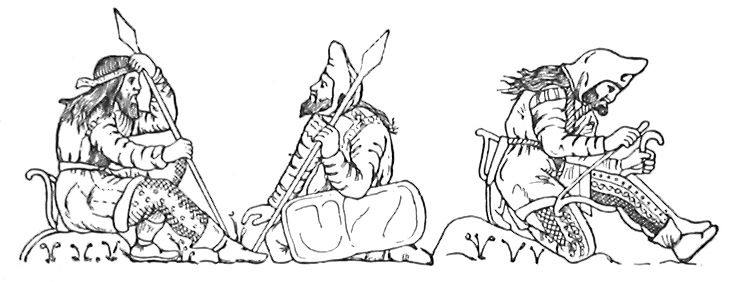
Scythian warriors, drawn after figures on an electrum cup from the Kul-Oba kurgan burial near Kerch, Crimea. The warrior on the right strings his bow, bracing it behind his knee; note the typical pointed hood, long jacket with fur or fleece trimming at the edges, decorated trousers, and short boots tied at the ankle. Scythians apparently wore their hair long and loose, and all adult men apparently bearded. The gorytos appears clearly on the left hip of the bare-headed spearman. The shield of the central figure may be made of plain leather over a wooden or wicker base. (Hermitage Museum, St Petersburg) Public Domain


However, another explanation comes from Herodotus once again. In book 3 passage 102-105, Herodotus mentions that the ants in question were slightly smaller than a dog but bigger than a fox. French ethnologist Michael Peissel suggests that the creature Herodotus called an ant was probably a Himalayan marmot that can be found on the Deosai Plateau in Gilgit-Baltistan province in modern-day Pakistan. This claim is because Peissel interviewed the Minaro tribe, which lived on the Deosai Plateau. Like their ancestors, the Minaro informed him that they had been collecting gold dust from the marmots that bring it to the surface when burrowing.5

Himalayan marmot in central Asia. CC BY-SA 3.0


In conclusion, the gold-digging ants were either Saka or marmots. While both are possible, the Himalayan marmot may very well be the fabled ant known for gold-digging.

If you wish to read a fictional about giant ants, please check out H.G. Wells’s book, “Empire of the Ants.” Check out the 1977 film if you wish. Not bad.

By Cam Rea

Notes

1. Herodotus, The Histories, 3. 102.
2. Swami Parmeshwaranand, Encyclopaedic Dictionary of Vedic Terms Vol. 2 Vol. 2. (New Delhi: Sarup & Sons, 2000), 455.
3. Guive Mirfendereski. “The Saka Nomenclature: A Persian appraisal” http://www.cais-soas.com/CAIS/Anthropology/Scythian/saka_nomenclature.htm
4. David Christian, A History of Russia, Central Asia, and Mongolia (Malden, MA: Blackwell Publishers, 1998), 130-131.
5. http://www.nytimes.com/1996/11/25/world/himalayas-offer-clue-to-legend-of-gold-digging-ants.html ; See also Michel Peissel, “The Ants’ Gold: The Discovery of the Greek El Dorado in the Himalayas”. Collins, 1984.


The Rise of the Arsacid Dynasty

Arsaces’ historic invasion of Parthia was a process.

Before Arsaces I, King and founder of the Arsacid dynasty, and his brother, Tiridates captured Parthia, they appeared to be residing in the province previous to the appointment of Andragoras as satrap, or governor. Andragoras gained this position due to Arsaces and Tiridates killing the last two previous satraps by the names of Pherekles and Agathokles.

Information concerning the death of Pherekles by Arsaces is scant. Greek historian Arrian of Nicomedia states it was “to avenge an insult offered to one of them.” This insult provoked a rebellion, which led to the death of the satrap. While nothing more is provided, this small amount of info says much.

Roman, Seleucid, and Parthian Empires in 200 BC.

Roman, Seleucid, and Parthian Empires in 200 BC. (CC BY-SA 3.0)

During this period, Arsaces probably controlled the Kopet Dagh mountain range running east-west across the northern edge of the Iranian plateau that bordered the Seleucid province of Parthia. Being in such close proximity, it would not be unreasonable to think that Arsaces’ sphere of influence extended somewhat into the province of Parthia. If so, Arsaces possibly held a considerable amount of influence among the locals, who may have provided him with tribute for his protection services.

Furthermore, in both attacks on the province of Parthia, it would not be unreasonable to assume that Arsaces confiscated some territory within the Parthian satrapy.

View on the Kopetdag mountains from the Ahal plain, Turkmenistan.

View on the Kopetdag mountains from the Ahal plain, Turkmenistan. (CC BY-SA 3.0)

As mentioned, an insult caused Arsaces to strike, but the type of insult is unknown, leaving one to speculate.

Afterwards, Arsaces and his military wing fled back to the Kopet Dagh mountain range. While Arsaces traversed his holdings, the Seleucid king, Antiochus II Theos, appointed a new satrap to the province by the name of Agathokles.

Seeing that the situation on the ground in Parthia was still unstable, Arsaces decided to invade again and violently remove the satrap from power. One could suggest that this attack on Parthia was nothing more than a raid. However, there is no mention of a raid. Instead, Arsaces went straight for the satrap.

With the sudden death of Agathokles, Antiochus II appointed a new satrap by the name of Andragoras.

Coin of Andragoras, a Seleucid satrap of Parthia and later independent ruler of the region. (Classical Numismatic Group, Inc.

Coin of Andragoras, a Seleucid satrap of Parthia and later independent ruler of the region. (Classical Numismatic Group, Inc. http://www.cngcoins.com /CC BY-SA 3.0)

Andragoras is said to possibly be Persian, his original old Persian name being Narisanka. Information regarding Andragoras before his arrival to govern Parthia is limited. What is possible and speculative is that he served as a functionary during the reign of Antiochus I. If so, he would have possibly continued in this role for a period under Antiochus II. Shortly after his appointment, Andragoras found himself defending his seat of power against the same unwanted guests.

WHO WAS ARSACES?

The origins of King Arsaces, the man who would give birth to the ancient Arsacid Dynasty, remain elusive. Information is scant. The oldest known source is Strabo. Strabo, a Greek historian, states, “that Arsaces derives his origin from the Scythians, whereas others say that he was a Bactrian.” Justin, a Latin historian, states that Arsaces was “a man of uncertain origin.” It is evident that Strabo and Justin are unsure of Arsaces origins. While Justin makes no mention of Arsaces ethnicity, Strabo does to a point. In order to uncover precisely who Arsaces was and his possible origins, one must first examine the name Arsaces and the tribe from which he came.

The name Arsaces may or may not have been his real name or, possibly, a throne name, taken by all the descendants who held the same status. Chronicler Syncellus, who relied on the fragments of historian Arrian’s Parthika, mentions that Arsaces was a descendent of the Persian king Artaxerxes II. Syncellus’ information concerning the relationship comes from the fifth century BCE Greek physician and historian Ctesias.

Ctesias was the physician of King Artaxerxes II of Persia, and he compiled a history of Assyria and Persia called Persica during his stay. Ctesias mentions that Artaxerxes’ name before his ascent to the throne was Arsaces, “the king’s son, who afterward changed his name to Artaxerxes.” Moreover, Artaxerxes’ grandfather was king Artaxerxes I, whose name was rendered as Arshak/Arsaces, Babylonian Arshu.

Gold coin with Artaxerxes II, Babylonia, ca. 330–300 BC; obverse: Persian king running holding a bow.

Gold coin with Artaxerxes II, Babylonia, ca. 330–300 BC; obverse: Persian king running holding a bow. (© Marie-Lan Nguyen / Wikimedia Commons / CC-BY 2.5)

MEDICAL MYSTERIES AND RIGHTFUL HEIRS

Besides Arrian’s claim that the Arsacids were descendants of the Achaemenid Dynasty, there is a possibility that the two dynasties were medically related due to the presence of a rare disease known as neurofibromatosis. This physical deformity might have been seen as a sign that they were part of a ‘chosen’ few.

The Greek historian Plutarch, speaks of a deformity that King Artaxerxes I “was surnamed Longimanus, because his right hand was longer than his left.” Artaxerxes suffered from a disease called unilateral upper limb gigantism, which is associated with, but not strictly to, neurofibromatosis. Neurofibromatosis is rare and, according to researcher Hutan Ashrafian, “causes include congenital diseases, such as Proteus syndrome, Klippel-Trenaunay-Weber syndrome, neurofibromatosis, and macrodystrophia lipomatosa. They can also be acquired in cancers and lymphoedema.” Ashrafian makes the case that Neurofibromatosis may have been the cause of Artaxerxes’ deformity.

When it comes to the Parthian kings, Don Todman notes, “The nodule is first seen in the coins of Mithridates II (123–88BC) beneath the left eye and in the image of Orodes II (57–38BC) and in succeeding kings, including Phraates IV (38–2BC), the son of Orodes II. They appear on the faces of many but not all of the subsequent kings up to Vologases I (51BC–AD78) and Vardases II (55–AD58).”

Todman rules out the many other possibilities and further adds, “Neurofibromatosis, however, has a high degree of penetrance and autosomal dominant inheritance.” Todman concludes, “The lesions in the Parthian Kings is speculative” and that the “appearance of the nodule is consistent with Neurofibromatosis and the occurrence over multiple generations also accords with this hypothesis.” Therefore, the Arsacid dynasty may have used their genetic defect to strengthen their claim as the rightful heirs of the Persian Empire.

The name Arsaces is a Greek rendering of his Old Persian name Arshak, also rendered as Arsak, Asaac, or Asaak.  The name Arsaces/Arshak suggests that he was of Saka/Scythian origin. This is due to the “Sac” or “Shak” found in his name. The Ar in Arshak quite possibly could mean Aryan in the Scythian language. In the Pahlavi dialect, the language of the Parthians, the word “Aryan” rendered as “Eran.” The “Er” in Pahlavi is said to mean “noble” or “warrior” and the suffix “an” attached to “Er” represents the relation. Thus, the name Eran can mean, “The noble race” or “the warrior race” along those lines.

MONEY TALKS

Another interesting aspect is one coin in particular that bears Arsaces’ image, but on the reverse of the coin, it has the Aramaic inscription of krny, translated as “Karen” or “Quren”. This is where the debate comes in. Either krny means “Commander-in-Chief,” or it is in reference to one of the powerful Parthian clans known as the House of Karen. The coin also bears his name ΑΡΣΑΚΟΥ, translating as “Arsaces”. It seems to be the only coin of his minted like this.

Coin of Arsaces I of Parthia. The reverse shows a seated archer carrying a bow. A Greek inscription on the right reads ΑΡΣΑΚ[ΟΥ] (from the outside). The inscription below the bow is in Aramaic.

Coin of Arsaces I of Parthia. The reverse shows a seated archer carrying a bow. A Greek inscription on the right reads ΑΡΣΑΚ[ΟΥ] (from the outside). The inscription below the bow is in Aramaic. (Public Domain)

One could read this coin to mean that Arsaces is from the House of Karen. However, other coins of Arsaces do not mention this but mention his name and title in Greek, not Aramaic.

The readings of these other coins say ΑΡΣΑΚΟΥ ΑΥΤΟΚΡΑΤΟΡΟΣ, translating as “Arsaces the Autocrat”. Both are plausible. If one considers Karen or Quren to mean “Commander-in-Chief,” it would be understandable for some coins bear the Greek inscription “Autocrat.” It would be true that an autocrat would be a commander-in-chief, for an autocrat is a ruler who holds unlimited power and is answerable to no other person, even though the possibility of the coin that says Karen and Arsaces may indicate a connection to the House of Karen.

Therefore, it seems plausible that ‘Karen’ found on the reverse of the coin is meant for the Aramaic speaking population at the time, in Parthia proper, indicating his authority rather than the house from which he came.

Other coins minted at the same time or later bear no Aramaic, but Greek instead. This is understandable, since Greek was the business and administrative language of the populace.

WHO WERE THE APARNI?

The name Aparni/Parni is Latin, while the Greeks referred to them as Aparnoi/Parnoi. However, there is a bit of dispute among historians over the names. Some historians believe the names are incorrect due to the Greek and Latin translations. The correct renderings could be Sparnoi, Apartanes, Eparns and Asparians. Since the names and translations are in dispute, we shall call them Aparni for now to avoid confusion.

The Aparni were a branch of the Dahae confederacy (central Asia, modern Turkmenistan), possibly a family clan of the tribe, and were said to have lived along the river Ochus, southeast of the Caspian Sea. What one can gather from the scant information provided is that the name Aparni may be incorrect, but the fact that they lived along the river Ochus and were a part of the Dahae confederacy remains undisputed.

Strabo is the only one who provides both tribe and ethnicity. Strabo states that Arsaces, “with some of the Däae (I mean the Aparnians, as they were called, nomads who lived along the Ochus), invaded Parthia and conquered it.” The Däae Strabo mentions are the Dahae. The first mention of the Dahae is found in Xerxes’ daiva inscription and they are described as a people he subdued during his reign. Nothing more follows. Herodotus was the next to mention the Dahae (Daans) and placed them among the tribes of the Persian nation:

“Now the Persian nation is made up of many tribes. Those which Cyrus assembled and persuaded to revolt from the Medes were the principal ones on which all the others are dependent. […]The rest of the Persian tribes are the following: the Panthialaeans, the Derusiaeans, the Germanians, who are engaged in husbandry; the Daans, the Mardians, the Dropicans, and the Sagartians, who are nomads.”

Relief of Cyrus II of Persia.

Relief of Cyrus II of Persia. (Siamax/CC BY-SA 3.0)

What else one can gather from this passage by Herodotus is that Cyrus was well aware of them before Xerxes. Herodotus account of the Dahae among the tribes of the Persian nation may have been “meant in a political, rather than an ethnic or linguistic sense, their Scythian identity poses no problem” as D. T. Potts mentions. While Herodotus provides little concerning their location, Strabo does.

Strabo provides three geographical accounts:

Those nomads (Dahae, however, who live along the coast on the left as one sails into the Caspian Sea are by the writers of today called Däae, I mean, those who are surnamed Aparni; then, in front of them, intervenes a desert country; and next comes Hyrcania, where the Caspian resembles an open sea to the point where it borders on the Median and Armenian mountains.

The Däae, some of them are called Aparni, some Xanthii, and some Pissuri. Now of these the Aparni are situated closest to Hyrcania and the part of the sea that borders on it, but the remainder extend even as far as the country that stretches parallel to Aria.

The Aparnian Däae were emigrants from the Däae above Lake Maeotis, who are called Xandii or Parii. But the view is not altogether accepted that the Däae are a part of the Scythians who live about Maeotis (Sea of Azov).

Western Asia c. 500–550 BCE; the Dahae lands are upper right.

Western Asia c. 500–550 BCE; the Dahae lands are upper right. (History of Persia at English Wikipedia /CC BY-SA 3.0)

Ptolemy places the Dahae between “the regions of Margiana adjoining the River Oxus.” What Strabo and Ptolemy are indicating is that the Dahae traverse a rather large region that expands from the Black Sea to the Aral Sea and from Central Asia to Northern Iran.

Therefore, from the sources examined, it seems evident, that Arsaces was indeed of Saka/Scythian origin and was associated with the Dahae tribe. Whether Arsaces was a decedent of the ancient kings of Persia seeking to reclaim and restore the once mighty Persian Empire will remain unknown. While the possibility is considerable, the connection remains uncertain.

ARSACES’ INVASION OF BACTRIA AND PARTHIA

It would be naive to suggest that the fundamental cause of the Aparni invasion is clouded in mystery, impossible to answer, or cannot be determined. As mentioned earlier, Arrian states the invasion was “to avenge an insult offered to one of them.” While Arrian is probably correct, Strabo may have the answer. Therefore, in order to understand why Arsaces raided and eventually conquered Parthia, we must first look to Bactria.

Historians tend to agree that the passages of Strabo indicate that the invasion of Parthia was due to Diodotus’ victory over Arsaces, which in turn, caused Arsaces to flee into neighboring Parthia. However, Strabo’s passage is rather silent concerning an actual battle that took place. Some look to Strabo as an indicator of this victory over Arsaces, in which Arsaces was “in flight from the enlarged power of Diodotus.” This passage also does not directly say that Diodotus defeated Arsaces, but it hints at the possibility that there was conflict. But what kind of conflict needs to be answered.

What seems overlooked is what Arsaces did best, raiding. The first clue comes from Justin. Justin speaks of Arsaces as being, “accustomed to live by plunder and depredations.” Strabo also mentions this and states:

“These people agreed to pay a tribute on condition of having permission to overrun the country at stated times, and to carry away the plunder. But when these incursions became more frequent than the agreement allowed, war ensued, afterwards peace was made, and then again war was renewed. Such is the kind of life which the other Nomads also lead, continually attacking their neighbors, and then making peace with them.”

It is no question that Arsaces made his living by pillaging. But, according to Strabo, the pillaging taking place was against those who did not pay tribute.

In order to understand why Arsaces I, King and founder of the Arsacid dynasty raided and eventually conquered Parthia, we must first look to Bactria.

It is no question that Arsaces made his living by pillaging. But, according to Strabo, the pillaging taking place was against those who did not pay tribute.

As mentioned, it seems evident that Arsaces’ “flight from the enlarged power of Diodotus” could indicate two possibilities.

The first proposal is that Arsaces continued pillaging Bactrian villages and caravans along the trade routes. Because of this, Diodotus, who held a considerable amount of power, confronted Arsaces and drove him out.

The second proposal could be that Diodotus either met Arsaces or sent an envoy to make a quasi-peace treaty to receive temporary peace by providing tribute. Remember, Strabo mentions, “Such is the kind of life which the other Nomads also lead, continually attacking their neighbors, and then making peace with them.”

Either Arsaces’ periodic raiding ended with force or tribute, or perhaps a combination of both. But given the passages of historians Strabo and Justin, it would seem that Arsaces was confronted, did not engage militarily, but realized that the military forces of Bactria were a far stronger. Arsaces turned his forces around and headed back into his lands. While at Kopet Dagh, Arsaces received news that Andragoras, satrap (governor) of Parthia, had broken away.

Leaving the Empire

It would be hard to believe that Andragoras was unaware of the vulnerability he placed himself in by separating from the empire. Andragoras declared independence after receiving news of the unexpected death of Antiochus II, Greek king of the Hellenistic Seleucid Empire, in Ephesus. The satrap knew that the death of his king would lead to succession uncertainty and a potential war for the throne. Therefore, Andragoras detached himself from the empire until he felt comfortable enough to rejoin the fold.

Coin of Andragoras, the last Seleucid satrap of Parthia. He proclaimed independence around 250 BC.

Coin of Andragoras, the last Seleucid satrap of Parthia. He proclaimed independence around 250 BC. (Classical Numismatic Group, Inc. http://www.cngcoins.com /CC BY-SA 3.0)

However, Andragoras may have felt secure enough to declare independence knowing that Diodotus had driven out the Aparni. While Andragoras was unaware of what was taking place north of Parthia, Arsaces was well aware after presumably gaining intelligence on the situation from his spies and possibly from merchants. The news Arsaces received was favorable; the military forces under the command of Andragoras was weak and the Seleucid Empire was busy fighting other rivals.

Arsaces mustered his forces and “invaded Parthia with a band of marauders, overthrew Andragoras, the governor, and, after putting him to death, took upon himself the government of the country. Not long after, too, he made himself master of Hyrcania, and thus, invested with authority over two nations.”

After establishing his capital at Nisa or Asaak, Arsaces was fully aware that if he wanted to hold his newly conquered, lucrative provinces, he must build up his military strength and so “raised a large army, through fear of Seleucus and Diodotus, king of the Bactrians.”

Diodotus I Soter, leader of the Bactrians.

Diodotus I Soter, leader of the Bactrians. (PHGCOM /CC BY-SA 3.0)

Arsaces knew that when the king of the Seleucids, Seleucus II, finished fighting in the west, he would make the trip east to recover former lands. Arsaces also feared his eastern neighbor Bactria, for even though Diodotus drove him from his territory, there was a chance Diodotus would invade.

Ancient site at Nisa, Turkmenistan.

Ancient site at Nisa, Turkmenistan. (Ljuba brank  /CC BY-SA 3.0)

Nisa, Turkmenistand

Nisa, Turkmenistand (CC BY-SA 4.0)

Unbeknownst to Arsaces was that Diodotus could do little outside his own satrapy. The reason for this was that if he were to enter the Parthian satrapy, he would be potentially incurring the suspicion of Seleucus II, which could lead to armed conflict. Because of this, Diodotus stayed put. Of course, this would imply that Diodotus was still loyal to the Seleucid crown. Perhaps he still was, at least to point. There is no doubt that Diodotus was slowly separating himself from the Seleucid fold during the reign of Antiochus II. But once Antiochus II died, Diodotus followed the lead of Andragoras of Parthia and declared independence shortly during the reign of Seleucus II.

SHIFTING POLITICS AND MILITARY MANEUVERS

It is possible that Diodotus not only bought off Arsaces, but also used him against Andragoras. However, this is unlikely. The probable reason as to why Diodotus did not left a finger was that not only did he fear the full force of the Seleucid Empire, but also he had not the military forces nor resources to invade, unhinge, confiscate, and hold onto Parthia and Hyrcania. However, one can also presume that Arsaces was just as ignorant of the military strength of Bactria, even after he increased his forces. But it was necessary for Arsaces to increase his military strength as he prepared for the possibility of a two-front war.

Therefore, Diodotus may have viewed Andragoras as a threat rather than an ally, because once Andragoras reunited with the Seleucid Empire, Diodotus feared that Seleucus II would mount a new campaign to recover the province of Bactria. One can assume that Diodotus welcomed the Aparni conquest of Parthia and Hyrcania. In this sense, Arsaces’ conquest of Parthia acted as a buffer between Bactria and the Seleucids, thus creating a potential ally for Diodotus since both kingdoms now had a common enemy.

A Parthian stucco relief of an infantryman, from the walls of Zahhak Castle, East Azarbaijan Province, Iran.

A Parthian stucco relief of an infantryman, from the walls of Zahhak Castle, East Azarbaijan Province, Iran. (CC BY-SA 2.5)

Even though not written, Diodotus may have wanted to establish a peace treaty with Arsaces. However, Diodotus died before the establishment of such a treaty in 238 BCE. With Diodotus dead, his son, Diodotus II, quickly accepted a peace treaty with Arsaces. Justin mentions this and states, “Soon after, relieved by the death of Diodotus, Arsaces made peace and concluded an alliance with his son, also by the name of Diodotus.”

Arsaces reaching out to Diodotus II to agree to a peace treaty was paramount in allowing Arsaces to concentrate the bulk of his military forces in preparation for the Seleucid invasion. Moreover, even though the agreement between the two was a peace treaty, one can presume that the treaty was also an alliance, which would be crucial in assisting in the defense of their territories from King Seleucus II, who would eventually be on his way.

SELEUCUS’ ATTEMPT TO RETAKE FORMER LANDS

Before Seleucus II set out to retake the provinces of Parthia-Hyrcania and Bactria, he had to deal with another situation at home, which involved his brother, Antiochus Hierax. Antiochus Hierax had rebelled against his brother Seleucus in Asia-minor. This war between the two lasted from 239-236 BCE. Hierax’s decisive victory over Seleucus at Ancyra (modern Ankara, Turkey) sometime between 240-237 BCE sealed the deal, but it would not be until 236 BCE when Seleucus surrendered all of Asia-minor north of the Taurus Mountains to Hierax.

Coin of Seleucus II. Reverse shows Apollo leaning on a tripod.

Coin of Seleucus II. Reverse shows Apollo leaning on a tripod. (Public Domain)

Seleucus’ loss of Asia-minor to his brother and the costly loss of territory to Ptolemy III during the Third Syrian War (246-241 BCE) undermined the unity of the empire. One can see why the eastern provinces broke away and declared independence. The continuous conflict, whether within the royal court or on the field of battle, kept the empire in constant uncertainty to the point that one either broke away and survived, or crashed and was left to an uncertain fate.

Seleucus knew that even though he might have been weak he could not afford more territorial losses. Further losses would destabilize the empire and encourage more breakaways, which in turn would entice his neighbors, like Ptolemaic Egypt, to gobble up more territory abundant with resources and the trade routes that passed through them.

With heavy losses in men, resources and territory, Seleucus took a gamble and decided to mobilize his forces for an eastern anabasis in hopes of retaking control of the crucial provinces of Parthia-Hyrcania.

Hyrcania and Parthia, and the section of the Royal Road noted by Herodotus.

Hyrcania and Parthia, and the section of the Royal Road noted by Herodotus. (CC BY-SA 2.5)

The reason for this is that when Arsaces conquered the provinces in question, he also captured the city of Hekatompylos, which lay astride the Royal Road linking Babylon and Seleucia on the Tigris to Bactria, and finally to India. Arsaces’ control over a portion of the Royal Road not only gave Arsaces control over the commercial traffic but also allowed the Parthians to intercept messages go to or coming from between the Seleucid and Bactrian kings.

Seleucus’ undertaking such an endeavor was both reckless and understandable. The reckless aspect of was that he quickly assembled his forces after suffering early defeats by Ptolemy III and Antiochus Hierax. Seleucus’ hasty military operation to recover former lands was a recipe for disaster. Either Seleucus was overconfident, desperate, or a combination of both.

The understandable aspect was his ambition to recover former lands, to exploit vital resources, and retake the trade routes that linked east with west back under the Seleucid umbrella, since most of the valuables enjoyed by the Greeks were coming through the eastern portions of the empire. If those provinces no longer belonged to the empire, the flow of wealth diminished.

The date of Seleucus’ anabasis is uncertain but possibly occurred between 236 and 229 BCE. But understand, there was not one invasion of Parthia but two.

WAR AND PEACE

Arsaces lay in his capital of Nisa, enjoying his newly conquered territory — but he was no fool. He understood that one day the Seleucid king would march east to recover former lands.

When word arrived that Seleucus was on his way, Arsaces quickly assembled his men and fled into the desert, taking up refuge with another nomadic tribe known as the Apasiacae, who were an offshoot of the Massagetae Scythians.

When Seleucus entered Parthia, he met with little resistance, one can presume, and reconquered his former provinces. As for how long he stayed in Parthia, this is unknown but it must not have been long, for shortly after entering Parthia, Seleucus was “recalled into Asia Minor by new disturbances.”

After some years had passed, Seleucus assembled another army and invaded Parthia a second time and was met with force. The outcome was an Arsacid victory. However, no detail of the battle exists. Moreover, it is possible that Diodotus II aided Arsaces in his victory over Seleucus. However, as mentioned already, details of the battle are silent, but there is an interesting passage written by Athenaeus in his Deipnosophists that speaks of Seleucus and “how he came against Media, and warred against Arsaces, and was taken prisoner by the barbarian, and how be remained a long time in captivity to Arsaces, being treated like a king.”

Frontispiece to the 1657 edition of the Deipnosophists, edited by Isaac Casaubon, in Greek and Latin.

Frontispiece to the 1657 edition of the Deipnosophists, edited by Isaac Casaubon, in Greek and Latin. (Public Domain)

Athenaeus’ reference came from Posidonius (135-51 BCE). A further backing of Seleucus’ imprisonment is due to coins. Earlier coins that portray Seleucus before the invasion of Parthia depict a clean-shaven and well-kept Seleucus, while the later coins depict him with a beard like that of the Parthians. According to Polybius, “Seleucus surnamed Callinicus (glorious victory) or Pogon (bearded).” The coins depicting Seleucus and Polybius passage inform that Seleucus adopted the two epithets before and after capture. How long Seleucus remained in Parthia is unknown, but it is evident that he was freed and died sometime around 226/5 BCE.

How long Seleucus II was imprisoned will continue to be disputed, but what is known is that the Parthians, possibly aided by the Bactrians under Diodotus II, defeated Seleucus. He had no other choice but to lick his wounds and sign a treaty that recognized the authority of Arsaces as the rightful ruler of an independent Parthia not subject to Seleucid rule. The historian Justin says, “The Parthians observe the day on which it was gained with great solemnity, as the date of the commencement of their liberty.” How the Parthians observed their independence day is unknown, as well are the remaining years of Arsaces’ reign.

LONG LOST BROTHER

There is one issue, not yet addressed: Arsaces’ brother, Tiridates. Photius and Syncellus provide the only two sources that mention Tiridates.

A depiction of what is believed to be Tiridates I

A depiction of what is believed to be Tiridates I (Public Domain)

However, their accounts of Arsaces and Tiridates are amalgamated with older stories. One being that of King Darius I of Persia, while the other is similar to the founding of Rome. Photius says, “These two brothers, with five accomplices, slew Pherecles.” Seven men partook in the assassination of Pherecles (Andragoras) when you include Arsaces and Tiridates involvement. This is similar to the account of Darius who seized the Persian throne with the help from six others when they slew the imposter named Gaumata.

Syncellus says, “After two years Arsaces was killed, and his brother Teridates succeeded him as king, for 37 years.” Syncellus’ account is similar to the story and Romulus’ murder of Remus. Moreover, even Justin mentions the memory of Romulus as in a memorable comparison to Arsaces’ foundation of the Arsacid Dynasty:

“Thus Arsaces, having at once acquired and established a kingdom, and having become no less memorable among the Parthians than Cyrus among the Persians, Alexander among the Macedonians, or Romulus among the Romans, died at a mature old age”

Unlike Syncellus, Justin is a much older source that does not mention Arsaces dying at an early age.  Moreover, Justin does not mention that Arsaces had a brother. What Justin does indicate is that Arsaces lived to be a ripe old age. If one were to take Syncellus’ account as true, what memory would the Parthian people have of a man who reigned for two years?

The sources that mention Tiridates are not in error, rather Syncellus is more likely in error suggesting that Arsaces reigned for two years and was murdered by his own brother. There is no doubt that Arsaces did have a brother by the name of Tiridates, but proof of that brother remind elusive until 1955, when an interesting Ostracon (pottery or stone piece with script), no. 2638 was found at the former Parthian capital of Nisa. However, the photos taken remained unknown to the world until 1986, when archaeologist S.D. Loginov (Institute of History, Turkmenistan Academy of Sciences) found them among the South-Turkmenistan archive.

Ostrakon of Cimon, an Athenian statesman, showing his name (as "Kimon [son] of Miltiades") Representational image only.

Ostrakon of Cimon, an Athenian statesman, showing his name (as “Kimon [son] of Miltiades”) Representational image only. (CC BY-SA 2.5)

Once the inscriptions were translated, they gave a completely different picture of the Arsacid genealogy: ‘rsk MLK’ BRY BR[Y ZY pryp]tk BRY ‘HY BR[Y ZY] ‘rsk. When translated into English it reads, “Year 157, Arsak king, grandson Friyapatak’a. son of the nephew of Arsak’a.” The year 157 does not mean 157 BCE; rather it means 157 of the Arsacid era, which would be our 91 BCE.

Notice that three names or three kings are mentioned; the first being Arsaces, the next being his son Arsaces II, and the third, Friyapatak’a, who renamed himself Arsaces III once he ascended the throne. Notice as well that there is no mentioning of a Tiridates. This does not mean that Tiridates never existed, but what it does indicate is that Tiridates was never a king. Moreover, Friyapatak’a may in fact be Tiridates’ grandson, which would make him the great-nephew of Arsaces I.

After the imprisonment and release of Seleucus II, Arsaces’ rule over Parthia remained peaceful up until his death in 211 BCE. Afterwards, his son Arsaces II inherited the throne and a new threat as well.

Seleucus II died before Arsaces. He is said to have fallen from his horse around 226/5 BCE. Seleucus III inherited his father’s throne, only to be murdered after a short reign of three years, in 223 BCE. The person next up for the job was Antiochus III, the younger brother of Seleucus III. The future was in his hands.

Coin of Seleucus III.

Coin of Seleucus III. (Public Domain)

Top Image: A rock-carved relief of Mithridates I of Parthia (r. c. 171–138 BC), seen riding on horseback. The Parthian rulers used the ancient Iranian art of Rock relief to mark the foundation of their new empire. (CC BY-SA 3.0)

Bottom Image: The silver drachma of Arsaces I of Parthia (r. c. 247–211 BC) (Classical Numismatic Group, Inc. http://www.cngcoins.com / CC BY-SA 3.0) and the Parthian fortress of Nisa (Flickr/CC BY-SA 2.0)

By Cam Rea

References

Arrian. Parthica, original Greek and English translation in F.A. Lepper, Trajan’s Parthian War. London: Oxford University Press, 1948.

Ashrafian, Hutan. “Limb gigantism, neurofibromatosis and royal heredity in the Ancient World 2500 years ago: Achaemenids and Parthians.” Journal of Plastic, Reconstructive & Aesthetic Surgery Volume 64, Issue 4 , 2011: 557.

Athenaeus of Naucratis, translated by Charles Duke Yonge. The Deipnosophists, or, Banquet of the learned of Athenaeus, Volume 1. Oxford: Henry G. Bohn, 1854.

Bivar, A. D. H. The Personalities of Mithra in Archaeology and Literature. New York: Bibliotheca Persica Press, 1998.

Charax, Isidore of. Parthian Stations.

Ctesias, and Jan P. Stronk. Ctesias’ Persian history. Düsseldorf: Wellem, 2010.

Curtis, Vesta Sarkhosh and Sarah Stewart. The Age of the Parthians The Idea of Iran Volume II. London: I.B.Tauris & Co Ltd, 2007.

Frye, Richard. The Heritage of Persia. New York: New York: New American Library; New English Library, 1966.

Gankovskiĭ, IUriĭ Vladimirovich. The Peoples of Pakistan: An Ethnic History. Lahore: People’s Pub. House, 1971.

Grainger, John D. The Rise of the Seleukid Empire (323-223 BC): Seleukos I to Seleukos III. Barnsley: Pen & Sword , 2014.

Green, Peter. Alexander to Actium: The Historical Evolution of the Hellenistic Age. University of California Press, 1993.

Herodotus. The Histories.

Holt, Frank Lee. Thundering Zeus: The Making of Hellenistic Bactria . Berkeley Calif: Univ. of California Press, 1999.

Justinus, Marcus Janianus. Epitome of the Philippic History of Pompeius Trogus, Trans. John Selby Watson. London: Henry G. Bohn, York Street, Convent Garden, 1853.

Lerner, Jeffery D. The Impact of Seleucid Decline on the Eastern Plateau. Stuttgart: Steiner , 1999.

Livshits, Vladimir A. “Three New Ostraca Documents from Old Nisa. (24 July 2004 “Transoxiana.www.transoxiana.org/Eran/Articles/livshits.html.

Metcalf, William E. The Oxford Handbook of Greek and Roman Coinage. Oxford: Oxford University Press, 2012.

P. Lecoq, P “Aparna”. http://www.iranicaonline.org/articles/aparna-c3k.

Plutarch. Lives, Volume XI.

Polybius. Evelyn S. Shuckburgh. translator. London, New York. Macmillan. 1889. Reprint Bloomington 1962. Histories. London, New York. : Macmillan. Reprint Bloomington, 1889. 1962.

Potts, D.T. Nomadism in Iran: From Antiquity to the Modern Era. Oxford: Oxford University Press, 2016.

Ptolemy. Geography.

Sachs, A. “Achaemenid Royal Names in Babylonian Astronomical Texts.” American Journal of Ancient History 4, 1979: 131.

Sidky, H. The Greek Kingdom of Bactria: From Alexander to Eucratides the Great. Lanham, Md: University Press of America, 2000.

Syncellus. In Roos, A. G. (ed.), Flavii Arriani quae exstant omnia. v.2. Scripta minora et fragmenta. Adiectae sunt tres tabulae geographicae et fragmentum Papyri 1284 Societatis Italianae. Leipzig: Teubner, 1967.

Todman, Don. “Warts and the Kings of Parthia: An Ancient Representation of Hereditary Neurofibromatosis Depicted in Coins.” Journal Of The History Of The Neurosciences 17, no. 2, April 2008: 141-146.

Wilson, N. G. Encyclopedia of Ancient Greece . New York: Routledge, 2006.


The Military Campaigns of Tiglath-pileser III: Sieges on Kingdoms – Part 2

The storm was on the horizon and it was time to pay financially, for King Menahem gave a thousand talents of silver (about 37 tons, or 34 metric tons, of silver) toTiglath-pileser by extracting 50 shekels from each wealthy man. An enormous 60,000 citizens of wealth gave up their money to the Assyrian coffers. This makes one wonder how many poor people in turn had to repay those wealthy citizens for their lost monies.

After receiving his tribute, Tiglath-pileser left the outskirts of Israel, leaving the kingdom intact and still in the hands of Menahem. One can only speculate if this was a one-time tribute deal, or it was performed multiple times, year after year. In either case, Menahem had just made his kingdom look impotent before the king of Assyria.

[Read Part 1]

Menahem was a king of the northern Israelite Kingdom of Israel.

Menahem was a king of the northern Israelite Kingdom of Israel. (Public Domain)

King Menahem remained on the throne six more years before he died. His son Pekahiah took the throne and reigned for only two years before he was murdered inside the palace by Pekah and 50 Gileadites in Samaria (II Kings 15:23-26). It seems Pekah murdered Pekahiah because he had continued to let Assyria dominate Israel. This made the people of Israel mad, and the result was a murdered king by a man of the military. The prophet Hosea mentions many reasons as to why Israel acted the way it and these four verses sum up the situation well.

They have set up kings, but not by me:
they have made princes, and I knew it not:
of their silver and their gold have they made them idols, that they may be cut off.

I know Ephraim, and Israel is not hid from me: for now, O Ephraim, thou committest whoredom, and Israel is defiled.

I have seen an horrible thing in the house of Israel: there is the whoredom of Ephraim, Israel is defiled.

Rejoice not, O Israel, for joy, as other people: for thou hast gone a whoring from thy God, thou hast loved a reward upon every cornfloor.

Israel was in a state of revolt both politically and spiritually and there is no way out for them, except the way of the sword:

They are all hot as an oven, and have devoured their judges; all their kings are fallen: there is none among them that calleth unto me.– Hosea 7:7

King Pekah quickly made an alliance with King Rezin of Damascus. This move indicated that Pekah was cutting the Assyrian yoke from Israel’s neck. Pekah also went to the Edomites and the Philistines for their support of a joint coalition to stop Tiglath-pileser from further expansion into their respective territories. In a way, this alliance was really an attempt to counter-balance the Assyrian power to the east. Pekah may have sent emissaries to King Jotham at the time, asking him to join the alliance against Assyria, but we have no word of it, and one can only speculate.

It seems that Jotham would have known of this alliance but decided not to join it, and probably for good reason. Jotham may have questioned why fight two enemies when I can easily just face one? There was no telling what Israel and Syria had in store, for Judah was not popular with either Israel or Syria. This might be the reason for the attack on Judah by King Pekah and King Rezin.

When King Jotham died, his son Ahaz took the throne but, unlike his father, it’s written Yahweh considered King Ahaz an evil king for worshipping ‘other’ gods (he even passed his own children through the fire to Baal). Israel and Syria then invaded Judah, most likely to set up a puppet King. The man whom they wanted in power was the son of Tabeal; he was possibly also a Syrian (Isaiah 7:6). If the placing of this ‘king’ were accomplished it would give the family of Tabeal reason to join them, and to unify in the war against Assyria. This invasion into Judah by the combined forces of Israel and Syria is discussed in the books of II King 16:5-6 & II Chronicles 28:5-9.

King Rezin of Syria attacked Judah first. As King Rezin was moving his forces south, he began pillaging the local villages on his way and most likely destroyed or occupied the garrisons on the eastern borders of Judah. He also took captives until he reached Elath on the Gulf of Aqaba, an area connected to the Red Sea. The King’s Highway ran through Elath.

King's Highway (red), and other ancient Levantine trade routes, c. 1300 BCE

King’s Highway (red), and other ancient Levantine trade routes, c. 1300 BCE (CC BY-SA 3.0)

The King’s Highway, in ancient times, started from Heliopolis, Egypt. The road continued through Elath and progressed forward, hugging the borders of eastern Judah and Israel. It then climbed its way up to Damascus and from there went on to Resafa, located on the upper Euphrates. This was a tactical military highway mentioned in the book of Numbers 20:17 & 21:22, and King Rezin now controlled it. This meant that the king of Syria could now deploy his forces up and down the eastern borders of Israel and Judah and allowed King Rezin the upper hand over Judah, in tactical terms.

While King Rezin battled, King Ahaz of Judah most likely assembled his forces and sent them against the Syrian attacker to retake the city of Elath. Nevertheless, the forces of King Ahaz came under attack from the forces of King Pekah of Israel who possibly also had the use of Syrian forces. In that engagement, the forces of King Pekah killed 120,000 men of Judah (men of King Ahaz) in one day and captured 200,000. The capture of 200,000 people was most likely over time, and not in one day as some may speculate and even suggest (II Chronicles 28:6).

After the battle, King Ahaz returned to Jerusalem to seal up the gates and prepare for a siege. But before this happened, it was most likely that he immediately sent messengers with treasure from the house of the Lord, as a gift to the king of Assyria. By doing this, he had just made the kingdom of Judah a vassal of the Assyrian Empire (II Kings 16:7-8). King Ahaz had ignored the prophet Isaiah and ignored the warnings about trusting Assyria for help. Ahaz had just created a bigger burden than that which was outside Jerusalem’s gate besieging the city. The forces of Israel and Syria besieged the city of Jerusalem. It is unknown as to how long the siege of Jerusalem lasted, but we know that it could not have taken long, for II Chronicles 28:20 mentions that the Tiglath-pileser was on his way.

Assyrian troops attacking a besieged city using a battering ram on a siege ramp. Enemy archers are returning fire. Headless corpses lie at the foot of the city walls.

Assyrian troops attacking a besieged city using a battering ram on a siege ramp. Enemy archers are returning fire. Headless corpses lie at the foot of the city walls. (Public Domain)

Shortly after the siege lifted, two more enemies of the Syrian-Israelite alliance came forth for their share. In II Chronicles 28:17-19, the Edomites came to pillage and take captives in the surrounding countryside of Judah while the invading Philistines took many cities and villages. The event stripped Judah naked and left it to rot in the sun.

In II Chronicles 28:5 & 28:9, mentions the captives which Syria and Israel took back to their kingdoms. What is interesting is that II Chronicles 28:5 & 28:9 describe a brief scenario regarding the siege of Jerusalem, which was lifted in haste due to the Assyrian war machine approaching fast to the kingdoms of Israel and Syria. Kings Pekah and Rezin meanwhile had returned quickly to their capitals with their spoils and captives to prepare their defenses.

Damascus

Around 734 BCE, Tiglath-pileser III was at the head of his army when they entered Syria on their way to besiege Damascus (II Kings 16:9). King Rezin of Syria and his army would meet the Assyrian forces head on.

Assyrian attack on a town with archers and a wheeled battering ram, 865–860 BC.

Assyrian attack on a town with archers and a wheeled battering ram, 865–860 BC. (Public Domain)

Details about the battle are unknown, but what is known is that King Rezin almost lost his life in the battle and quickly fled back to Damascus with remnants of his army. Once the gates were shut, the siege was on. This event mentioned by Tiglath-pileser on his inscriptions state:

That one (Rezin of Damascus) fled alone to save his life— and like a mouse he entered the gate of his city. His nobles I captured alive with my own hands, and hanged them on stakes and let his land gaze on them. 45 soldiers of my camp— I selected, and like a bird in a cage I shut him up. His gardens and— plantations without number I cut down, not one escaped—.

Tiglath-pileser boasts that he destroyed 591 cities in Syria and took many captive back into Assyria, with the possibility of the inclusion of Jews that were previously taken captive by King Rezin when he invaded Judah and besieged Jerusalem along with King Pekah of Israel. Tiglath-pileser says:

Hadaru the house of the father of Rezin of Syria where he was born, I besieged, I captured… captives I carried off. 16 districts of Syria I destroyed like mounds left by a flood.

The siege took two years to complete, and it is most likely that during the siege Tiglath-pileser assembled and sent his forces to the regions conspiring against Assyria. It is uncertain if he stayed with his army at the siege of Damascus, spearheaded the invasion into Israel, or attacked along the coastline of Palestine. We do know that two Assyrian armies were sent to subdue and incorporate the regions hostile to Assyria. From Damascus, the Assyrian army forked out like a snake’s tongue.

Assyrian chariot with charioteer and archer protected from enemy attack by shield bearers. Assyrian relief from Nineveh. Alabaster relief, made about 650 BC.

Assyrian chariot with charioteer and archer protected from enemy attack by shield bearers. Assyrian relief from Nineveh. Alabaster relief, made about 650 BC. (CC BY-SA 3.0)

To the Coast!

While part of the Assyrian army was busy fighting in Syria, Tiglath-pileser sent another army to spearhead an attack and subdue the every-so-often rebellious Phoenician cities, along with the Philistines on the coastline of the Levant. The Assyrians captured the cities of Sumer, Arka, Byblos, and Sidon. Next was Tyre, forcing them to pay tribute, and give part of their population over as captives. The Assyrian army continued to march south, sacking Accho and burning it to ashes. Next was Dor, a port city of the tribe of Manasseh (Joshua 17:11), then Aphek a city belonging to the tribe of Asher (Joshua 19:30-31). The Assyrian army also destroyed the Philistine cities of Ashdod, Ashkelon, and Gaza, and continued until it reached the river El Arish that borders Egypt. Tiglath-pileser mentions “Hanno of Gaza fled before my weapons.”

Ancient Egypt and Mesopotamia c. 1450 BC

Ancient Egypt and Mesopotamia c. 1450 BC (Public Domain)

It seems that by taking the coastline, the Assyrians were cutting Israel off from their Phoenician allies, preventing them from fleeing by across water. This coastal takeover by Assyria almost certainly had an economic impact. Many Phoenician cities along with the Israelite cities on the coast were destroyed or occupied by the invading force. Because of Assyrian depredations, many of the surrounding nations (whether free or vassal to Assyria) now depended on Assyria for their economic prosperity as well as military security.After Tiglath-pileser campaign through the Levant was finished, he headed home. In 727 BCE, Tiglath-pileser died at his grand palace in Nineveh. His son Ulylaya would succeed him and his throne name would be Shalmaneser V. Tiglath-pileser came from obscure origins but his impact upon the reconstruction of Assyria was paramount on both domestic and foreign affairs and his ability to lead men into battle demonstrated his charisma and leadership both on and off the battlefield. Overall, Tiglath-pileser was a capable general and king who is sometimes forgotten in the annals of military history.

Illustration of an Assyrian High Priest and an Assyrian King.

Illustration of an Assyrian High Priest and an Assyrian King. (Public Domain)

Top Image: Deriv; Head of winged bull, 9th c. BC, Assyrian (Public Domain) and bronze relief decorated the gate at the palace of the Assyrian ruler Shalmanesar III (Public Domain)

By Cam Rea

References

Caiger, Stephen L.,  Bible and Spade: An Introduction to Biblical Archaeology.

Gordon, Cyrus H., The Ancient Near East.

Mackenzie, Donald A., Myths of Babylonia and Assyria.

Redford, Donald B., Egypt, Canaan, and Israel in Ancient Times.

Roaf, Michael, Cultural Atlas of Mesopotamia and the Ancient Near East.

Rogers, Robert William, A History of Babylonia and Assyria: Volume Two.

Roux, Georges, Ancient Iraq.

Sayce, Assyria: its Princes, Priests, and People.

Stern, Ephraim, Archeology of the land of the Bible: The Assyrian, Babylonian, and Persian periods, 732-332 BCE Vol II.

Sykes, Percy, A History of Persia.

Yalichev, Serge, Mercenaries of the Ancient World.

The Military Campaigns of Tiglath-pileser III: Priest King and Conqueror – Part 1

The year is 745 BCE and much of the Middle East is about to be conquered and confiscated by the powerful Assyrian Empire under King Tiglath-pileser III.

Tiglath-pileser III is regarded as the founder of the second Assyrian Empire. Though his origins are obscure, Greek tradition claims Tiglath-pileser was originally a gardener. His real name is uncertain but some say that it may have been Pul, according to 1 Chronicles 5:26 in the Bible. The name Tiglath-pileser is one that he took once he had ascended to the throne.

And the God of Israel stirred up the spirit of Pul king of Assyria, and the spirit of Tilgath-pilneser king of Assyria, and he carried them away, even the Reubenites, and the Gadites, and the half tribe of Manasseh, and brought them unto Halah, and Habor, and Hara, and to the river Gozan, unto this day.

Tiglath-Pileser III: stela from the walls of his palace.

Tiglath-Pileser III: stela from the walls of his palace. (Public Domain)

Before moving on, it must be noted that the name Pul or Pulu has significant meaning, and in I Chronicles 5:26, we see the first mention of Pul and Tiglath-pileser together. It seems that even the Bible indicates that Tiglath-pileser invaded Babylon before he conquered the northern Kingdom of Israel and that the name Pul may have possibly been his real name. In the records, when Yahweh says He “stirred up the spirit of Pul king of Assyria and the spirit of Tiglath-pileser king of Assyria, what we have here is a metonym. That is to say, two different things which represent the same thing, or the same person in this case.

Tiglath-pileser had taken the hand of Bel (Marduk the supreme god of Babylonia), and by taking Marduk’s hand, he had thus proclaimed himself the son of God in the city of Hammurabi on New Year’s, and had named himself Pul or Pulu, and was proclaimed King of Babylon. We can say that by this very act Tiglath-pileser had proclaimed himself a priest-king, or a type of Messiah. This shows that he intended to unite the military (Assyria) and spiritual powers (Babylonia) together into one nation. Pul represents the spiritual crown, and Tiglath-pileser represents the military crown.

Now some may debate this and say he took this title Pul or Pulu the year before he died. This is not true, for it is recorded twice that he took the oath; and in Babylonian tradition a king had to take Marduk’s hand every year on New Year’s to be the king of Babylonia. We also must remember that he invaded Babylonia to free them from the Syrian threat, while at the same time conquering them. However, this event came after his great conquest of the Near East in 729 BCE.

Tiglath-pileser III, an alabaster bas-relief from the king's central palace at Nimrud, Mesopotamia. The Assyrian king, identified by his conical cap with a turban wrapped around it (so-called Polos), stands (under a parasol) in his royal chariot and raises his right arm in a greeting gesture.

Tiglath-pileser III, an alabaster bas-relief from the king’s central palace at Nimrud, Mesopotamia. The Assyrian king, identified by his conical cap with a turban wrapped around it (so-called Polos), stands (under a parasol) in his royal chariot and raises his right arm in a greeting gesture. (CC BY-SA 4.0)

He must have been a charismatic man with the ability to lead, as he was able to seize the crown of Assyria and unite the chaotic factions into a single nation. He also provided a network of security and trade that would eventually expand to those under Assyria’s sphere of influence. But how did this man conquer so many nations with such ease?

Looking at the Near East from Afar

When looking at this period in Near Eastern history, all one has to do is refer to the Bible and read the inscriptions of Tiglath-pileser III to realize that Assyria had no outside threats. The Hittites and Egyptians were a shell of their former glory and imposed no threat to the Assyrian borders. The once mighty United Kingdom of Israel under the reign of King David and later his son Solomon were divided into two separate kingdoms after Solomon’s death. The Houses of Israel and Judah were too busy fighting amongst themselves and jockeying for outside alliances. The fragmented Syria to the northwest was not even a threat to Assyrian expansion either. As for Phoenicia, they were unstable on land and had no real standing army other than relying on mercenaries or those that volunteered. The rest of the smaller tribal groups were mere principalities or city-states similar to Phoenicia. One could easily argue that the reason the Near East was so easy to take was due to fragmentation, and thus no single nation surrounding Assyria, whether it be a kingdom, city-state, or a community of tribes, posed a real threat to Assyria.

Assyrian Soldier with Standing Shield, Soldier with Small Shield, Archer.

Assyrian Soldier with Standing Shield, Soldier with Small Shield, Archer. (Public Domain)

Tiglath-pileser III rejuvenated the Assyrian army through military reform. In the past, Assyria had relied on its provincial governors to supply the army, which was comprised of provincial militias gained from a typical workforce of the time. The only permanent army was the ‘royal guards’. What Tiglath-pileser did was reorganize the army into a permanent standing fighting force that over time progressed to become a professional army. In doing so, he gained a tighter control on his kingdom because the army was loyal to him. By these means he transformed the population into a model military society based on war and expansion made to quench the thirst of their rejuvenated philosophy, which was the worship of war.

Assyria on the Move

They were like a lion on the Serengeti; Assyria represented the lion, and the Near East was its Serengeti. Tiglath-pileser III’s first footprints outside Assyria stained the desert floor blood red.

None shall be weary nor stumble among them; none shall slumber nor sleep; neither shall the girdle of their loins be loosed, nor the latchet of their shoes be broken: Whose arrows are sharp, and all their bows bent, their horses’ hoofs shall be counted like flint, and their wheels like a whirlwind.

To secure his holdings, Tiglath-pileser sent his new professional army to secure his empire by attacking the upstart Syrian-Urartu alliance, which posed a potential threat as it had done many times in the past. He decided to lead his forces towards the Aramaean (Syrian) tribes, with whom Assyria had had many conflicts in the past. The powerful Aramaean tribes had previously invaded the Kingdom of Babylonia from the South. They had taken the cities of Sippar and Dur-Kurigalzu, and posed a threat to the Babylonian way of life. They had also threatened to destabilize Assyria’s power, influence, and historical association with the Babylonians. The weakened state of Babylonia needed a champion.

Assyria’s hatred for the troublesome Arameans gave them reason to strike and to reestablish their rule over Babylonia. Tiglath-pileser pushed farther south for some time, winning battle after battle with his new army, and gaining ever more confidence after each engagement with the enemy. He then turned east to cross the Tigris River. While on the east side of the Tigris, he began attacking along the mountains of Elam, taking many nomadic tribes captive. He then retraced his steps, crossing back over the Tigris, and began his assault on the Aramaeans until he pushed them out of the cities of Sippar and Dur-Kurigalzu. Tiglath-pileser III continued to push south until he reached Nippur, an ancient city of Babylon, before returning home.

Assyria’s (under Ashurbanipal) brutal campaign against Elam in 647 BC is recorded in this relief.

Assyria’s (under Ashurbanipal) brutal campaign against Elam in 647 BC is recorded in this relief. (CC BY-SA 3.0)

The people of Babylon looked to Tiglath-pileser III as the savior of Babylonia. This did not look good for the King of Babylon, Nabonassar. Tiglath-pileser began by setting up a new government in Babylonia and placing the kingdom under the suzerainty of Assyria. Never before had Babylonia been under the complete rule of Assyria. Thus, Nabonassar became a mere vassal king, a symbol of state and not power, while the real king remained Tiglath-pileser III, the conqueror and savior of Babylonia.

Assyrian Expansion

After securing Babylon and driving out the Aramaean raiders, Tiglath-pileser then turned his army loose on the known world.

His first campaign of aggression was against Northern Syria, which was an ally of Urartu. Urartu was a rival to Assyria and at the time was gaining much influence over the former vassals, who were becoming an increasing threat to Assyria. Because of the threat they imposed on the weakened state of Assyria, Tiglath-pileser decided it was time to take action and to restore the right of Assyria’s might. However, he did not want to take the chance of invading Urartu head on, and rightfully so.

The Kingdom of Urartu was located on a mountainous plateau located in Eastern Turkey and Armenia, and led up into the Caucasus Mountains with Lake Van in the middle of the kingdom. The Urartu region appeared to be difficult for the Assyrian army to invade, indicating that they had difficulty in conducting mountain warfare, at least for now. Tiglath-pileser understood the best way to defeat his enemy was to beat them on the open plain. He knew that he had to either conquer them, or beat them so badly that he would not have to come back later and finish the job. The Kingdom of Urartu was no joke for Assyria and Tiglath-pileser took the easier of the two roads.

Tiglath-Pileser assembled his army, crossed the Euphrates, and headed for Northern Syria, to the city of Arpad. Before he reached the city of Arpad, a coalition was already assembled to counter the Assyrians. King Sarduri II led the armies of Urartu and King Matiil led the armies of Arpad, along with many other Syrian tribal kings.

The coalition and Assyria met in furious battle. The Assyrians were victorious in the engagement and over 70,000 are said to have been slain or captured, but the numbers are most likely exaggerated.

Tiglath-pileser then turned his attention to the land of the Medes, conquering them on the Iranian plateau. From this expedition he deported 65,000 Medes and made their remaining chieftains pay homage, while incorporating the newly conquered districts into Assyrian lands. The Assyrian army continued to push farther East until they reached the Slopes of Lapis Mountains or “Mount Damavand”.

In 737 BCE Tiglath-pileser invaded the Median territory again and wiped everything out of these territories except for those Medes who lay further to the east of Mount Damavand, and it was also during this campaign that the Assyrians deported another 154,000 people from southern Mesopotamia. In addition, the Syrians also suffered before the events of 737 BCE, as the Assyrians deported 30,000 Syrians to the region of the Zagros Mountains, an area once considered Median territory in 742 BCE, and not to forget that an additional 18,000 more who were deported from the Tigris to be settled in Northern Syria. The time span for the invasion described may have been five to six years.

Tiglath-pileser III stands over an enemy, bas-relief from the Central Palace at Nimrud.

Tiglath-pileser III stands over an enemy, bas-relief from the Central Palace at Nimrud. (CC BY-SA 4.0)

Pushing into Israel, Judah, and Phoenicia

In 738 Tiglath-pileser made his way west to collect tribute and to expand the growing Empire. He began his regional tour starting with what was left of the fractured kingdoms of the former Hittite empire.

Turning back south to Syria and then heading west to the city-states of Phoenicia, he subdued the citizens without a fight, collecting just about anything and everything the individual kingdoms could offer. This kept Assyria out of their lands by turning them into their vassals.

Next on the list for Assyria was the kingdom of Israel. Menahem was the king of Israel at the time when Tiglath-pileser III came upon the northern horizon of Israel. For a long time before the Assyrian threat, the Hebrew prophets Hosea, Amos, and Joel foretold the coming destruction of Israel if they did not repent of their sins and come back to Yahweh.

And Pul the king of Assyria came against the land: and Menahem gave Pul a thousand talents of silver, that his hand might be with him to confirm the kingdom in his hand. And Menahem exacted the money of Israel, even of all the mighty men of wealth, of each man fifty shekels of silver, to give to the king of Assyria. So the king of Assyria turned back, and stayed not there in the land.

Map showing Tiglath's conquests (green) and deportation of Israelites. Tiglath-Pileser III discouraged revolts against Assyrian rule with the use of forced deportations of thousands of people all over the empire.

Map showing Tiglath’s conquests (green) and deportation of Israelites. Tiglath-Pileser III discouraged revolts against Assyrian rule with the use of forced deportations of thousands of people all over the empire. (CC BY-SA 3.0)

The storm was on the horizon and it was time to pay financially, for King Menahem gave a thousand talents of silver (about 37 tons, or 34 metric tons, of silver) to Tiglath-pileser by extracting 50 shekels from each wealthy man. An enormous 60,000 citizens of wealth gave up their money to the Assyrian coffers. This makes one wonder how many poor people in turn had to repay those wealthy citizens for their lost monies.

Top Image: Deriv; Tiglath-Pileser III (Public Domain) and bronze relief decorated the gate at the palace of the Assyrian ruler Shalmanesar III (Public Domain)

By Cam Rea

References

Caiger, Stephen L.,  Bible and Spade: An Introduction to Biblical Archaeology.

Gordon, Cyrus H., The Ancient Near East.

Mackenzie, Donald A., Myths of Babylonia and Assyria.

Redford, Donald B., Egypt, Canaan, and Israel in Ancient Times.

Roaf, Michael, Cultural Atlas of Mesopotamia and the Ancient Near East.

Rogers, Robert William, A History of Babylonia and Assyria: Volume Two.

Roux, Georges, Ancient Iraq.

Sayce, Assyria: its Princes, Priests, and People.

Stern, Ephraim, Archeology of the land of the Bible: The Assyrian, Babylonian, and Persian periods, 732-332 BCE Vol II.

Sykes, Percy, A History of Persia.

Yalichev, Serge, Mercenaries of the Ancient World.

The Mongol Military – Part II


Genghis Khan, founder and emperor of the Mongol Empire rarely needs an introduction, but it is crucial in understanding how he gained his place in history by examining the Mongol military organization he pieced together to become one the world’s greatest fighting machines ever seen. How did he do it?

[Read Part 1]

Military Organization

Mongol military organization based on decimal lines under Genghis Khan was nothing new. Other steppe peoples, like the Khitan and Jurched had been using the same system for many years beforehand. Genghis Khan was introduced to this military system during his time with Ong Khan. The system introduced by Genghis Khan to the Mongols was structured as arban, jagun, minqan, and tumen.

Mongol military leadership started with the arban at the bottom of the chain. Every Mongol warrior belonged to an arban. An arban consisted of 10 men with one being the commander. Ten arbans equaled one jagun (plural jaghut) consisting of 100 men. Ten jagunt consisted of 1000 men and formed a minqan(plural minqat). Ten minqat formed one tumen (plural tumet) consisting of 10,000 men.

10 men = 1 arban

100 men = 1 jagun

1000 men = 1 minqan

10000 men = 1 tumen

100000 men = 1 Tuc

The military organizational structure was divided into three corps that consisted of the baraghun ghar (right flank), je’un ghar (left flank), and tob or gol(center or pivot). To move this large army the command structure of course started with the Great Khan, who issued orders to three commanders in charge of the three tumen. See the figure below.

Chart showing command structure of Mongol leaders.

Chart showing command structure of Mongol leaders.

To break down the chain of command further, Marco Polo provides more detail:

You see, when a Tartar prince goes forth to war, he takes with him, say, one hundred thousand horse. Well, he appoints an officer to every ten men, one to every hundred, one to every thousand, and one to every ten thousand, so that his own orders have to be given to ten persons only, and each of these ten persons has to pass the orders only to other ten, and so on; no one having to give orders to more than ten. And every one in turn is responsible only to the officer immediately over him; and the discipline and order that comes of this method is marvelous, for they are a people very obedient to their chiefs.

Even though Marco Polo wrote this during the time of Kublai Khan, the document indicates that the military organization Genghis Khan had set in place was still in use and relatively unchanged. Furthermore, Marco Polo’s description shows how well organized the Mongol military staff was, and indicates the effectiveness of this system to rapidly relay orders from the top down and information from the bottom up. This allowed swift changes to be made during the thick of battle.

With such a large army on hand, every Mongol preformed certain duties within the camp. Some were in charge of carrying bows and arrows. Others were responsible for the manufacturing of the arrows. Some were responsible for food and drink. Others were responsible for watching over the sheep and horses in the pasturage. Carts were of great importance and men were assigned to prepare, repair, and watch over them. Carrying swords was another duty. Overseeing the domestic staff was another. Lastly, two men would serve as guardians of the assembly. Overall, every Mongol soldier had a duty to perform and most likely rotated out to perform other tasks once or every two weeks. Leaving one Mongol unit for another was unheard of. The Persian historian and bureaucrat Juvayni (1226–1283) noted, “No man may depart to another unit than the hundred, thousand, or ten to which he has been assigned, nor may he seek refuge elsewhere.” The organization of the Mongol support structure looked something like this:

Organization of Mongol support structure.

Organization of Mongol support structure.

Military Training and the Great Hunt

When it came to military training, the Mongols would take part in a great hunt called the Nerge. The Nerge was a way for the Great Khan, starting with Genghis Khan, to see how well his commanders led their men on a hunting expedition and how well the soldiers performed. The Nerge was nothing more than a war game but an important one at that. Genghis Khan and his descendants understood the importance of military exercise.

The Mongols partook in the Nerge every winter. Before winter arrived the Great Khan would send out orders to his commanders to send seven out of ten men with arms to participate in the hunt. Once the men arrived, they would be placed under one of three military wings: the right wing, left wing, or center army. Afterwards the Great Khan would arrive with his huge entourage of ladies, concubines, food and drink.

Genghis Khan.

Genghis Khan. (Public Domain)

Once all was ready, they armies pushed ahead slowly forming a large circle. For two to three months, they would slowly push forward, disrupting the habitat before them and causing millions of creatures to rush away from the oncoming line of cavalry. The goal was to make sure that no animal escaped the ring. If any animal were to escape, the commanders, along with the men were severely punished for being irresponsible. Once the ring was tight enough, it was ten miles in circumference.

Afterwards, the Great Khan would enter the circle, which at that time would be teeming with wild animals, and he would pull back his bowstring and fire an arrow at his prey. After the Great Khan had finished, the princes would take their turn and soon after the commanders and the lower ranks. This carnage would go on for several days before a group of old men would come forth and beg the Great Khan to allow the remaining animals to go free to find food and water. As for the dead animals, the Khan’s men would begin gathering the corpses which were counted and each warrior received his share.

While one would think that the Nerge taught little to the Mongol armies since many were already familiar with such training, as it was a part of their culture. But the training was necessary to sharpen the skills of those commanders and their soldiers. Such drills exercised the army as a whole and taught the individual warrior much. Mass training allowed the Mongols practice, horsemanship, strategy, tactics, and communications at a distance, since they used signals to coordinate precise tactical maneuvers with strategic precision. Such actions during the heat of battle, (or even if in a great hunt), allows commanders and lower ranking officers and soldiers, to react to any situation without waiting for orders from above.

Mongol soldiers using bows

Mongol soldiers using bows (Public Domain)

Genghis Khan and his great commanders, like Subutai, educated the officers and the common soldier in the ability to be flexible. With flexibility came the ability to adapt under any condition and once the army, whether on a macro or micro level, became comfortable with their surroundings, that is when the lethality of the army can be coordinated on the intended target.

War Games

Besides the Nerge was the sham-fight. The sham-fight was what we call today war games, where two armies face in a nonlethal contest. Genghis Khan understood that while hunting, cornering, and engaging the animals was one way to train an army, the idea of actual mock combat was another. During the sham-fight, Genghis Khan would have large forces square off against one another. Large Mongol forces, perhaps two tumen, would engage in a ballet of attacking, retreating, and wheeling as a unit. The men partaking in this fight would be close kin to one another and the side that lost felt disgrace. The goal was to see who could out maneuver the other in a series of circumventive moves. Forces from both sides would continue to probe each other’s lines until one side out-flanked or pierced the enemy’s center.

The Mongols at war.

The Mongols at war. (Public Domain)

The sham-fight sharpened the skills and senses of the Mongol officers and the soldiers under their command. Furthermore, it tested the clarity of the crucial bidirectional flow of information during the organized chaos of mock combat. It allowed commanders to reevaluate how fast their units reacted to orders and how their officers and subordinate military units responded.

Mongol War Academy

While the Nerge taught much to all ranks, those who wished to further their understanding in the art of war attended an academy. The Mongol war academy came about due to Genghis Khan’s keen understanding of the ever-changing nature of warfare. This willingness to learn from setbacks and even victory filled a void in an officer’s education. However, this academy did not come until sometime later.

Any officer who desired to lead a Mongol regiment had to attend this academy. The education primarily focused on the art of siege warfare. The reason for making siege warfare the Mongol focus was due to challenge in dealing with the fortified cities throughout northern China.

The officer in question would be trained by Chinese siege experts in how to best approach the walls of the city. These educators would train the officers in the use of large shields that provided suitable protection to the soldiers advancing towards the walls. Once close enough, the officers would be instructed in the deployment and use of storming-ladders and sandbags. When the officer had completed his training, he would take back the knowledge to his men where they would make the devices needed, train with them and store them in special arsenals for future use under the supervision of the officer appointed to provide such crucial support when needed.

While training in siege warfare was a major focus in the Mongol military, the actual experience the officers underwent in scaling fortress walls was valuable in training future officers. Besides siege warfare, the experience the officers faced in battle was also crucial in preparing future officers. The diverse strategies and tactics utilized by their enemies were taught to younger officers. In this way, those future officers would learn how to approach the enemy, how the enemy might approach them, and the best way to counterattack their efforts to defeat them. Such military exercises cultivated the young officer’s mind to help him perform with near precision on the field of battle.

Reconstruction of a Mongol warrior.

Reconstruction of a Mongol warrior. (CC BY-SA 2.0)

In conclusion, the Mongol military organization was in many ways ahead of its time. It reminds one the old Roman system and of the more modern armies to come many centuries after the Mongol rampage throughout Eurasia. Overall, Genghis Khan did well in creating and establishing a fighting machine the world has never forgotten, but continues to mesmerize us by its sheer ability to innovate, adapt, and overcome nearly all obstacles thrown its way.

Top Image: Deriv; Illustration of Yesugei, Temujin’s father (CC BY-SA 3.0) and a battle between Mongols and Chinese (Public Domain)

By Cam Rea

References

Thomas J. Craughwell, The Rise and Fall of the Second Largest Empire in History: How Genghis Khan’s Mongols Almost Conquered the World (Beverly, Mass: Fair Winds Press, 2010).

Timothy May, The Mongol Conquests in World History (London: Reaktion Books, 2012).

Timothy May, The Mongol Art of War: Chinggis Khan and the Mongol Military System (Yardley, Penn: Westholme, 2007).

Richard D. McCreight, Mongol Warrior Epic: Masters of Thirteenth Century Maneuver Warfare (Fort Leavenworth, KS: US Army Command and General Staff College 1983).

Marco Polo, The Book of Ser Marco Polo, the Venetian: Concerning the Kingdoms and Marvels of the East. Volume 2 edited and translated by Henry Yule. 3rdedition (London: J. Murray, 1929).

Michael Prawdin, The Mongol Empire: Its Rise and Legacy (London: G. Allen and Unwin, 1961).

George Vernadsky, A History of Russia, Vol 3 (New Haven and London: Yale University press, 1953).

The Mongol Military – Part I


Genghis Khan, founder and emperor of the Mongol Empire rarely needs an introduction, but it is crucial in understanding how he gained his place in history by examining the Mongol military organization he pieced together to become one the world’s greatest fighting machines ever seen.

So how did Genghis Khan take the Mongols and turn them into a fighting machine? It starts with abandonment.

The Abandonment of Temujin and Rise of Genghis

It was through his abandonment that Genghis Khan, whose real name was Temujin, learned quickly whom he could trust and whom he could not. Because of this, he sought to rebuild his family’s status through alliances, and he started with Börte of the Onggirat tribe. At age 16, Temujin rode to the Onggirat tribe to take his wife. After much talk, the marriage took place, and Dei-sechen presented Temujin with a valuable sable coat. After much celebration, Temujin took his sable coat as treasure with which to connect with a more powerful alliance.

After his marriage to Borte, Temujin and his brothers traveled to meet with his father’s blood brother, Tooril Khan, known as Ong Khan, leader of the Kereit people. Ong was a powerful chieftain whose territory expanded from the Onon River across the lands of Mongol to the eastern borders of China. When Temujin arrived and approached Ong, he said, “In earlier days you and my father agreed to swear brotherhood, so you are almost as a father to me.” Then he said, “I have acquired a wife and brought you the emüsgel (new clothing).” Temüjin presented Ong with the sable jacket.

Alliances are crucial for they build a political power base from which one, a weaker host, can create an army due to the trust and stability it can provide. So long as the host remains in good favor with those more powerful, this will allow the weaker host, like Temujin, to further strengthen his political and military might through a series of wars and battles. This shows favor not only to the Khan he serves but those weaker tribes also would find favor in him due to his honor to the khan and showmanship on the field of battle. Because of this, Temujin quickly rose through the political ranks of Mongol society and eventually was titled Genghis Khan.

Mongol cavalry archery from using the Mongol bow.

Mongol cavalry archery from using the Mongol bow. (Public Domain)

With politics comes war. Unlike today, while most politicians talk of war but may not have experienced it or seen one up close and personal, Temujin was baptized in both fields. It during Temujin’s time with Jamuqa from which he learned much. Before Temujin joined and co-ruled with Jamuqa, he understood little in the art of steppe warfare. This is not to say he had no knowledge, but his understanding was rudimentary. Under Jamuqa, Temujin learned much in the art of command and control, tactics and strategy. But more importantly, he was a great organizational leader, unlike Jamuqa. Temujin was not seeking to build his military and political organization based on tribal status but rather on merit (meritocracy). This allowed Temujin to tap into the vast resources of the people who were tired of their overlords on the steppe. One such example was a commoner from the Uriankhai clan by the name of Subutai. It was these qualities from which Temujin would achieve victory, but before that happened he would have to suffer defeat first— as he did at the Battle of Dalan-baljut.

Statue of Boorchi, one of the first and most loyal of Genghis Khan's friends and allies.

Statue of Boorchi, one of the first and most loyal of Genghis Khan’s friends and allies. (CC BY-SA 3.0)

If one wishes to be a master, he has to have lost first. Temujin understood that defeat could result in victory so long as the loser learned from his mistakes. Moreover, Temujin learned to fight smarter, not harder, to achieve victory. His defeat at Dalan-baljut taught him much, and once Jamuqa, his last great adversary, was dead, he then truly focused without hindrance in turning the united Mongol tribes into a war machine.

A Brief Look at the Mongol Soldier

Before he could even walk, a Mongol boy became one with the horse. As he grew in the saddle, he learned to herd, hunt, and become a warrior. His environment would further harden him as he traversed a complex landscape of mountains, rolling plateaus, deserts, and endured a climate of long, cold winters and short, hot summers. Besides the physical environment, he grew up in a system where individual combat took place to defend one’s honor or to aid his tribe in times of war. A Mongol warrior loved and respected his tribe and family but also lived by the principle of ‘might makes right’.

Once Genghis Khan united these fierce warriors, he organized them into the world’s deadliest fighting force. The Mongol army of the 13th century was highly mobile, capable of traveling thousands of miles, and of living off the land, and they were not hampered by supply trains. The armies of the Khan seemed nearly invincible to their enemies, as neither terrain nor climate appeared to stop their progress. To understand how the Mongols did this one must first look at recruitment.

Recruitment

Not every Mongol male rode off into war, nor did the leadership require the enlistment of every able-bodied male from among the conquered. However, the Mongols had to have a system from which they could acquire the much-needed manpower to refill the empty spots and to add additional troops if need be for larger campaigns. In order to do this the Mongols took a census. What the census provided was the ability to calculate how many people lived within their borders, how much in taxes they could obtain to pay for future military campaigns, the amount of resources available, and the total number of skilled craftsman and technicians on hand.

Information as to the size of the Mongol army in 1209, and before Genghis Khan expanded his borders, is uncertain. The problem stems from how large the Mongol population was during that time. Some have estimated that the population was between 4-500,000, 700,000, and 2.5 million. However, according to a census taken in 1241, the estimated population was 723,910 in Mongolia. The size of the Mongol army according to the Secret History indicates that when Genghis Khan was crowned in 1206, there were 95,000 troops. This may be the only creditable figure for Mongol troop strength according to Timothy May. However, Leo de Hartog suggests that the troop number was roughly 70-80,000 strong, but even he says that, “this is a liberal estimate.”

To fill the ranks, Genghis Khan relied on a registry. This registry kept records on the people, particularly males, assigned to the various Mongol princes and military leaders. When it came to recruitment, the admissible ages were between 15 and 70. A census taken in 1241, 97,575 says troops were ethnic Mongols out of a population of 723,910. This indicates that each Mongol household had 7.4 family members on average.

The recreated interior of an ancient Mongolian ger (also known as a yurt), from Genghis Khan: The Exhibition.

The recreated interior of an ancient Mongolian ger (also known as a yurt), from Genghis Khan: The Exhibition. (CC BY-SA 2.0)

Besides the recruitment of ethnic Mongols, Genghis Khan and future leaders also incorporated conquered armies as their borders expanded. As R.A. Skelton states in Tartar Relation, “Chingis (Genghis) conquered and incorporated his beaten followers in his own army. For he had acquired the invariable habit of conscripting the soldiers of a conquered army into his own, with the object of subduing other countries by virtue of his increased strength, as is clearly evident in his successors, who imitate his wicked cunning.” Those armies brought into the Mongol fold either would fight under their own commanders, like the 10,000 Uighur’s under Baurchuk Art Tekin during Genghis Khan’s conquest of Khwarezmia, or were divided among the Mongol army to serve under Mongol-appointed officers. With new territories under Mongol control, the Khans realized the additional manpower they could draw from.

After Genghis Khan’s death in 1227, his son Ogodei Khan expanded Mongol military service by conducting a systematic registration of the non-nomadic population. However, this focused only on Northern China between 1234-1236. Another such census was taken again during the reign of Mongke Khan. Unlike the previous one that focused on a specific region, the Mongke Khan census covered the whole empire starting in 1252. Because of this, the number of men the Mongols could acquire from in 1267 differed, as a household consisting of two or three males provided one soldier, four or five males per household provided two men, while households with six or seven males would provide three men for military service.

Portrait of Ögedei Khan (the 14th century). The Chinese annotation reads: Third son of Genghis Khan, also known as Emperor Qaγan.

Portrait of Ögedei Khan (the 14th century). The Chinese annotation reads: Third son of Genghis Khan, also known as Emperor Qaγan. (Public Domain)

While the Mongols could recruit many from their large population, not all were fit for certain military duties. Take Iran for instance where only one out of ten adult males were drafted for military service. However, they were not assigned to a cavalry unit. This is not to say that Middle Eastern equestrians drafted for service were not suited to serve among the Mongol cavalry ranks. Instead, this focus is primarily on the commoner who was not accustomed to riding. These men were assigned to serve in other military capacities such as garrison duty and as corvée labor. Once they joined their assigned unit, they were disciplined, trained in infantry tactics, and subject to military reviews. Those who were of nomadic stock were absorbed in the Mongol cavalry. Many of the new cavalry recruits were placed in existing units or were added to newly created units with veteran oversight, particularly those units that consisted of men between the ages of 20-30 in 1229. Once assimilated, they would begin military drilling in the arts of horsemanship, archery, unit tactics, strategy, and formations. Such training disciplined the rider in order to mold his physical and mental training.

Drawing of a mobile Mongol soldier with bow and arrow wearing deel, traditional clothing.

Drawing of a mobile Mongol soldier with bow and arrow wearing deel, traditional clothing. (Public Domain)

The newly acquired men would also get a haircut to distinguish them from the rest of the population. The Flemish Franciscan missionary and explorer William of Rubruck describes the haircut of the Mongol soldier:

The men shave the square on the top of their heads and from the front corners of this square they continue the shaving to the temples, passing along both sides of the head. They shave also the temples and the back of the neck to the top of the cervical cavity, and the forehead as far as the crown of the head, on which they leave a tuft of hair which falls down to the eyebrows. They leave the hair on the sides of the head, and with it they make tresses which they plait together to the ear.

Besides hairstyle came benefits for some Mongol and non-Mongols through the registration process. This process ensured that males from the same household would always be enlisted, which in turn created a long line of hereditary military families among the nomadic and sedentary populations. As for the death of soldier on duty, whether it was by accident or disease, it would take up to 100 days until the next able-bodied soldier from the same household was ready to replace the dead soldier. If a soldier died in combat, his family would be exempt for a year from providing another male to the Mongol ranks.

In addition to soldiers, the Mongols also drafted those with expertise to serve in other capacities among the Mongol ranks. Those with skills were often the artisans, engineers, and artillerists who provided the Mongols with abilities they lacked, like the construction and utilization of siege equipment. Artisans also had tasks that were desired outside the court in the military, as in the manufacturing of weapons, arms repair, armor, cooking pots, and other miscellaneous metal items.

With the conscription of many men came desertion. Any man failing to report to their assigned duty station would be executed. The same consequence was upheld for those who deserted their unit. Such penalties kept the draftees in check and kept the ranks of the Mongols satiated.

Top Image: Deriv; Illustration of Yesugei, Temujin’s father (CC BY-SA 3.0) and a painting depicting the Battle of Cheoin (Korea) between Goryeo and Mongol Empire forces in the Korean peninsula in 1232. (CC BY-SA 3.0)

By Cam Rea

References

Thomas J. Craughwell, The Rise and Fall of the Second Largest Empire in History: How Genghis Khan’s Mongols Almost Conquered the World (Beverly, Mass: Fair Winds Press, 2010).

Timothy May, The Mongol Conquests in World History (London: Reaktion Books, 2012).

Timothy May, The Mongol Art of War: Chinggis Khan and the Mongol Military System (Yardley, Penn: Westholme, 2007).

Richard D. McCreight, Mongol Warrior Epic: Masters of Thirteenth Century Maneuver Warfare (Fort Leavenworth, KS: US Army Command and General Staff College 1983).

Marco Polo, The Book of Ser Marco Polo, the Venetian: Concerning the Kingdoms and Marvels of the East. Volume 2 edited and translated by Henry Yule. 3rdedition (London: J. Murray, 1929).

Michael Prawdin, The Mongol Empire: Its Rise and Legacy (London: G. Allen and Unwin, 1961).

George Vernadsky, A History of Russia, Vol 3 (New Haven and London: Yale University press, 1953).

The Persian War Machine: The Immortals – Part II


The Persian war machine made empires beforehand look miniature. The Persians were able to take the best from all over the Near East and turn it into a force that could not be defeated for many centuries to come.

[Read Part I here]

Many Guard Units

Herodotus states in 7.40 that “For before him (King) went first a thousand horsemen, chosen out of all the Persians; and after them a thousand spearmen chosen also from all the Persians, having the points of their spears turned down to the ground; and then ten sacred horses, called “Nesaian,” with the fairest possible trappings.” The thousand spearmen marched with their spears reversed, and the spear butts, which would normally have a point, were replaced with “golden pomegranates.” Herodotus refers to these men as “spear-bearers.” These men were the king’s own spear-bearers.

Furthermore, Herodotus 7.41 mentions that once the thousand horsemen passed by, they were followed by ten thousand men who “went on foot; and of these a thousand had upon their spears pomegranates of gold instead of the spikes at the butt-end, and these enclosed the others round, while the remaining nine thousand were within these and had silver pomegranates. And those also had golden pomegranates who had their spear-points turned towards the earth, while those who followed next after Xerxes had golden apples.” While the passage provided describes what appears to the famous “immortal” it appears not. A thousand had upon their spears butts ‘pomegranates of gold’, while the remaining nine thousand had ‘silver pomegranates’. Behind the ten thousand came another thousand had ‘golden apples.’ While it appears that this is not the ten thousand as some suggest, perhaps it is. In other words, the thousand spearmen who’s spear-butts had a golden pomegranate were perhaps the captains in charge of the nine thousand. But who were the “Immortals”?

The Immortals

Herodotus makes the first mention of them in Histories 7.83 stating, “these ten thousand chosen Persians the general was Hydarnes the son of Hydarnes; and these Persians were called “Immortals,” because, if any one of them made the number incomplete, being overcome either by death or disease, another man was chosen to his place, and they were never either more or fewer than ten thousand.” While Herodotus calls them by this title, they are not mentioned during the reign of Xerxes. Xenophon, who came later, does mention that Cyrus established a personal guard of ten thousand spearmen and mentioned they the guard of ten thousand was still existent when he wrote this in the 360s BCE.

Modern reenactors of the Immortals in their ceremonial dress at the 2,500-year celebration of the Persian Empire.

Modern reenactors of the Immortals in their ceremonial dress at the 2,500-year celebration of the Persian Empire. (Public Domain)

The Immortals were a fearsome army of ten thousand men that was created by Cyrus the Great to guard him, and were recruited from the lower classes of Persia to serve as the king’s personal bodyguard day and night, and wherever the king went so did they. The name Immortals comes from that whenever one of them got ill, wounded, or even died, he was replaced quickly with another man to ensure that the number stayed at ten thousand.

The Immortals were more than just mere spear-bearing infantry. In times of war, the Immortals surrounded the king while the inner core of Immortals consisted of two royal regiments; The first being infantry that carried a composite bow with a seven-foot-long spear and an akinakes (a dagger or short sword).

The second royal regiment of the Immortals was cavalry archers who carried spears and the majority of the Immortals that surrounded them were infantry. To give you a better picture of the Immortals in terms of battle formation. The front rank consisted of infantry carrying shield and spear, the spear they carried was seven feet in length, and they were the front, rear, and sides of the formation. They provide protection for the archers behind them while the cavalry likely stayed outside of the formation protecting the flanks.

Mosaic depicting Persian archers. (Pre 4th Century BC)

Mosaic depicting Persian archers. (Pre 4th Century BC) (CC BY 2.0)

Besides the Immortals, there was the cavalry. The cavalry only made up 10 percent of Cyrus’s army in the early days of his conquest while the other 90 percent of the army was infantry, or should we say foot soldiers. As time went on, Cyrus noticed the importance and the effectiveness of cavalry forces. He thus added more cavalry to his army and reduced the amount of foot soldiers to get a better ratio that was 20 percent cavalry and 80 percent infantry. The cavalry would have been mostly light and carrying only a bow, and were mainly of non-Persian ethnicity but were commanded for the most part by Persian officers. Their duty was to harass the enemy with a barrage of arrows and draw them into an attack, a hit-and-run you could say that would be annoying to any attacker.

Persian nobles formed the heavy cavalry. They were armed with two javelins, a lance made of wood and sometimes metal, and they carried an akinakes as well as a small oval shield. The armor of a heavy cavalryman was made of leather overlapped with metal disks or scales of bronze, iron, or gold, and was often colored in order to distinguish one unit from another. This must have been an impressive sight on a sunny day—unless you were the enemy.

Persian infantry varied between light and heavy. The light units carried spear and swords while their heavier counter parts carried a longer spear a shorter sword and a battle-axe. These heavier infantries wore black hoods that covered their head and much of their face. In combat, the front rank of the phalanx carried a shield made of wicker and a single spear while the ranks behind them carried no shield but had two spears on hand. Their main function was to toss the first spear over the front rank while keeping the other spear on hand for close combat. The heavier infantry, the elites, otherwise known as the Immortals, were the ones who kept silent when marching en masse. It must have been eerie for those about to receive the sword on the other end of the battlefield, when all you felt was the earth tremble slightly under your feet while an army of silence approached you from the other end. It was common for most warriors to scream and shout when in combat in order to intimidate their opponent. The immortals did the exact opposite. They killed in silence.

Charioteers

Besides the cavalry and infantry units of the Persians, there were the charioteer units. The Persian chariot was slightly higher and heaver then their Assyrian, Egyptian and Babylonian counterparts. Its wheels and axle were heavier and the platform on which the soldiers stood was much wider and carried two men. One man was to drive the heavy, cumbersome vehicle, and the passenger was a soldier, either a spearman or an archer. It took four horses to pull this chariot, which is a considerable amount of power compared to chariots pulled by two horses. To make it even more deadly, Cyrus had scythes installed on the axles, which extended two yards out from the wheel. Overall, it was a deadly machine when the opportunity presented itself on the battlefield since no charioteer, or for that matter horse, would plow into a forest of spear points and shields. It was more effective against light infantry, loose formations, and troops of undisciplined men unwilling to stand their ground in the face of combat.

Persian scythed chariots.

Persian scythed chariots. (Public Domain)

Cyrus also introduced the use of siege weapons into his ranks. Siege towers weighing in at seven tons when fully staffed and were twenty-four feet (7.3 meters) high had to be pulled by sixteen oxen. It is said that each story of the siege tower was about three stories in height, and was manned by twenty archers, giving it a total of 60 archers inside. These siege towers were also used as a command center for the Persian army and were great for surveillance due to its height.

An English siege tower, representational image.

An English siege tower, representational image. (Public Domain)

The Persians also had a special unit that used naphtha during sieges. Naphtha is similar to “Greek fire” a chemical mixture of a thinner consistency than oil. The purpose of naphtha was to burn wooden structures in combat. The Persians would use this during siege warfare by shooting flaming arrows over the enemy’s walls hoping to hit the wooden rooftops in the city thus causing a blaze that could spread throughout. Alternatively, they used it for defensive purposes by burning wooden siege equipment the enemy brought forth to the walls. In addition, the combat engineers of the Persian army were of great importance to the army. For they would move ahead of the army to repair or build roads and bridges, to dig ditches, and used pontoon boats as floats for bridges to get their massive and heavy army across.

To move this huge army was a feat in itself. The Persians, with all the ingenuity and complexity of their military system, had to have a supply line able to provide this juggernaut when on the move. The job of supplying the army was left to the commissariat. When the army was on the move, the commissariat was split into two, with one in front of the army and another in the rear. The commissariat who moved ahead of the army was tasked to look for suitable places to encamp where clean water could be found and the livestock could be grazed for a brief time before they moving on. The rear commissariat was tasked to keep the army supplied with all types of weaponry such as bows, swords, spears, arrows, armor and many other items that would be needed. Now, due to the amount of equipment the commissariat provided they would eventually run low, and in order to solve this problem the Persian king required that each satrap (governor) keep a certain amount on hand for the incoming army when it arrived to restock before the next big move.

While this small piece on the Persian military only skims the surface, understand that what Cyrus created came about with the aid of his many allies and most importantly, the trial and error of battle. Cyrus, once in power, began to formulate an army capable of adopting what was practical and functional when it came to the art of command and control on the battlefield. After his death, the Persian military maintained this, making few adjustments.

Immortals fighting Alexander's troops. Color reconstruction of the original reliefs on the Alexander Sarcophagus, in Istanbul.

Immortals fighting Alexander’s troops. Color reconstruction of the original reliefs on the Alexander Sarcophagus, in Istanbul. (CC BY-SA 3.0)

Overall, the Persian army was a professional fighting force of a complex magnitude that in many ways would not be matched until the Macedonian and Roman Empires. However, with their professionalism, also came their weakness. As stated before, they were complex. The Persians, even though they could field a huge army that was disciplined, they were homogenous nor were all of them skilled in the same weapons. Persia had its own standing army that was professional but too small, while the many regions under Persian control provided a hodgepodge of military units all accustomed to their own fighting style and practice. Many of these units were light infantry such as archers and spearmen with little to no armor what so ever. The Persians relied on quantity over quality in its military ranks. It worked well for the region of the world they were in, but as time went on, they faced armies who were all about amour and standard structure, and who may have been small in comparison but undoubtedly more disciplined.

Cam Rea is an author and military historian. He has written numerous articles for Ancient Origins Premium and Classical Wisdom Weekly as well as several books.

Top Image:  Deriv; Faravahar carved in stone at Persepolis, Iran, (Public Domain) and Achaemenid soldiers.

By Cam Rea

References

Briant, Pierre. ‘From Cyrus to Alexander: A History of the Persian Empire’. Publisher: Eisenbrauns; 1st English Edition edition (January 1, 2002)
Farrokh, Kaveh. ‘Shadows in the Desert: Ancient Persia at War’. Publisher: Osprey Publishing (2007)
Head, Duncan. ‘The Achaemenid Persian Army’. Publisher: Montvert (1992)
Herodotus, Histories
Strabo, The geography of Strabo.
Xenophon, Cyropaedia