The Battle of Jaxartes (329 BCE)


In what is said to be Alexander the Great’s most spectacular battle, the Macedonian king tested their most daring tactics against the fierce Central-Asian mounted Scythian nomads on the banks of the Jaxartes River.

Before charging into the battle, a little geography would not hurt. The Jaxartes River, what is known today as the Syr Darya, originates in the Tian Shan Mountains in Kyrgyzstan and eastern Uzbekistan. The river flows for 2,212 kilometers (1,374 miles) west and northwest through Uzbekistan and southern Kazakhstan to the remains of the Aral Sea.

Sunset over Sir-Darya river, Kazakhstan.

Sunset over Sir-Darya river, Kazakhstan. In Ancient Greek river is called Yaxartes (Ἰαξάρτης). (Petar Milošević /CC BY-SA 3.0)

Map of the Syr Darya Basin watershed, of the Syr Darya and Chu Rivers in Central Asia.

Map of the Syr Darya Basin watershed, of the Syr Darya and Chu Rivers in Central Asia. (CC BY-SA 4.0)

The battle of Jaxartes was a result of an earlier rebellion between the Scythians and the Macedonians.

A man named Spitamenes instigated the cause that would lead up to the battle. Spitamenes was famous for his capture of Bessus, in which he put him in chains and left him for Alexander, resulting in Spitamenes becoming the invisible tribal leader among the Sogdiana, an ancient civilization of Iranian people.

The Punishment of Bessus, by Andre Castaigne

The Punishment of Bessus, by Andre Castaigne (Public Domain)

Alexander had targeted Cyropolis in 329 BC in his conquest of Sogdiana.

Beginning with Cyropolis

Spitamenes, now Sogdian warlord, skillfully planned a rebellion of which not even Alexander had a clue. Spitamenes attacked Alexander’s rear, disabling the fortification system on the frontier starting with Cyropolis.

Silk road figure head, thought to be Sogdian.

Silk road figure head, thought to be Sogdian. (CC BY-SA 4.0)

Sogdians, depicted on a Chinese Sogdian sarcophagus of the Northern Qi era.

Sogdians, depicted on a Chinese Sogdian sarcophagus of the Northern Qi era. (CC BY-SA 3.0)

Spitamenes’ men caught them by surprise, storming the fort and taking no mercy. Spitamenes also garrisoned these fortresses with his own men afterwards. Once word reached Alexander, it must have been a total shock to him, as he was busy building the new city of Alexandria Eschate.

Sogdiana and Alexandria Eschate, in the north of the map.

Sogdiana and Alexandria Eschate, in the north of the map. (Public Domain)

Alexander quickly assembled his men for battle and sent them to the nearest fortress called Gaza. From Gaza, Alexander and his forces captured four fortresses in two days, killing the inhabitants inside. Next, Alexander turned his forces to Cyropolis.

Out of all the forts, Cyropolis was the hardest to take.

Alexander’s plans to march further east were now on hold due to the rebellion. Alexander could not leave with tension existing in his empire. So, Alexander went on a policy of terror as he did at Thebes, but this did not seem to faze the Sogdians, and in doing so, prompted the mighty nomadic confederation of Massagetae to assemble with many horse archers on the right side of Jaxartes River, waiting to invade if the Macedonians failed in stamping out the revolt.

The rebellion became so serious that news came to Alexander that Spitamenes had besieged Maracanda. Alexander quickly sent forces to lift the siege under the command of Pharnuches, who was a diplomat and not a soldier. Once Pharnuches made it to the outskirts of the city, he engaged the enemy and was teased by the Scythians to follow them into the desert.

Scythian Horseman depicted on felt artifact, circa 300 BC.

Scythian Horseman depicted on felt artifact, circa 300 BC. (Public Domain)

Once in the middle of nowhere, Spitamenes and his Sogdiana Scythian nomads enveloped them from all sides. Pharnuches ordered his forces to form a square formation, leaving the center empty during the battle. The Macedonian forces fought well during the battle, but needed to withdraw quickly, and once they spotted the river Polytimetus to cross for safety, they made a mad dash for it. This very act of breaking rank and battle formation is a mistake when fighting the Scythians, for once the Macedonian forces exposed themselves by breaking rank, the heavier Scythian cavalry mowed them down and totally annihilated them.

This would prove to be the worst disaster that any of Alexander forces would ever face in battle. Alexander knew he would have to react quickly in order to put down the rebellion by defeating those responsible with a show of force.

The Men of War

When it came to the size and composition of both military forces, the estimations are relatively unknown. As far as technology, there is no exact information regarding what was used at the battle, but due to the circumstances of the time and what we do know regarding the Macedonian army Alexander led, we have only to look at the main army Alexander brought with him.

Mosaic detailing the famous military leader and conqueror Alexander the Great/Alexander III of Macedon.

Mosaic detailing the famous military leader and conqueror Alexander the Great/Alexander III of Macedon. (Public Domain)

What history books tell us is that Alexander had a mix of Macedonian infantry and cavalry along with Thessalian and Thracian cavalry. In addition, Alexander required the Greek states to provide additional cavalry and infantry alongside his main forces when he invaded Asia. However, we should consider that by the time Alexander’s forces had made it up to this point in history, those men that accompanied him from Macedonia into Persia, and right before the battle of Jaxartes, were not the vast majority, but rather a mix of forces and foreigners in his ranks. Thus, to get an idea of what units partook in the battle is unknown, but assumptions can be made.

The Scythians on the other hand, were pure cavalry, carrying the bow and arrow. They may have had some heavy cavalry among their ranks, but it is doubtful. Rather, we can gather that the Scythians were mainly light cavalry archers since there are no descriptions of heavy cavalry mentioned.

As for military doctrine and training, Alexander the Great learned warfare, tactics, and strategy from his father Philip. Before Alexander became king, he had already experienced battles beforehand as the commander of Philips left wing, such as at the battle of Chaeronea. Alexander was a practitioner of his father’s style of organized warfare, which was called the hammer and anvil tactic. The Macedonian phalanx served as the anvil while the cavalry served as the hammer.

Alexander the Great liked to charge head on with his men but always kept a close eye on the situation. His leadership skills were numerous due to the many detailed battles provided in historical chronicles. Alexander was a leader who led his men into battle, charging in head-first at every chance he got. He led by example and bore the scars to prove it. He desired not to sit in the back of his army and shot out orders like a manager. He was a natural leader, with a natural gift. Not many leaders in the annals of war have ever had such a gift as had by Alexander.

As for the Scythian leader Satraces, there is nothing known about him other than by name for being at the battle. Leadership is crucial under such circumstances, but in this case, there is virtually nothing known about Satraces leadership ability. As for skills, he was a true Scythian tactician, wherein swarming and deception was the game. One only knows this due to the battle description provided.

From the info gathered before the battle, Alexander had no choice but to cross the Jaxartes River and engage the Scythians. If he did not, the situation could have gotten out of hand and the number of Scythians may have started to grow. Alexander only had one choice and that was to attack them and win. If he lost, it might have cost him his empire or at least part of it. These Scythians were most likely paid by Spitamenes to harass and engage Alexander. Alexander had no choice but to deal with the enemy.

Feasts and Fights

The opening moves before the battle were actually feasting. Once Alexander founded a new city-fort named after him, he held an elaborate feast with a sacrifice to the gods and even held a gymnastic contest. Alexander was having a merry ole’ time.

But while feasting and having a luxurious time with his men, Scythians on the far side of the bank of the River Jaxartes began to shout insults at Alexander and his men. Alexander knew that if he ignored this and allowed it to continue, the numbers of these men might swell and become too big to handle. Alexander stopped the party and began planning.

Alexander was in no mood for combat, but rather relaxation and celebration. He was still recovering from a leg wound he received from an earlier battle, and the bone splinters were making their way out of Alexander’s leg. Alexander had no choice but to send in his advance cavalry. However, in order to do this, he needed to establish a beachhead first to protect his forces that would be crossing.

The Hammer and Anvil

He moved his artillery to the bank of the river and began to shower the Scythians with projectiles—one of the projectiles said to have killed the Scythian chief Satraces or their champion warrior, nevertheless, it remains unknown, but the outcome seems to have not rattled the Scythians knees.

The artillery Alexander placed on the bank of river worked well for its intended use, which was to push the Scythians back, allowing the Macedonian forces to cross the river safely. Once the river was safe to cross, Alexander sent in a portion of cavalry first. However, some think that the use of cavalry was a military blunder that turned in his favor.

Battle between the Scythians and their enemies.

Battle between the Scythians and their enemies. (Public Domain)

Stephen Tanner, who wrote the popular book, “Afghanistan: A Military History from Alexander the Great to the War against the Taliban Insurgency” argues that the Macedonian element (cavalry) advanced to quickly and was surrounded by the Scythians. However, it seems Alexander may have done this intentionally. The tactician knew better than to just send in an attack force for the slaughter. He knew he had to bait the Scythians, for if he did not, the Scythians would play a cat and mouse game of reverse attrition. In other words, the Scythians would lose few while the bigger forces would lose many!

Battle of the Jaxartes, Alexander crossing river. Battle movement images by Stephen Smith.

Battle of the Jaxartes, Alexander crossing river. Battle movement images by Stephen Smith. (Creative Commons)

As the advance Macedonian cavalry came closer into contact with the Scythians, the Scythians broke themselves up into units and quickly moved into position surrounding the enemy from afar. Each unit began to form a circle and rode around like they were in a race, chasing each other’s tails. This was like how a hurricane is perceived; it is a deadly circle that rotates about, spewing forth projectiles. The high winds represent the bow and whatever the winds spit out are the arrows.

With the advanced Macedonian cavalry now surrounded by many Scythian cavalry circles showering them down with arrows, Alexander began to advance with the rest of his force. Alexander knew that by sending in a small cavalry force as bait, the Scythians would quickly go after it. What the Scythians did not expect was what was coming next.

Battle of the Jaxartes, Alexander luring Scythians to battle.

Battle of the Jaxartes, Alexander luring Scythians to battle. (CC BY-SA 3.0)

Alexander then gave the orders for his light infantry to advance towards the Scythian cavalry in front of Alexander. Now, as the light infantry advanced towards the Scythians, Alexander than gave the order for a second part of his cavalry to block any flanking attempt by the Scythian horse archers. Once the pieces were in place, half of the Scythian cavalry found themselves surrounded. Alexander then gave the order to his heavy cavalry to charge at the surrounded Scythian horse archers. The heavy cavalry shot through the gaps between his light infantry and anti-flanking cavalry and plunged right into the Scythian ranks, thus allowing the advance cavalry unit that was sent in as bait to now focus on the Scythians that found themselves surrounded. This allowed Alexander’s anti-flanking cavalry to ward off the remaining Scythian cavalry, thus allowing the light infantry men to advance in quickly in order to dislodge any enemy combatants on horseback. Overall, it was a brilliant maneuver on Alexander behalf.

The Battle of Jaxartes – Alexander traps the nomadic Scythian cavalry.

The Battle of Jaxartes – Alexander traps the nomadic Scythian cavalry. (Creative Commons)

The outcome of the battle was a Macedonian victory through Alexander’s brilliance. As for deaths, the Macedonians only killed a small number, roughly around 1,000 with another 150 captured. The main part of the Scythian cavalry force escaped capture. It was a small battle that produced a new tactic for consideration when facing the Scythians.

The Economy of Force

Assessing the significance of the actions and the lessons learned from the battle of Jaxartes is one-sided. The Scythians deceived themselves with over confidence. They figured that this foreign element was no different than what they had encountered before, thus making themselves one-dimensional. As for Alexander, he quickly looked at the situation, understood what he was facing, and quickly executed his objective with precision.

In order for Alexander to accomplish this, he had confidence in his men and captains, and his men, in turn, showed faith in him and his battle plan. In other words, when it came to the economy of force, every Macedonian was responsible for the other. Because of this, Alexander placed his men in areas that they would be effective against the enemy and allowed his captains and men to build on their effectiveness.

Alexander won many battles before Jaxartes using the hammer and anvil tactic made so famous by the Macedonians. However, the traditional Macedonian way of war came to a standstill when confronting the Scythians and this demonstrated not only their strength but also their weakness. Nevertheless, the strength and simplicity of these tactics are obvious; adapt to your enemy’s method and incorporate some of your own—innovate!

Alexander knew that if he were stay with the same old tactical method it would kill him in the end. Alexander also felt that he and his men were in an ‘unholy land’ and had to fight in ‘unholy ways’ in order to achieve victory.

As for the Scythians, their form of guerrilla-like warfare has gone unnoticed for thousands of years, but every so often hordes (camps) from the east have pushed successfully west. Nevertheless, the methods of these steppe peoples are very unorthodox, innovative, and asymmetrical. They fight without touching you and deceive you without notice. However, the Scythians could have given Alexander a bigger hassle, but they did not. And in turn, Alexander knew that it was best to beat them and leave them alone. Alexander the Great did not want or need the weight of Central Asia pouring down on him like lava from a volcano; it was not worth it. The Scythians would have loved if Alexander had marched into the open fields of Central Asia—but Alexander knew better.

Featured image: Another of Alexander’s important battles – The battle of Issos between Alexander the Great and Darius of Persia. Representative image only (Public Domain)

By Cam Rea

References

Arthur Preston, Richard. Roland, Alex. Wise S. F. Men in Arms: A history of warfare and its interrelationships with Western society. Orlando: Holt Rinehart and Winston, 1991.

Edwards, Sean J.A. Swarming On The Battlefield: Past, Present, And Future. Santa Monica: Rand Corporation, 2000.

Ferrill, Arther. The Origins of war: From the Stone age to Alexander the Great. Oxford: Westview Press, 1997.

Fuller, John Frederick Charles. The Generalship of Alexander the Great. New York and Washington D.C.: Da Capo Press, 2004.

Heckel, Waldemar. Who’s who in the age of Alexander the Great: prosopography of Alexander’s empire. Maiden, MA: Wiley-Blackwell, 2008.

Sekunda, Nick, and John Warry. Alexander the Great: His Armies and Campaigns 334-323 BC. Oxford: Osprey Publishing, 1998.

Tanner, Stephen. Afghanistan: A Military History from Alexander the Great to the Taliban Insurgency. New York and Washington D.C.: Da Capo Press, 2009.

Ward, Steven R. Immortal: a military history of Iran and its armed forces. Washington D.C.: Georgetown University Press, 2009.

Roger de Flor and His Catalan Company


Roger de Flor was a swashbuckling military adventurer and condottiere (mercenary) leader of the Catalan Company. He was born in the city of Brindisi, Italy, which at the time of his birth was a part of the Kingdom of Sicily. He was the youngest son of Richard von Blum (Blum in German means flower), a German falconer who served Frederick II, Holy Roman Emperor and an Italian mother was the daughter of an honorable and wealthy man (possibly a patrician) from Brindisi. Roger also had an older brother by the name of Jacob.
Not long after Roger’s birth, the Kingdom of Sicily was embroiled in a war between Charles of Anjou, the youngest son of King Louis VIII of France, and King Conradin (Conrad) of Sicily in late summer of 1268. It was during this war that Roger’s father, Richard, joined to aid in the defense of Sicily. According to the Ramon Muntaner Chronicle, Richard was “a man expert in arms and wished to fight in the battle.” On 23 August 1268, the supporters of Conradin and the army of Charles of Anjou meet at Scurcola Marsicana province of L’Aquila, present-day Italy, in what is known as the Battle of Tagliacozzo. Conradin’s forces consisted of Italian, Spanish, Roman, Arab and German troops, while Charles forces were primarily consisted of French and Italian troops. Conradin’s forces initially had the upper hand during the battle. However, the overconfidence of his men got the best of them, for they soon became preoccupied with plunder. Charles took advantage of the situation and defeated the forces of Conradin to become the new king of Sicily. It was during this battle that Roger, who was not even a year old and Jacob, who was only four, would lose their father during the battle. With Sicily now under his control, Charles took it upon himself to enjoy the spoils of war:

And King Charles, when he had seized the Kingdom, took for himself everything belonging to all who had been in the battle, and what had belonged to the family of the Emperor or of King Manfred. There remained no more to those boys than what their mother had brought as her marriage portion, for, of the rest, they were disinherited.

Whatever Richard had accumulated for his children, was now in the hands of the king.
To suggest that Roger grew up poor would be a stretch, since his grandfather was a patrician. Because of this, it is safe to assume that Roger and his older brother partook in their grandfather’s business and learned a great deal in finance since lived in a port city dealing in trade.  And, at that time, the ships of commercial houses touched at Brindisi, and those of Apulia, who wished to take pilgrims and provisions from the Kingdom, came there to spend the winter. The commercial houses all had, and have still, great establishments at Brindisi and in an Apulia and in all the Kingdom. And so the ships which winter there begin to load up in the spring to go to Acre, and take pilgrims and oil and wine and all kinds of grain of wheat. And, assuredly, it is the best fitted out place for the passage beyond sea of any belonging to Christians, and in the most abundant and fertile land, and it is very near Rome; and it has the best harbour of the world, so that there are houses right down to the sea.

And, at that time, the ships of commercial houses touched at Brindisi, and those of Apulia, who wished to take pilgrims and provisions from the Kingdom, came there to spend the winter. The commercial houses all had, and have still, great establishments at Brindisi and in an Apulia and in all the Kingdom. And so the ships which winter there begin to load up in the spring to go to Acre, and take pilgrims and oil and wine and all kinds of grain of wheat. And, assuredly, it is the best fitted out place for the passage beyond sea of any belonging to Christians, and in the most abundant and fertile land, and it is very near Rome; and it has the best harbour of the world, so that there are houses right down to the sea.

Given the location and job occupation of his mother’s family, Roger would have been familiar with ships and may have gone on a few voyages himself with his grandfather. Reason for this, is that Roger was caught to playing on a ship in port when he was eight. This moment would change Roger’s life forever.

A notable of the Templars, a brother sergeant, called Frey Vassayll. And whilst he was having the ship repaired, the boy Roger ran about the ship and the rigging as lightly as if he were a monkey, and all day he was with the sailors, because the house of his mother was near to where the ship was taking in ballast. And the notable, Frey Vassayll, took a liking to the boy Roger.

Vassayll took to liking the boy “and he asked his mother for him and said that, if she gave him up to him, he would do all in his power to get him a good post with the Templars. And the mother, as he seemed to her a man of importance, gave the boy up to him willingly, and he received him.” However, this seems unlikely. While it is possible that Roger’s mother handed him over to Vassayll, it seems plausible that a deal had been struck a long time ago given the families occupation in business. Roger’s mother could provide little and giving him over to those who could offer her son a much better education was far more lucrative. Roger turned out to be a quick learner:

And the boy turned out the most expert boy at sea; he performed marvels of climbing and of all things. When he was fifteen he was considered one of the best mariners of the world, and when he was twenty he was an accomplished mariner in theory and in practice, so that the worthy Frey Vassayll let him do entirely as he liked with the ship. And the Master of the Templars, seeing him so zealous and expert, gave him the mantle and made him brother sergeant and a short time after he had been made a brother, the Templars bought a great ship from the Genoese, the greatest that had been built at that time, and it was called the Falcon, and they gave it to this Frey Roger de Flor. And in this ship he sailed a long time, showing great knowledge and great valour. He found himself at Acre in this ship and the Templars did so well with this ship that they liked none so well as this one. This Frey Roger was the most generous man ever born; he can only be compared to the young King. And all he gained he divided and gave to the principal Templars and to many friends he knew how to make.

In 1291, Roger was 24 years old when the city of Acre had come under siege by the Mamluk Sultan Al-Ashraf Khalil. Seeing that the city could not be saved, Roger rescued and “brought away ladies and damsels and great treasure and many important people.” Once away from the city he brought the people to the city of Montpelgrin. Roger would soon meet with the Master Templar who was pleased. However, there were those who were jealous, and made accusations that Roger was holding onto more treasure hidden away in Acre from the Templar order. To make matters worse, his supposed crimes were brought forth to the pope where he was denounced as a thief and apostate. Soon after Roger was expelled and fled to Genoa away from the Templar order. Once in Genoa, Roger would barrow money from friends, particularly Ticino Doria, and used those funds to purchase a new ship from which his career in piracy would soon flourish.

Piracy

Roger would take his ship and crew in search of work. His first stop was at Catania to meet the Duke where he offered his services, but the Duke knew of Roger the accusations against him and decided not to hire him. Roger sailed south to Messina where he offered his services to King Fadrique (Frederick III, king of Sicily). King Fadrique liked what he heard and made Roger a member of his house and allowed his men to rest eight days before setting off. After the eight day, it was time to go to work. Roger and crew made their way to the city of Apulia, Italy, which at the time was under the Kingdom of Naples. The area would have been a lucrative trading hub. The first ship Roger took was one owned by King Charles. What makes this capture interesting is that the ship was heading to the Duke in Catania, the very same man who turned down his services. After the ship had been captured, Roger gave his men their share and the rest was brought back loaded with many valuables to King Fadrique. As for the captured ship, Roger “manned it with some of his company, and those of the ship he put in the galley, and sent the ship, which was three-decked and loaded with grain and other provisions, to Syracuse.”
Roger’s piracy would have a great impact on the moral of King Fadrique’s troops. Roger made so much money that he was able to pay the soldiers at Syracuse, Agosta, Lentini, among many other places a sum of six months pay. Many soldiers took the coin while many others took victuals. Because of this, Roger was able not only to revive the men’s purses but also their spirits that made them better soldiers. This would not end, as Roger would continue to seize ships, particularly the rich laden ships of King Charles from which he would pay his men and the wages of the King’s men for six months or more considering the amount o wealth flowing into the King Fadrique’s coffers:

And he came to Messina and sent to the Lord King, who was going about Sicily, a thousand onzas in fine carlinos, and paid also, for six months, the soldiers who were with count de Squilace, and at Calana and La Mota and at the castle of Santa Agata and at Pentedatilo and Amandolea and Gerace; namely in money and in victuals.

Which makes one wonder — who was really the king, Roger or Fadrique?
Besides crewing ships to search for loot, he also began to hire and equip land forces, for “he bought full fifty mounts, all of good quality, and mounted Catalan and Aragonese squires which he received in his company, and he took five Catalan and Aragonese knights into his house.” Afterwards, Roger brought to the king at Piazza and to “Don Blasco and En G. Galceran and En Berenguer de Entenza” a thousand or more in coin. While there is no questioning that Roger’s great gift, like the many gifts given, were political, for he knew that he needed more than just the king as his ally and like any generous gift, it went over well. Roger now had acquired not only the security of the king but the nobles as well. The gifts kept on coming in as Roger showered everyone he came across with wealth:

There was no rich hom or knight who did not accept his presents and, in all the castles to which he came, he paid the soldiers for six months. So did he strengthen the Lord King and refresh his followers that one of them was worth as much as two had been before. And the Lord King, seeing his worth, made him vice-admiral of Sicily and a member of his council, and gave him the castles of Tripi and Alicata and the revenues of Malta.

Roger’s new promotion to vice-admiral and given the castles was a tremendous gift that needed to be repaid in his mind. Roger decided to double up his efforts and made his way to Messina where he would equip five galleys “and proceeded to scour all the Principality and the Roman shore, and the strand of Pisa and Genoa and of Provence and of Catalonia and Spain and Barbary. And all he found, belonging to friend or foe, in coin or valuable goods, which he could put on board the galleys, he took.” Roger made sure that any wealth taken from his friends would be repaid once the war was over. Roger also went out of his way sparing the lives and ships of his enemies. When Roger returned to Sicily with gold and grain, “all the soldiers, horse and foot, were awaiting him as the Jews do the Messiah.” Roger’s plundering along the Italian coasts would soon end, as King Fadrique made peace with Charles II. King Fadrique was able to keep Sicily, thus ending the war between Aragonese kings of Aragon and the French kings of Naples over the control of Sicily on 31 August 1302 in what became known as the Peace of Caltabellotta. Because of this, Roger and his men were out of job. With no money flowing to Roger’s coffers, the king unwillingly and understandably had no use for the mercenaries. Therefore, Roger sought employment elsewhere and found it in Byzantium.

The Grand Company (or Catalan Company)

Roger had a few dilemmas after the Peace of Caltabellotta. The first being that his men were soon to if not already ran out of money. However this was the least of his worries at the moment. His biggest concern was the peace. While peace cuts the flow of money it also allows those who had issue with Roger to take up arms against him, even though one would think that all sins were forgiven after the war. One can assume this only applies to those who are nobles and their men. Because of this, Roger felt that if he were to stay in Sicily, the king would possible hand him over to King Charles, the Duke, or perhaps the Master of the Templars who would turn him over to the Pope. Therefore, Roger decided to head east.
Roger decided to contact Emperor Andronicus II of Byzantium and offer his services against the threat of the Ottoman Turks led by Osman I who was at this time pushing slowly pushing westward gobbling up the Byzantine lands of Anatolia (Turkey). Roger decides to show his intentions by sending a small force in his discussion with King Fadrique:

I shall send two knights with an armed galley to the Emperor of Constantinople, and shall let him know that I am ready to go to him with as great a company of horse and foot, all Catalans and Aragonese, as he wishes, and that he should give us pay and all necessaries; that I know he greatly needs these succours, for the Turks have taken from him land of the extent of thirty journeys; and he could not do as much with any people as with Catalans and Aragonese, and especially with those who have carried on this war against King Charles.

Afterwards, King Fadrique said to Roger, “you know more in these matters than We do; nevertheless, it seems to Us that your idea is good, and so ordain what you please, We shall be well satisfied with what you ordain.” Roger soon after kissed the King’s hand and left. The next day Roger sent a galley with troops led by two knights with a message that outlined his intentions. Roger especially desired to obtain the niece of Emperor Andronicus II as his wife “and also that he be made Grand Duke of the Empire; and again, that the Emperor give pay for four months to all those he would bring, at the rate of four onzas a month to each armed horseman and one onza a month to each man afoot. And that he keep them at this pay all the time they wished to remain, and that they find the pay at Monemvasia.” Roger was playing it smart. He knew, like many adventures seeking glory that the Byzantine Empire was vastly rich in land and titles, and would be offered to those especially involved in martial affairs, such as mercenaries. Roger went so far to not only ensure his place among the elites through marriage and title, which Andronicus II granted him both along with paying his men. After all had been agreed to, Roger began his journey towards Constantinople with a large following:

when they had embarked, there were, between galleys and lenys and ships and terides, thirty-six sails; and there were one thousand five hundred horsemen, according as it was written down, fitted out with everything except horses. And there were full four thousand almugavars and full a thousand men afoot without the galley-slaves and seamen who belonged to the shipping. And all these were Catalans and Aragonese and the greater part brought their wives or their.mistresses and their children. And so they took leave of the Lord King and departed from Messina at a suitable hour with great cheer and content.

Once Grand Duke Roger and his men entered Constanople a fight soon broke out between his troops and the Genoese in which three thousand Genoese were killed. Reason for this quarrel is understandable from a trade point of view as they saw Roger muscling in on their business, which in turn caused a bit of rift among the elite in the Byzantine royal circle.
After the debacle with the Genoese, the Emperor soon after transported Roger and his Catalonians to Anatolia to lift the siege of Philadelphia by attacking the Turks. Roger and his Hispano-Byzantine troops were able to free the city. With such great success, the people of Constantinople found favor in the use of western mercenaries and felt that the Turkish menace was gone forever, how wrong they were. But the events soon after made many believe that the Turks were going to be pushed back as Roger and his troops continued to have many victories. However, these victories came with costs. On one hand, Roger had been extorting the people through Asia Minor along with arbitrary cruelties commented by his men. This in turn did not go over well with the Emperor for the cities, towns, and villages brought back within the Byzantine fold were now citizens and any abuse caused by Roger and his troops would not be forgotten thus causing a strain in relations between the Emperor and his own people. In other words, many of the atrocities committed by Roger were bad for public relations throughout the empire. Furthermore, the Emperor saw through Roger and notice that his new Grand Duke sought to established a principality of his own. This would not have been an issue had not Roger strained the relations between the people of Asia Minor and the Emperor, for if the Emperor were to grant Roger a dominion of his own, it might incite rebellion.
Therefore, the Emperor called Roger back:
But the Grand Duke was greatly displeased at having to abandon, at that time, the Kingdom of Anatolia which he had conquered completely and delivered out of its troubles and out of the hands of the Turks. And after he had received the message and the pressing entreaties of the Emperor, he assembled a council and told all the Company the message he had received, and that he begged them to advise him as to what he should do. And finally, they gave him the advice that, by all means, he should go and succour the Emperor in his need and then, in the spring, they would return to Anatolia.

Once back in Constantinople, the Emperor gave Roger a new title and mission thus allowing the situation simmer down in Asia Minor. Once back in Constantinople, the Emperor bestowed the title of Caesar to Roger, which had never been granted to a foreigner. Reason for this title was to curtail Roger’s obviously over ambitions prospects by granting Roger additional powers. Roger’s new mission was to take care of business by taking the fortress of on the straits of Gallipoli from which he would march and take the entire peninsula of Gallipoli. After this had been accomplished, the Emperor sought to give Roger a new mission in Asia Minor. However, before Roger left for new adventures, the Emperor’s eldest son named Michael IX, who happened to be the co-emperor of the empire, invited Roger to a festival. Once Roger and his small band arrived to celebrate, the slaughter began:

And so, by his journeys, he came to the city of Adrianople, and the son of the Emperor, Skyr Miqueli, issued forth to meet him and received him with great honours; and this the wicked man did in order to see with what company he was coming. And when he had entered Adrianople, the son of the Emperor stayed with him, amidst great joy and Muntaner cheer which the Caesar made for him, and Skyr Miqueli made the same for him. And when he had stayed with him six days, on the seventh, Skyr Miqueli made the same for him. And when he had stayed with him six days, on the seventh, Skyr Miqueli summoned Gircon to Adrianople, the chief of the Alans, and Melech, chief of the Turcopoles, so that they were altogether nine thousand horsemen. And on that day he invited the Caesar to a banquet. And when they had eaten, this Gircon, chief of the Alans, entered the palace in which Skyr Miqueli and his wife and the Caesar were; and they drew their swords and massacred the Caesar and all who were with him shortly after Michael had Roger and his men killed.

Roger, the great mercenary was now dead but his company was not. Soon after Catalan Company received word, that Roger was dead they went on a rampage throughout Macedonia and Thrace plundering the landscape. Even though Roger was dead, the Catalan Company did not fold and stayed in the service of the Byzantine Empire. Overall, the life of Roger de Flor was not so bad in some aspects, not so bad for an eight year old boy to becoming a Templar, to being banished into a life surviving as an outlaw, who sought employment wherever there is a need, Roger de Flor was indeed the Caesar of Mercenaries.
References:

Setton, Kenneth M. A History of the Crusades: Volume III — The Fourteenth and Fifteenth Centuries. Harry W. Hazard, editor. University of Wisconsin Press: Madison, 1975.

Muntaner, Ramon. The chronicle of Muntaner

Vasiliev, A. A. History of the Byzantine Empire, 324-1453. Madison, Wis: University of Wisconsin Press, 1952.

Waley, Daniel Philip, and Peter Denley. Later Medieval Europe, 1250-1520. Harlow, England: Longman, 2001.

The Master’s Hand and the Secular Arm: Property and Discipline in the Hospital of St. John in the Fourteenth Century”, Mark Dupuy, Crusaders, Condottieri, and Cannon: Medieval Warfare in Societies Around the Mediterranean, ed. Donald Joseph Kagay, L. J. Andrew Villalon, (Brill, 2003)

Madyes: Master of Asia, Historical Enigma

Top Image: Deriv; Man With Cap, Probably Scythian, Bamiyan 3-4th Century (PHGCOM/CC BY-SA 3.0) and Gold Scythian neckpiece (FreeArtLicence)

Madyes, the mysterious Scythian stepped onto the world stage. There is not a great deal of information about him, nor has his name turned up in any of the Assyrian tablets. Herodotus and Strabo are the only two writers who mention him other than Arrian, who refers to him as “Idanthyrsus.”

Herodotus provides the most information about Madyes. Most historians have read and used Herodotus’ work for their research in dealing with this matter. But what if Herodotus was wrong? This would not be a new statement by any means nor is it to meant to demean Herodotus’ work. So let us look at Herodotus’ chronology from the Scythian invasion to the massacre of the Scythians by Cyaxares.
According to Herodotus, Madyes was the son of Bartatua (Protothyes) but there is no concrete evidence for this even though some suggest he is the son of Bartatua and the Assyrian Princess. Unfortunately, no evidence says Esarhaddon handed over his daughter in marriage. That is not to say it is not possible, but it has a high likelihood of being improbable.

Herodotus tells us that Madyes “burst into Asia in pursuit of the Cimmerians whom they had driven out of Europe, and entered the Median territory.” This seems to be true to a certain extent, except for the fact that Madyes drove the Cimmerians from the battle into Europe rather than from Europe into Asia and not in the migratory sense. The sources provided by Herodotus and Strabo, along with Ashurbanipal’s inscriptions, do attest that Dugdammi’s defeat was by an outside element close to his borders and of the same ethnic stock, as both Herodotus and Strabo provide. Therefore, either Ashurbanipal paid for Madyes’ services or it is true that Bartatua married an Assyrian princess to strengthen Assyrian-Scythian relations through Bartatua’s son, Madyes. Madyes would become king of the Scythians and most likely was the nephew of Esarhaddon and cousin to Ashurbanipal, if this is true.

Now, Madyes was not king of all the Scythians, Umman-manda, or Cimmerians. However, it does seem that Madyes had a large army and possibly many provinces. His influence proved effective enough to sway Assyrian politics, as Bartatua had done to a certain degree. After Madyes took his father’s throne, Ashurbanipal may have asked him to deal with Dugdammi. Thus, according to Herodotus, Madyes defeated and chased the remaining forces of Dugdammi out of Asia and into Europe.
Herodotus goes on to say, “The Scythians, having thus invaded Media, were opposed by the Medes, who gave them battle, but, being defeated, lost their empire. The Scythians became masters of Asia.” After Madyes effectively defeated Dugdammi in 639 BCE, he thus sets off to conquer the eastern half of Dugdammi’s empire. The eastern half of Dugdammi’s empire would be the regions of Media and Mannea. Thus, the Scythians under Madyes took full control of Dugdammi’s empire. Therefore, to say, “The Scythians became masters of Asia” is incorrect and correct. It is incorrect to say the Scythians are the masters when they already had been, under Dugdammi, but it is correct to say the Scythians and other nomads have a new master by the name of Madyes.

The Scythians continued to push on conquering, for Herodotus states:

After this they marched forward with the design of invading Egypt. When they had reached Palestine, however, Psammetichus the Egyptian king met them with gifts and prayers, and prevailed on them to advance no further.

When Psammetichus became king of Egypt in 664 BCE, Assyria still held a tight grip over the country, which he was able to shake off over time, allowing him to reunite Egypt. Ashurbanipal could do little about the events transpiring in Egypt, since his borders were already buckling under pressure from systematic warfare with neighboring states. Thus, Ashurbanipal effectively pulled out of Egyptian affairs. Whether he removed Assyrian troops out of Egypt is a matter of debate, for the Assyrian inscriptions are silent on this matter, other than some reliefs that depict the issues going on in Egypt.

Assyrian troops would pull out of Philistia and the northern portions of what used to be the Northern Kingdom of Israel around 640 BCE. With Assyrian troops effectively gone from the region, Psammetichus moved into Philistia around 640 BCE, while King Josiah of Judah pushed north to retrieve the remnants of Israel shortly after 630 BCE. As for the Scythian invasion of Palestine, the year remains uncertain, but some suggest 626 BCE or shortly after.

The reason for the Scythian invasion of Palestine seems to be due in part to the destabilization of the Assyrian Empire shortly after Ashurbanipal’s death in 631 BCE. This led to the rise of his son Ashur-etil-ilani. Ashur-etil-ilani’s reign would be very short and much undocumented. Ashur-etil-ilani would be deposed of in 627 BCE by a usurper named Sin-shumu-lishir, who reigned on the throne for a year or less. With this transfer of power through what looks to be a coup d’état, the Assyrian Empire was fractured and open to foreign conquest.

Egypt at that time had been spreading its sphere of influence throughout Palestine, but how much land they controlled the further they pushed north remains unknown. It seems possible that when Sinsharishkun recaptured the throne in 626 BCE, he sent messengers to the Scythians and Cimmerians to check the Egyptian advancement. But once the Scythians arrived on the scene they were paid off by the Pharaoh, as Herodotus mentions. Another alternative as to why the Scythians may have pressed on into Palestine is that they felt the pressure of the Egyptian advancement northward. Remember, the Scythians had hegemony over the lands to the north of Palestine and felt the need to attack or at least check out their new neighbor. If so, then the Egyptians must have made an impression, for they paid off the Scythians with either a handsome gift or tribute.

Herodotus’ description shows that the Egyptians were weak in terms of military power but were rich in treasure, and therefore were able to bribe the Scythians from pillaging or conquest. In doing this, the Egyptians had exposed themselves, admitting their vulnerability, but at the same time showed their value. Treasure defeated the potential threat and allowed Egypt to carry on unopposed from the nomadic north to fight another day. The amount of money given to the Scythians must have been great, but some decided to pillage “the temple of Celestial Aphrodite” at Ascalon, where “female sickness” overcame some few of the greedy. Those suffering from the curse would be deemed, “Enarees.”

Many do not accept the Scythian invasion of Palestine, finding the “female sickness” too similar to the story found in the book of I Samuel of how the Philistines got hemorrhoids in the same area that the Scythians would pass through later on. Tales can be intermingled over time. Another argument is that the Scythians were Assyrian mercenary troops assigned to certain posts to guard Assyria’s interests and borders. This I agree with somewhat, as indicated earlier, for Assyria had pulled out of the region before the invasion took place, while others just outright reject the whole invasion. However, I do think the Scythians really did invade Palestine, for “female sickness” is our clue.

Female sickness, according to Herodotus created Enarees. The Enarees were women-like men who were soothsayers or prophets who received training from the goddess Aphrodite. These Enarees were not homosexual or transvestite, but rather transsexual, as implied by the Roman poet Ovid. Ovid tells us that these Enarees were young boys who had been castrated and says, “Ah me, that you, neither man nor woman, serve the lady; you who can’t know the mutual delights of Venus! Whoever first cut off a boy’s genitals, that one, who made the wound, should suffer it himself.” Ovid, in book 1 section 8 of the Amores, explains further concerning the process of male to female transsexual gender change. “She’s a witch, mutters magical cantrips, can make rivers run uphill, knows the best aphrodisiacs – When to use herbal brews, or the whirring bullroarer, How to extract that stuff from a mare in heat.” The women are really men, and the urine that mares in heat produced allowed them to look more feminine, as Ovid explains. He tells the men to avoid this, and states, “Put no faith in herbals and potions, abjure the deadly stuff distilled by a mare in heat.” This deadly stuff is mare’s urine. The urine from a pregnant mare is high in estrogen levels and helps males develop female sexual characteristics.
Herodotus is partially right in his statement that the Scythians pillage the temple of Aphrodite at Ascalon. Nevertheless, the temple of Aphrodite Herodotus mentions most likely was the temple of the goddess Atargatis, where emasculation was practiced among the cult followers.
The followers of Atargatis, particularly men, would dance to the music and work themselves into a frenzy of wild behavior. During the music and orgies, from among the onlookers of the frenzy, a young man taken up in the emotions of the frenzy would strip off his clothes, pick up a sword, and make a loud shout in the midst of the crowd, then castrate himself before the onlookers. Then he would run through the streets carrying his testicles in hand and from whatever house he threw his testicles in, he would receive women’s garb to wear in order to join the temple priesthood of Atargatis.
Notice that the priesthood of Atargatis is similar to the soothsayers and prophets of the Scythians. Both are castrated, both dress as women and have woman-like features. Thus, the few Scythians that pillaged the city or temple of Ascalon may not have pillaged the temple at all, but might have been caught up in the Atargatis cult. A few, if not all who were there, castrated themselves and brought the practice home, and Herodotus and many others would describe this later on. Therefore, the Scythian invasion of Palestine is proved by these two descriptions of the adoption of a local religious practice.

Besides the Scythian invasion of Palestine, Herodotus continues to explain that the Scythians went on to become masters of Media for the next twenty-eight years. That rule would end when Cyaxares invited the leaders to a banquet, rendered them defenseless by getting them drunk with wine and massacred them. Afterward, the Medes regained their empire.
Herodotus says that King Madyes reigned for those twenty-eight years, but I doubt it. If Madyes reigned for twenty–eight years, he would have to start at the death of Dugdammi, which was around 640/39 BCE, and when you subtract twenty-eight years we come to either 612/11 BCE as the year of Madyes death. But if we take The Fall of Nineveh Chronicle into account, then Madyes would have to have died much earlier, because the first time we read of Cyaxares is in The Fall of Nineveh Chronicle, and according to its chronology, Cyaxares arrived on the scene in 614 BCE. Thus, Madyes was dead and his reign over Asia after defeating Dugdammi did not last twenty-eight years as Herodotus says. Therefore, Cyaxares was free to go about his business in Asia unopposed as no Scythian threat seems near or far, and it could be argued that the Scythians, who did not oppose Cyaxares, joined his forces.

Whether or not the Scythians controlled the whole of Asia for twenty-eight years is true to some extent if you consider Dugdammi and add the reign of Madyes; then you have twenty-eight years and more. Now, this is not to say Herodotus is wrong, but if one considers that from the time Nineveh fell in 612 BCE to the Battle of the Eclipse or Halys, then you would get twenty-eight years. The notion of the Medes led by Cyaxares conquering a portion of Anatolia while bringing on the downfall of Urartu may in fact have been an invention of Herodotus.

Robert Rollinger’s paper, The Median “Empire”, the End of Urartu and Cyrus’ the Great Campaign in 547 B.C. (Nabonidus Chronicle II 16), makes a great argument that it was not the Medes who made their presence felt in Anatolia, but rather the Babylonians. This is shown in the inscription provided from The Fall of Nineveh Chronicle during the seventeenth year (609 BCE) of Nabopolassar’s reign:

The king of Akkad went to help his army and … [ … ] he went up [to] Izalla and / the numerous cities in the mountains … [ … ] he set fire to their [ … ] / At that time the army of [ … ] / [ma]rched / as far as the district of Urartu. / In the land … [ … ] they plundered their [ … ].

The Babylonians in 608-607 BCE continued to attack Urartu and the surrounding area including eastern Anatolia, and according to the inscriptions, acted alone, without the help from the Medes, during the eighteenth year of Nabopolassar’s reign. Overall, The Fall of Nineveh Chronicle supports a Babylonian domination of the north, including portions of eastern Anatolia. This does not mean that the Babylonians occupied or controlled the lands mentioned;, rather they are the only ones named as having conducted military activities in the areas and having some influence over the regions for a time. At least until the arrival of Cyrus the Great in which the Nabonidus Chronicle mentions that in 547 BCE Cyrus attacked and conquered the Kingdom of Urartu, leaving behind a garrison to watch over his newly acquired territory.
Therefore, I agree with Rollinger’s conclusion concerning Herodotus and the Halys River in which he states, “Herodotus’ image of the Median “Empire” has been modeled to a high degree on the Achaemenid Empire and the Halys border seems to be a much later invention.”

Beside the twenty-eight year domination by the Scythians, Herodotus goes on further to say:

The dominion of the Scythians over Asia lasted eight-and-twenty years, during which time their insolence and oppression spread ruin on every side. For besides the regular tribute, they exacted from the several nations additional imposts, which they fixed at pleasure; and further, they scoured the country and plundered every one of whatever they could.

This description is usual applied to Madyes. However, Herodotus may be attributing to Maydes acts described in the passage carried out by someone else, such as Dugdammi. Assyrian sources remain silent about Madyes and the troubles that came with him.

If Madyes did do the things that Herodotus suggests, whom did it affect? The civilizations of Mesopotamia and Palestine, particularly Judah, seem to have escaped this ransacking. Egypt did pay a fee to the Scythians during what would have been the rule of Madyes. However, if we consider Dugdammi, mentioned in Assyrian sources, then we may have a case, for the Assyrians feared Dugdammi and it seems if anyone could get Assyria to pay tribute, Dugdammi would have been the person to do so. But even the Assyrians mention Dugdammi paying tribute to them. Therefore, I would suggest that the statement made by Herodotus is in fact much broader than he realized. In other words, if you consider the Scythians and Cimmerians from Esarhaddon to Ashurbanipal, you will find these nomadic peoples raiding and pillaging whoever they can whether it is Assyria, Lydia, or others in their vicinity. This is not to say Herodotus is wrong, but rather he is right in one sense and that is the Scythians and Cimmerians did in fact, regardless of the leader mentioned or not, before Madyes, pillage and raid. Madyes is not the pillager who is forcing tribute with ease as Herodotus tells.

As for the Scythian dominion that Herodotus speaks of, I do question whether the Scythians ruled as a single entity. It seems more plausible that they controlled Asia, not as a centralized united empire, but rather as a loose tribal community that goes about their own business, unless an outside element threatens their pastures and way of life. Consider the Assyrian inscriptions earlier in the book: the Assyrians name names, but none of chieftains seem to hold a firm grip on their own people, other than those tribes who are sympathetic to rebellion against Assyria. Once again, the only true Scythian king, according to Assyrian sources, was Dugdammi, but I am skeptical about Madyes kingship over the nomadic peoples.

During the Scythian-Cimmerian presence in Asia, most of the conquered or neighboring peoples would adopt the manners and customs of the Scythians and Cimmerians. The Assyrians, Babylonians, and others may have sent selected trainees to go to the Scythians to learn certain military skills, such as with bows and arrows, much desired by the regional powers, particularly Assyria, and then Babylonia. Thus, Scythianization became the trend from Asia Minor to the Indus valley and from the Caucasus to the Persian Gulf for twenty-eight or more years. Once King Madyes died, Cyaxares hosted a banquet and invited the many Scythian chieftains, possibly in order to debate who should be king. However, the question remains, why did Cyaxares go on to massacre them?

Cyaxares invited Scythians of noble status and possibly many others, including those of non-Scythian birth. Every nomadic nation within the confines of the loosely held Scythian confederation was invited to dine and debate. As for the massacre, not everyone at the banquet was murdered.
I would suggest that the only people targeted were those that supported a continuation of an alliance with Assyria, or would protect Assyria in a time of crisis. This would be due to treaties and loyalty oaths that may have been undertaken when Madyes was alive and Assyria needed extra help in dealing with Dugdammi. The massacre that took place does not mean that Cyaxares hated the Scythian lords, but rather their continued policy of supporting the Assyrians. Remember, Cyaxares had no blood ties with the country, nor treaties or oaths to tie him to the Assyrians. Cyaxares most likely understood that a continued alliance with Assyria was dangerous due to its history of instability with neighboring countries.

There is an alternative to consider concerning the massacre: fratricide. This may be farfetched speculation, but Cyaxares actually may have been killing his brothers or cousins to acquire the throne of Madyes. Therefore, it is possible that the father of Cyaxares was Madyes.

With a weakened Assyria stumbling around due to all the previous conflicts conducted by Ashurbanipal, the time was right for war. Once the personages of power who supported Assyria were removed, Cyaxares drove out the remainder who escaped execution. The forces of Cyaxares must have been in hot pursuit of those who did not yield to his rule. Cyaxares was in charge with no real threat to challenge him since both Madyes and Ashurbanipal were now dead. Cyaxares most likely thanked the gods that these “two birds” had been killed with one stone.

By Cam Rea

References

Arrian. Anabasis Alexandri (Books V-VII) Indica (Book VIII). Translated by E. Iliff Robson. Cambridge, Massachusetts : Harvard University Press, 1966.

Cernenko, Dr. E.V. The Scythians 700-300 BCE

Glassner, Jean-Jacques and Benjamin R. Foster. Mesopotamian Chronicles. Atlanta: Society of Biblical Literature, 2004.

Herodotus. The Histories.

Ivantchik, Askold I. Les Cimmeriens au Proche-Orient

Kristensen, Anne. Who were the Cimmerians, and where did they come from? Copenhagen: Det kongelige Danske videnskabernes selskab, 1988.

Morkot, Robert. Historical Dictionary of Ancient Egyptian Warfare. Lanham, Md: Scarecrow Press, 2003.

Na’aman, Nadav. “Chronology and History in the Late Assyrian Empire 631-619 BC.” Zeitschrift für Assyriologie, 1991: 81:243-267.

Rea, Cam March of the Scythians: From Sargon II to the Fall of Nineveh

Robert Drews, Early Riders: The Beginnings of Mounted Warfare in Asia and Europe

Saggs, H.W.F. The Might that was Assyria

Stern, Ephraim. Archaeology of the land of the Bible: The Assyrian, Babylonian, and Persian periods, 732-332 BCE Vil II. New York: Doubleday, 2001.

Tsestkhladze, Gocha R. Ancient Greeks West and East: edited by Gocha R. Tsetskhladze. Leiden: Brill, 1999.

Dugdammi: The Man Who Shook Assyria

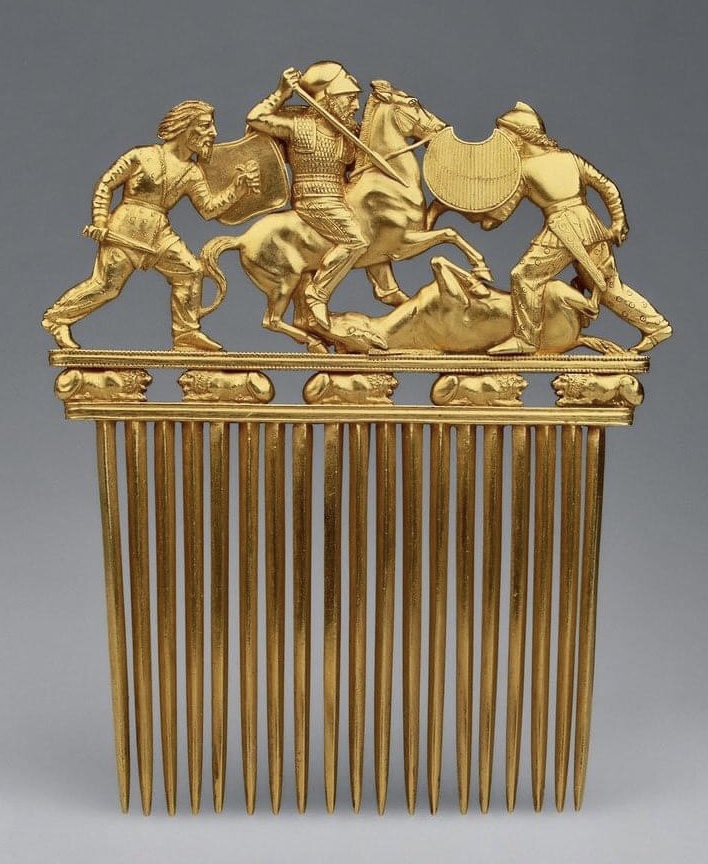
Scythian comb.jpg


In 660 BCE, mighty Assyria was about to be shaken. A Scythian named Dugdammi united many nomadic tribes into a confederation. This nomadic confederation pushed at the borders of Assyria which so frightened King Ashurbanipal that they felt Assyria had finally met its equal.
The Assyrians were already facing problems other than the Scythians and Cimmerians to the northeast of Assyria and to the west in Anatolia. This specific issue was regional and internal. Ashurbanipal had many problems even after conquering or putting down rebellions in Babylonia, Elam, and Egypt. Assyria was not in a position to take on more problems after a failed policy of economic aid to those affected by their own hand, which led in turn to brutish subjugation of the rebels, such as when Assyria sacked Elam sometime around the mid-640’s BCE.

Besides the events transpiring in and around Assyria of a non-nomadic nature, the Cimmerians were on the move again but seemed to be in greater numbers than in the past. Assyria’s new threat was slowly materializing on their northwestern and northeastern border. As mentioned before, these groups were typically unorganized and insufficient to pose a real threat other than hit-and-run guerilla tactics, and on some rare occasions, as you read earlier, joining in a battle. It is possible that this new Cimmerian-Scythian threat was loosely united, but by and large they did not mix, only getting involved in the affairs of the region they jointly controlled or roamed. Assyria at the time had no real control over Anatolia or Media. These two regions could be considered Assyria’s blind spot. In this blind spot, a certain chieftain would rise up to become not only a king of the Cimmerians but also the “king of the world.” His name was Dugdammi.

The origin of Dugdammi is rather vague according to most historians, but we will try to discover the facts. His name in classical Greek was Lygdamis, in Assyrian it was either Dugdammi or Tugdammi. He was either a Cimmerian or Scythian since the names are interchangeable and are practically the same. His story begins around 660 BCE. It seems that the first known attacks from Dugdammi were against Greek coastal cities such as Sardis of Lydia. Afterward, he pushed at the Assyrian empire around 652 BCE. Because of this external pressure, Assyria would be drawn into another war against Urartu and Dugdammi’s forces. Ashurbanipal mentioned Dugdammi in his annuals as “King of the Sakai and Qutu.” The term Sakai (Scythians) was used primarily by Western Iranians to indicate those who spoke in the Iranian vernacular.

Before discussing Dugdammi and his effect on Assyria, we should focus on the various names mentioned such, as Sakai and Qutu.

The term Qutu, also rendered as Quti, Qutians, or even Gutium, is a loosely used generic and archaic expression during this period of Assyrian history that has no real value for identifying a particular people. The term Gutium when used by Ashurbanipal, refers to those who were hostile to Assyria, particularly those who lived along the Zagros Mountains. However, the term was also applied to Manneans or Medes during this period. In other words, the term Gutium indicates anyone who is hostile and lives from east of the Tigris River into lands of Western Iran. Therefore, it seems evident that when Ashurbanipal speaks of Dugdammi, he is telling us that Dugdammi is from the region of Gutium, which could mean that he came from Media or maybe from the province of Mannea. What is certain is that Dugdammi is King of the Sakai, while his base of operations is evidently in the lands of Gutium.

There are two interesting letters given to Ashurbanipal by his astrologer Akkullanu that discuss revelations about the origins of the Cimmerians, Scythians, and Umman-manda:

To the king, my Lord, your slave Akkullanu. Peace be with the king, my Lord, may Nabu and Marduk bless the king, my Lord. March was visible on the path of the (stars) of Enlil, close to the feet of Persee; he/it was drab and pallid. I saw (it) the 26th day of the month of Aiaru, when it had risen strongly. I sent its interpretation later to the king, my Lord.”[If] March approaches from Persee, there will be revolt in the Amurru country, the brother will kill his brother. The sovereign’s palace will be robbed, the treasures of the country will be carried away to another country. The sign of the country is unfavorable. The king of the world will be delivered by his gods to his enemy.” It is a bad omen for the Amurru country. Your Assur gods (and), your god, will surely remove the power acquired by the Cimmerians, so great that it is, and will give it to the king, my Lord.” [“If] the starry Sanuma approaches of the Enmesarra god, the heart of the country will be happy, [the people will increase.”] Sanuma is March. [It is] a good omen for the king, my Lord. “So March rises while changing its color and if its radiance is yellow, the king of Elam will die this year.” “So Nergal is small and pallid at the time of its apparition and that he changes his color strongly like a celestial star, he will be understanding for Akkad. The forces of my army will resist and undo the enemy. The enemy’s army won’t resist against my army. The livestock of Akkad will lie down quietly on grazing. The sesame and the dates will be abundant. The gods will be understanding for Akkad.” “So March is visible in the month of Aiaru, some hostile actions will take place, (there will be) the defeat of Umman-manda.” Umman-manda are the Cimmerians.

What is interesting about this letter is that Akkullanu is referring to the Amurru as Umman-manda, but he goes on to reveal that the Umman-manda is the Cimmerians. But what does this mean? It means that the term Amurru in this inscription tells us that the Umman-manda and the Cimmerians are the same and that they are Amurru. If this is true, then the Cimmerians and Scythians are originally from the lands west of Mesopotamia.

The term Amurru in Akkadian means, “the west lands” or the land west of Mesopotamia which includes the Mediterranean coast. The Assyrians are notorious for using archaic terms when referring to peoples who inhabit certain regions, such as the region of Syria, which would be a province within the lands of the Amurru and over which, as discussed earlier, the Scythians had hegemony. On the other hand, Dugdammi’s title, “King of the Sakai and Qutu” may refer to tribal identity and location of the residence, as previously mentioned. If this is the case, then one should consider that the Cimmerians and Scythians came from the lands west of Assyria originally.

As for the term Umman-manda, the Assyrians and Babylonians have equated the Umman-manda with the Medes as described in the Fall of Nineveh Chronicle. Moreover, the meaning of Umman-manda could be “Manda-host” or “host of the Manda.” It has also been suggested that Umman-manda could mean “Who Knows,” “Barbarous people,” or “Nomads.” Nevertheless, one could say that the term means nothing more than a mixed multitude of uncivilized people from the north.

The meaning of the term Umman-manda has evolved among the regional people that mentioned them. Take for instance the name Tidcal or Tudkhul. Tidcal/Tudkhul is said to be the king of the Hittites, but he is also called king of the Umman-manda or “Nations of the North.” Consider also a much older event in which Naram-Sin, king of the Akkadian empire, defeated the Umman-manda and he states, “the powers of the Umman-manda are struck down.”

So what does this mean? This means from the time the Umman-manda first were mentioned by Naram-Sin up to the time of Ashurbanipal, over a thousand years had elapsed between events. This suggests that the term Umman-manda is generic and does not identify one particular people, but rather a horde of many tribes with various names, and Ashurbanipal’s Umman-manda are the Cimmerians. Therefore, the term Umman-manda was just a Mesopotamian stereotype used when referring to people not native to the civilized powers in the region. The Umman-manda of Naram-Sin and the Umman-manda of Ashurbanipal were indeed two different peoples.

The next interesting aspect of this letter indicates that Dugdammi is not only king but also king of the world, for the letter states, “The King of the world will be delivered by his gods to his enemy.” The Assyrians saw King Dugdammi worthy to hold the title “Sar kissati,” which means “King of the universe” or “King of the world” which is translated as “King of Kish.” This does not mean Dugdammi used the title or even considered the title, let alone even knew about the title, but rather that the Assyrians found him worthy of the title. The meaning of the title “Sar kissati” suggests that Dugdammi controlled regions rather than smaller provinces. In ancient times, this title went to those who controlled vast regions within or outside the boundaries of Mesopotamia. Akkullanu tells Ashurbanipal that he will gain back the power and title once King Dugdammi is defeated. It seems that if Ashurbanipal defeats Dugdammi, he will gain back the respect of his people, as well as his enemy, and in doing so, he will control the four corners of the known world.

Since there could only be one king of the world, Ashurbanipal of Assyria desired such a title. Ashurbanipal was most likely envious that Dugdammi, a man of non-Assyrian birth, held such a prestigious and sacred title. Ashurbanipal desired the title for it meant the defeat of his regional rival and would secure Assyria’s borders. The title Dugdammi holds brings up another question. The title “Sar Kassati,” as discussed earlier, suggests that his domain would have been vast, extending from Anatolia to Western Iran if not further to the east. This would mean that Dugdammi was the first Cimmerian-Scythian king to rule, unlike his predecessors, who were mere chieftains. However, this is only speculation. For how extensive his nomadic empire may have been is a matter of debate, but to the Assyrians it was rather threatening.

Another interesting name comes from the next letter provided by Akkullanu to Ashurbanipal concerning a people known as the Ahlamu:

[“So to him] month of Simanu [the moon] appears (for the first time) on 30th day (of Aiaru), the Ahlamu will eat the wealth of the Amurru country”. [These] omens are bad for Amurru. [Assour, Be] Nabu, your gods, [if hostility,] to the king’s hands, my Lord […] [… the defeat] of your ene[mies[…] […]

Once again, we notice the name Amurru being used that was shown previously to apply to the Cimmerians. Now we have the name Ahlamu added to the list as eating the riches of the Amurru. What is fascinating about this inscription is the Ahlamu are now side by side with Amurru. The Ahlamu were a tribe of Arameans who were semi-nomadic and occupied northern Syria, many times giving Assyria trouble during the reign of Tiglath-pileser I around the 12th-11th centuries BCE. The Ahlamu gave the Amurru people trouble during Biblical times, as well, for the people living within the lands of southern Syria and Canaan or any inhabitant who lived west of the Euphrates River, were considered Amurru by the Assyrians. An example of this trouble is illustrated in I Chronicles 18:1-17, in which King David slew many Arameans. In other words, we have what the Assyrians would consider Amurru, that is Israel, and this is not due to ethnicity, but that Israel lives in the region designated by the Assyrians as Amurru country at the time. But what does this say about the Cimmerians and the Ahlamu? The answer to that question is difficult but within reach. The Cimmerians under Dugdammi seem to have origins in Amurru country, but further investigation is needed due to the wording of the inscriptions.

Now, the letter or inscription you read says, “the Ahlamu will eat the wealth of the Amurru country.” This seems to indicate that the Ahlamu are living within the confines of Dugdammi’s empire and may be hostile to the Cimmerians, as indicated by eating the wealth of the Amurru. The Assyrians would know this due to their vast spy network and hoped the Ahlamu would cause a revolt significant enough to allow the Assyrians to take advantage of the situation. However, only two letters mention the Ahlamu as having a possible effect on the Cimmerians, but nothing more is mentioned other than possible hope. Ashurbanipal’s inscriptions for some time would continue referring to Dugdammi as “the king of Amurru” without mentioning his name:

The king of Amurru will die, his country will be reduced (in size) or again it will be devastated. The experts will probably have something to say about Amurru to the king my lord.

On the 15th day of Tebet, during the middle watch, a lunar eclipse took place: it began in the East and passed toward the West: a sinister omen, whose evil (import) is confined to Amurru and its territory. (Indeed) it portends evil to the king of Amurru and to his country. Since the chief enemy of the king my lord is in Amurru, the king my lord may do as he wishes: the arms of the king my lord shall conquer, the king shall accomplish his defeat. The text of their decision is reliable: Shamash and Marduk are giving into the hands of the king my lord a passage through the land, which you have seized by force of arms, from the upper to the lower sea. From the shore of the sea I lift up my hands toward the king my lord, for you are benign. May Marduk and Sarpanitum intercede for me before the king my lord.

Ashurbanipal must have been happy with his spy’s reports that the soothsayers used to fill the king’s ears with prophetic victory fast approaching. This also suggests the Assyrians may have become strong enough to make a challenge, thus giving Ashurbanipal the confidence to approach his enemy. Whatever reason allowed Ashurbanipal to feel more secure about his position seems to have backfired, for Dugdammi goes on to threaten the Assyrian border along with Mugallu’s son, “ussi.”

The name of Mugallu’s son remains unknown, all that is left of his name on the inscription is “-ussi:” This ussi along with Dugdammi would attack Assyria, but the outcome of the battle remains undecided:

[x x] ussi, his son sent every year, without interruption his heavy tribute and implored [my] lordship. I made him swear by the great gods, my Lords, he (but) despised the oath by their (sic) great gods. He has conferred with Dugdammi, king of the barbarian destroyer? destructive. Assour, great mountain, whose signs / borders don’t change, has it terrace [of] far and burned his body by the flaming fire. Without bow, nor horses, nor [mules], (nor?) his brothers, (nor?) his parent, seed of his father’s house, his great army, the aid of his hands, sent emergency following his own decision of the horses and mules without number in Assyria. Dugdammi, king highlander (?), Gutium, insolent that didn’t know the terror of Assour, has trusted in his own strength and has gathered his army to wage fight and battle. He established his camp on the border of Assyria. Assour, Ellilitu, Beautiful, Nabu, Ishtar living in Arbela […] Blood flowed out of his mouth and its sick tomb. Following it [the fire of the sky has fallen on them (the Cimmerians), and himself, his army and his camp, he burned them. Dugdammi was terrified, he is in a deplorable situation and removed his army and his camp; he came back… in his country. The terror of Assour, of Ellilitu, of Beautiful, of Nabu, of Ishtar of Arbela, gods who help me in striking him and he sent his captains (to establish) friendship and peace. I received [his heavy tribute]. Gold, multicolored clothes […] with great horses […horses of horsemanship of his lordship, military equipment, his heavy tribute, he sent it to me and he has kissed my feet. I made him swear to Assour and Ellilitu not to sin against the borders of the Assyria, and I have reinforced (it) while concluding with him a treaty under oath. He hasn’t respected the bill under oath by the great gods. He has entered in the borders of Assyria with the intention to make pain […]. He sinned against the borders of Assyria on the place of libation; for the establishment […The weapon] of Assour, my Lord has stricken him; he became a madman, and in (his) madness he bit his fingers.

From this inscription, we gather that Mugallu’s son ussi was loyal for some time to Assyria but did go on to join Dugdammi and his forces. Some have suggested that ussi was pressured by Dugdammi’s power. This is plausible, for ussi would feel pressured to make a decision based on the interest of his kingdom, since Dugdammi was a much closer threat than Ashurbanipal. In addition, consider also that ussi, like many others, grew tired of Assyrian dominance that imposed heavy tribute. Assyria would impose heavy tribute as a form of punishment to those that rebelled. It would perpetuate bad feelings, leading to further uprisings as in the case of ussi. Because of this, one could look at Dugdammi as a way out of Assyrian dominance. Dugdammi was not a threat, after all, but a blessing.

The next part of this inscription indicates a cease-fire. Ashurbanipal would impose heavy tribute on Dugdammi. Notice that in the inscription it says divine intervention defeated Dugdammi and his forces. This defeat could have come from another force but it is unclear. It may have been that Dugdammi’s attacker could not beat him and so they had settled for a draw. Had Ashurbanipal really defeated Dugdammi, the title “Sar Kassati” would be his; however, Ashurbanipal did not trounce Dugdammi and the Assyrian soothsayers never mention the title, while the Assyrian spies report only hostility.

These next inscriptions are somewhat similar to the previous one, particularly the next one you are about to read.

Dugdammi, demon gallu, barbarian-destructor […] that doesn’t bring [the yearly tribute,] [has trusted in] his own strength, [covered] the country like an invasion of locusts. He has gathered [his army and] established [his] camp [on the border of Assyria…] […]… the coming down (?) Assour, sin, [Shamash, Ishtar of] Nineveh, Ishtar of Arbela […] Blood flowed out [of his mouth;] he is [sick tomb.] […] size, established place (?)] [… the fire of the sky is tomb and himself, [his army and his camp,] it burned [them]. [Dugdammi] [was terrified and] he is put in [a deplorable situation; [he removed his army and his camp,] in Harsale […]… […] (of) his countries rebelled against him and […] he has expired. He was in a bad place and […] [..] he plotted against my gods in the inside of his army. […] theirs. The terror of Assour, of Sin, of Shamash of Ishtar of Nineveh, of Ishtar of Arbela, [gods, my Lords,] that helped me, striking him; his captains (to establish) friendship and peace […] with [great (?)] horses […]horses of horsemanship of his lordship, […]…military equipment, his heavy [tribute,] he sent it to me and he has kissed my feet. I made him swear by the great gods, [my Lords not to sin] against the borders of Assyria and I have reinforced (it) [while concluding with him the treaty under oath. He rejected the treaties under oath by the great gods and [didn’t respect it.] He has entered in the borders of Assyria with the intention (to make) pain. He sinned against the borders of Assyria [on the place] of libation; for the establishment (?) […The weapon of Assour, my Lord struck him; [he became a madman,] and in (his) madness he bit his fingers. […] he has changed and has inflicted upon him a stern punishment. [The moist of sound (body) has been reached of paralysis,] a sharp pain has pierced his heart; […] of him didn’t have, his army […] his penis was claw and was tomb. […His life ended…]

The inscription starts with Dugdammi being described as a “demon gallu” we will address this description later. As for the rest of the inscription, notices that it is a rehash of the previous inscription until you reach the last few portions. These last few lines suggest Dugdammi died in battle, using the imagery of a “pierced his heart” or his “penis was claw and was tomb.” Overall, the message is simple, Dugdammi is dead and shall no longer pose a threat to Assyria, but there is more:

[I have] killed, I have changed [Dugdammi, the king of Ummanmanda, destructive-barbarian…]

And Dugdammi, king of Umman-manda, creation of Tiamat, a species of gallu demon, despised the oath [by the gods] not to make crime, not to sin against the borders of my country; he didn’t fear your great name that the Igigis [venerate.] To magnify your lordship and the power of your divinity […] Following the message of your divinity that you sent: “I will disperse [his] army […] will I hurl down (?)] Sandakkurru / Sandaksatru, son (his), his offshoot that one designated like his heir.” I heard (it) and I have glorified the powerful Marduk.

Dugdammi is clearly dead according to the inscriptions, but another interesting aspect is the insults used to describe Dugdammi by Ashurbanipal. The term “demon gallu” and “Tiamat” as you read are descriptions of Dugdammi’s character according to Ashurbanipal. The term “demon gallu” is in reference to seven demons who love to eat flesh. You could take this meaning at face value, for some Scythian groups such as the Androphagoi and Massagetae, did consume human flesh and it is possible that Dugdammi partook of such a practice. On the other hand, Dugdammi may not have consumed any human flesh, but rather his sword consumed the flesh of the many thousands he and his forces had slain. However, it could be a stereotype, for certain Scythians and Cimmerians may have partaken in the consumption of human flesh, while Dugdammi took no part in, but due to his relation to them, one would think otherwise. Nevertheless, whatever the circumstance is one can agree that the term shows the distaste Ashurbanipal had for Dugdammi and his nomadic forces.

The next term mentioned in the last inscription is “Tiamat.” Tiamat represents the goddess of chaos. According to Babylonian mythology, Marduk slew Tiamat to create order and peace. Ashurbanipal obviously saw himself as being in the same position as Marduk and that something had to be done in order to bring about social order. In other words, this war with Dugdammi was a clash of civilizations in Ashurbanipal’s mind. You have the civilized Assyrians, keeping the peace and stability throughout the known world; while on the other hand, you have the uncivilized Dugdammi and his nomadic forces that represent palpable darkness.

The Assyrian inscriptions do not mention where Dugdammi died or how he died, but the statement is rather clear, Dugdammi is dead for, “a sharp pain has pierced his heart.” According to the historian Strabo, Dugdammi died at the Cilicia gates, but refers to him as Lygdamis and says, “Lygdamis, however, at the head of his own soldiers, marched as far as Lydia and Ionia and captured Sardes, but lost his life in Cilicia.” Unlike Strabo’s account, Ashurbanipal’s letters do not mention where the battle took place but only mention Dugdammi’s death. The inscriptions remain silent concerning a battle or a series of battles that most likely took place. However, the inscriptions do suggest a possible ceasefire at one time before the renewal of hostilities between the two.

The Ashurbanipal inscriptions mention two types of death; one is physical and the other spiritual. For the physical, Ashurbanipal says, “I have glorified the powerful Marduk.” Ashurbanipal claims the kill for himself, while in another inscription provided earlier speaks of the supernatural being responsible for slaying Dugdammi and says, “The weapon of Assour, my Lord struck him.” Regardless of the inscriptions, Ashurbanipal is responsible for Dugdammi’s death. However, it is interesting that Ashurbanipal speaks of himself as the taker of life, while in other he speaks of a god having taken Dugdammi’s life. It seems both are true, but with a twist.

To summarize, it is safe to say that Dugdammi was no friend of Assyria and he held in his grasp a huge nomadic empire that threatened the civilization of Assyria. Before the hostilities began, it seems that a “soft alliance” existed between them, perhaps because Dugdammi had been bought off by Ashurbanipal in preparation for dismembering the kingdom of Lydia. If true, it would have been a great move by Ashurbanipal at the time, but the Cimmerians still proved too wild to control directly or indirectly, and they quickly turned their attention back toward Assyria. This turning could be due to the desperate plea for help of Ardys, son of Gyges, to Ashurbanipal, and his willingness to patch up their differences over past issues.
Ashurbanipal may have accepted the terms, which is a cause for concern. At this point, we could say that Dugdammi was still on comfortable terms with Assyria, but felt threatened and undermined by a possible new alliance between Ashurbanipal and Ardys. The reason Ashurbanipal might have rekindled his trust in Lydia rather than with the Cimmerians could relate to economics and trade.
Lydia had an abundance of natural resources at its disposal, such as gold and silver. Trade routes also crossed through Lydia, making it and a commercial powerhouse for business and trade. The fact is that Assyria needed resources such as iron ore. However, the Cimmerians that lived and roamed in the Anatolian region were also in control of the iron ore. The Cimmerians were bad for business and they had to go. It seems that by making a pact with Lydia there was a chance to squeeze and expel the Cimmerians, as well as to establish trade relations with Lydia.
Earlier we discussed the death of Dugdammi and touched on the inconsistency of the battles, which suggest both Ashurbanipal and Dugdammi could have claimed victory. Both sides suffered heavy losses. However, it does seem that Ashurbanipal suffered most of the casualties in this conflict. Before the events that culminated in the death of Dugdammi, it appears that he took a short break before going on to violate the border agreement. This in turn would have caused upheaval along the borders and within Assyrian territory. In the inscriptions, one could glean from them that Ashurbanipal was quietly saying he was defeated. By invoking the god’s name as the sole benefactor in defeating Dugdammi, it does suggest that an outside element was possibly responsible. This outside element may have been Madys, according to Strabo:
Lygdamis, (King of the Cimmerians) however, at the head of his own soldiers, marched as far as Lydia and Ionia and captured Sardes, but lost his life in Cilicia. Oftentimes both Cimmerians and Trerans made such invasions as these; but they say that the Trerans and Cobus were finally driven out by Madys, the king of the Scythians. Let these illustrations be given here, inasmuch as they involve matters of fact which have a bearing upon the entire
compass of the world in general.

As Strabo suggests, it is quite possible that Madys did defeat and kill Dugdammi (Lygdamis) in Cilicia around 640 BCE if not 639 BCE. Ashurbanipal might have sent envoys to invite Madys to invade the lands of Dugdammi and kill him. The reason could be due to the wars in which Ashurbanipal was already engaged. Ashurbanipal was still intermittently fighting the Scythians and Cimmerians and at the same time having to suppress rebellions in Elam and Babylonia. Because of this, not only was he depleting his forces, he was also overextending his lines of supply and support. This massive onslaught on Assyria meant Ashurbanipal had to find someone to aid him, or hope for something or someone to intervene. He needed something as mighty as Dugdammi’s forces in the north, whether it was by force or influence. Madys was the choice. Strabo also says that Madys drove the Cimmerians out of Anatolia. This could be true, but unlikely. Madys may have defeated the forces led by Dugdammi, but more likely, that the dwindling remainder of Dugdammi’s force simply joined Madys. This region was under Cimmerian control and they probably did not mind being ruled by one of their own kin.

Dugdammi did have a son by the name of Sandaksatru who would succeed Dugdammi after his death. However, nothing is really known about him or where he went. It is possible that Sandaksatru was with his father at Cilicia during the battle, and fled into Europe along with the remainder of the forces when his father was defeated and killed. Nevertheless, the inscriptions definitely make no mention of Sandaksatru’s presence at this particular battle.

References

Askold I. Ivantchik, Les Cimmeriens au Proche-Orient

Cam Rea, March of the Scythians: From Sargon II to the Fall of Nineveh

Dr. E.V. Cernenko, The Scythians 700-300 BCE

Robert Drews, Early Riders: The Beginnings of Mounted Warfare in Asia and Europe

H.W.F. Saggs, The Might that was Assyria

Top Image:

https://commons.wikimedia.org/wiki/Category:Art_of_Scythia#/media/File:Scythian_comb.jpg

By Cam Rea

Hunting the Lions: The Last King of Assyria, and the Death of the Empire – Part II


The Assyrian empire, with the death of King Ashurbanipal, was collapsing under the weight of politics and war. Kingdoms and leaders previously held in Assyria’s great grasp fell upon the vulnerable empire, retaking land and gaining power.

One can argue that Assyria set itself back during the last years of Ashurbanipal’s life, since much of that period remains silent. With his death, those that ascended the Assyrian throne fared no better and yet worse than Ashurbanipal. With ineffective kings sitting on the Assyrian throne taking turns just as quick as they were seated, once prized holding such as Babylonia quickly slipped away from Assyrian control. This shift in power was a sign to other nations that neighbored Assyria that the time to challenge the former power was now. To hesitate could be costly and problematic if not all was put forth in bringing down their demise. The first of these woes for Assyria started with Nabopolassar, king of Babylonia.

Assyrian relief

Assyrian relief (CC BY 2.0)

Nabopolassar Invades Assyria!

It has been suggested that Nabopolassar invaded Assyria to revert the land back to how it had been; this had largely to do with redrawing the borders between Babylon and Assyria. Battles at the border became so frequent that Assyria started receiving help from the Egyptians and Mannaeans, and because of the strength of arms showing up for the fight, Nabopolassar most likely went on the offensive in order to hastily protect his interest.

Babylonian boundary stone.

Babylonian boundary stone. (Walters Art Museum/CC BY-SA 3.0)

In 616 BCE, Nabopolassar marched his forces out of Babylonia and into Assyria. Once in Assyria, Nabopolassar followed the Euphrates River, where he encountered the Suhi and Hindanu tribes who paid tribute to him.

Three months later the Assyrians prepared for battle in the city of Qablinu. Once Nabopolassar got word that the Assyrians were nearby in Qablinu, he gathered his forces and advanced towards the city where he would do battle against the combined forces of the Assyrians and Mannea. Nabopolassar defeated them and took captive many of the Mannai who had aided the Assyrians in battle. The outcome of this battle relieved pressure off the border of Babylon with Assyria and at the same time secured the city of Uruk.

Afterwards, Nabopolassar plundered and sacked the Mane, Sahiru, and Balihi, stealing their gods and goods, as well as the Hindanu who were deported back to Babylon. On the journey back to Babylon, the combined forces of Egypt and Assyria made an unsuccessful strike at the forces of Nabopolassar near Qablinu. Later that year, Nabopolassar led his forces back into Assyria and did battle against them at Arraphu (modern day Kirkuk). Nabopolassar won the battle, pushed the remaining Assyrian forces back to the Zab River, and took many chariots and horses.

Assyrian chariot, and a royal lion hunt

Assyrian chariot, and a royal lion hunt (CC BY-SA 2.0)

In 615 BCE, Nabopolassar attempted to take the old Assyrian capital of Ashur, only to fail and have to retreat to the city of Takrit. Thus, he was now under siege himself by the Assyrian forces that were in pursuit. The Assyrians, even though they were weak, were still able to field an army of considerable size.

The battle for Takrit lasted ten days and in the end resulted in a very important victory for Nabopolassar. It was also probable that during this time, the Umman-manda went down to Arraphu (moder Kirkuk) and took it. This would have meant that the Babylonians were never in control of Arraphu. If the Babylonians were in control of the city, one would expect war to have been declared on the Umman-manda for such an act. It suggests that the Babylonians would have been too weak to hold onto the city of Arraphu anyway, and may have over-extended themselves militarily, abandoning the city and region altogether.

Love, War, and Politics

In the following year of 614 BCE, the Umman-manda attempted to sack Nineveh but without results. They then turned their attentions to the city of Tarbisu, which they captured. Soon after, the Umman-manda moved along the Tigris River until they came to the ancient Assyrian capital of Ashur. The Umman-manda sacked and plundered the city of Ashur and left nothing behind. Nabopolassar rushed his forces to the battle but by the time he and his forces had arrived, it was too late. Most importantly here, Nabopolassar and Cyaxares became allies at the ruins of Ashur. To make this peace treaty and alliance legitimate, a marriage was arranged. Nebuchadnezzar, the son of Nabopolassar married Amytis who was the daughter or granddaughter of Cyaxares.

An illustration of Nebuchadnezzar II

An illustration of Nebuchadnezzar II (CC BY-SA 4.0)

Cyaxares and his Umman-mandan forces returned home for a short time, but in the process gained the relics of Ashur and the surrounding region. Nabopolassar and his Babylonians returned home displeased, demoralized by the destruction and treatment of Assur. But on the positive side, Nabopolassar may have just saved his kingdom from resembling Assur through the alliance that had led to a marriage between Nebuchadnezzar and Amytis. However, it also may be more romanticism than fact, but we should also consider that there is probably some truth behind this.

Map of the Neo-Babylonian Empire.

Map of the Neo-Babylonian Empire. (Public Domain)

In 613 BCE, Nabopolassar faced few and sporadic rebellions along the Euphrates River. These rebellions by various smaller tribes were most likely in alliance with Assyria. When Nabopolassar captured Anati on the Euphrates, the king of Assyria marched his forces down the river towards Nabopolassar. Nabopolassar retreated and returned home. Some question why he returned home so rapidly, knowing that Assyria (for the most part) was just a shell of its former glory. The first answer to this question, as some have suggested, may be associated with the Scythians.

Shifting Allegiances

Historians have speculated that either the Umman-manda switched sides for a brief time, or the Scythians still loyal to Assyria came from the west. I suggest it was actually the Egyptians who aided the Assyrians and came down the Euphrates River and made their presence known to Nabopolassar. This is probably why he retreated. The reason for the Egyptians’ involvement is that under Necho II, they controlled and garrisoned the city of Carchemish. A Psammetichus I cartouche and seal were found in a building at Carchemish, as well as one belonging to Necho II.

Relief of Psamtik I making an offering to Ra-Horakhty (Tomb of Pabasa)

Relief of Psamtik I making an offering to Ra-Horakhty (Tomb of Pabasa) (Public Domain)

Carchemish on the Euphrates River was under Egyptian control from 616 BCE to 605 BCE. It would have been easy for the Assyrians to ask the Egyptians for aid and to march along with them down river to stop Nabopolassar.

In 612 BCE, Nabopolassar marched his forces into Assyria while Cyaxares and his Umman-manda forces came from the east to join him. Together they combined their forces and besieged Nineveh. The siege lasted three months until the walls finally tumbled. Once inside, the forces of the Babylonians and Umman-manda pillaged and looted the city, leaving only a broken shell behind, with a dead king inside.

This was not the end for Assyria. The remaining survivors fled to Harran and a new king ascended the throne of Assyria by the name of Ashur-uballit. Afterwards Cyaxares returned to Media and Nabopolassar continued conquering Assyrian territory, reaching as far west as Nisibin. During this time, King Ashur-uballit partially reorganized what was left of Assyria, that being Harran. King Ashur-uballit sent a request to Egypt for aid but at the same time retreated from the area. The Umman-manda were on their way to Harran with the aid of Nabopolassar. The forces of Nabopolassar and the Umman-manda conquered Harran.

Harran, Carchemish and other major cities of ancient Syria (Public Domain)

“Beehive houses” of ancient Harran (in modern Turkey)

“Beehive houses” of ancient Harran (in modern Turkey) (CC BY-SA 4.0).

King Ashur-uballit made his new home with the Egyptians at Carchemish. It was during this time that a throne change took place in Egypt, for Pharaoh Psammetichus was now dead and his son Necho II had become the new Pharaoh. Pharaoh Necho II gave full support to Assyria by moving a large army to Carchemish. However, it was during this move that Necho II stumbled.

King Josiah also proved instrumental, even though it is not recorded on any Babylonian tablet. Josiah did cause some kind of collateral damage to the Egyptians as they were allied to Assyria. Nabopolassar could not thank Josiah enough.

It seems that the seventeenth year of the reign of Nabopolassar is when Josiah king of Judah died. Biblical scripture suggests that a large army tore rapidly out of Egypt to assist Assyria in the aim of re-taking the city of Harran. The Bible gives us a glimpse into the large army that was rushing to assist the King of Assyria. The scripture found in II Chronicles 35:20-21states:

After all this, when Josiah had prepared the temple, Necho king of Egypt came up to fight against Charchemish by Euphrates: and Josiah went out against him.

But he sent ambassadors to him saying, what have I to do with thee, thou king of Judah? I come not against thee this day, but against the house wherewith I have war: for God commanded me to make haste: forbear thee from meddling with God, who is with me, that he destroy thee not.

Necho knew that the best possible route to reach Harran was up past the Mediterranean coast, cutting across Josiah’s newly re-conquered territory (formerly belonging to the Northern Kingdom of Israel) and then northward until reaching the city of Carchemish/Charchemish. From Carchemish, Necho would then go directly east until he reached Harran. Josiah, for the most part, disrupted the movement of Necho’s forces. Necho says: “For God commanded me to make haste.” Josiah’s attack on Necho may have saved Harran from being re-taken by the Assyrians, aided by Egypt. Even though Josiah made Necho stumble before he got to Harran, retaliation from an Egyptian archer put Josiah down. Josiah lost his life supporting Babylonia and the Umman-manda unofficially.

Bronze kneeling statuette, likely of the pharaoh Necho II

Bronze kneeling statuette, likely of the pharaoh Necho II (CC BY-SA 3.0)

Necho II finally led his army to Carchemish to help aid Ashur-uballit in his struggle against Babylonia and the Umman-manda. Nabopolassar came to the aid of Harran and defeated the forces brought across from Egypt. What was left of the Assyrian army along with the Egyptians fled back to Carchemish for the time being, in order to reorganize and in hopes of fighting another day.

As for the fate of Ashur-uballit, the last king of Assyria, his fate remains unknown. Ashur-uballit may have died attempting to retake Harran, but it is also possible that he died in 605 BCE, when Babylonian forces crossed the Euphrates River and attacked the city of Carchemish, led by none other than the famed Nebuchadnezzar. Nebuchadnezzar would extinguish the last remnants of the Assyrian Empire, only to replace it with another version known as Babylonia.

A new empire took the place of the previous. Striding Lion 1 from Processional Way in Babylon, Neo-Babylonian Period, c. 604-562 BC (Public Domain)

Top Image: A once-powerful lion is hunted and lies dead. Assyrian relief, Nineveh, north palace, 645-635 BCE (Public Domain)

By Cam Rea

References

Boardman, John, I. E. S. Edwards, and N. G. L. Hammond. The Cambridge Ancient History. The Assyrian and Babylonian Empires and Other States of the Near East, from the Eighth to the Sixth Centuries B.C. Volume III, Part 2. Cambridge: Cambridge University Press, 1993.

Bright, John. A History of Israel. Philadelphia: Westminster Press, 1959.

Brosius, Maria. Women in Ancient Persia, 559-331 B.C. . Oxford: Clarendon, 1998.

Chavalas, Mark W., and K. Lawson Younger. Mesopotamia and the Bible: Comparative Explorations. Grand Rapids: Baker Academic, 2002.

Glassner, Jean-Jacques and Benjamin R. Foster. Mesopotamian Chronicles. Atlanta: Society of Biblical Literature, 2004.

Lipinski, Edward. On the Skirts of Canaan in the Iron Age: Historical and Topographical Researches. Leuven: Uitgeverij Peeters en Departement Oosterse Studies, 2006.

Olmstead, A.T. History of Assyria. Chicago and London: The University of Chicago Press, 1975 reprint (1923).

Saggs, H.W.F. The Might that was Assyria. London: Sidgwick & Jackson, 1984.

Zawadzki, Stefan. The Fall of Assyria and Median-Babylonian Relations in Light of the Nabopolassar Chronicle. Poznań: Adam. Mickiewicz University, 1988.

Hunting the Lions: A Dead King, and a Collapsing Assyrian Empire – Part I


The fall of Assyria was with a whimper and in no way ended with a bang. Instead, it ended in a slow, agonizing death. Ashurbanipal, Assyria’s last great king, ascended the throne only to inherit a storm forming on the horizon. From the time he became king until his death, wars and revolts were commonplace throughout his empire. One could easily speculate that Ashurbanipal in fact died from pure exhaustion due to the series of wars he led. His army was stretched, exhausted, and depleted from conducting military operations.

Sculpture of Ashurbanipal

Sculpture of Ashurbanipal (Public Domain)

The Fall of A King, The Rise of Troubles

Once the great Ashurbanipal died, his successors were not ready for the job and duty to support and defend the empire. His younger son Ashur-etil-ilani (still a young boy at the time), was chosen over Ashurbanipal’s eldest by the chief eunuch, Sin-shumu-lishir. This eunuch is also said to have used a private army from Ashurbanipal’s estate in 631 or 627 BCE, so it appears this man had great influence over the court. When the young king finally took over the throne, he was forced to share power with at least several other people claiming rights to his position. This was because the region and its politics were still very unstable, so he really didn’t have much say in the matter. It should be noted that one of the contenders was Sin-shumu-lishir, the chief eunuch.

A drawing believed to represent Assyrians (a beardless eunuch in middle) (Public Domain)

Out of the many claiming rights to the throne, one was powerful enough to be mentioned in the ever-so-obscure Assyrian tablets that are silent for this period. This man’s name was Nabu-rihtu-usur. Nabu-rihtu-usur rose from obscurity and laid claim to the title of King of Assyria, gaining much support from Sin-shar-ibni, the governor of Te. In addition, many of the Assyrian citizens, including those of the city of Ashur, threw in their support for Nabu-rihtu-usur. It also appears that around this time, King Josiah of Judah rebelled against Assyria by throwing out objects considered pagan. These objects were thought to have had strong connections with Assyria (II Kings 23:12). Josiah then went on the attack, taking back former lands from Assyria that had once been occupied by the Northern Tribes of Israel (II Kings 23:15-20).

When the wars had subsided, the boy king Ashur-etil-ilani, gave property to his chief eunuch (Sin-shumu-lishir) as reward. Not only was this for his loyal support, but the eunuch had also been the commander and chief of Ashur-etil-ilani’s forces, and his military ability in defeating the king’s enemies must have been greatly received. In addition, the eunuch was exempt from paying taxes, as were those of his household and in fact anyone else of power who supported the young king as rightful heir to the throne. It later became evident that the royal house would eventually come under siege by those much stronger and more influential than even the royals were. This led to a total breakdown in royal authority and influence which not only affected the court but the empire as well.

It is said that Ashur-etil-ilani did not last long on the throne. His trusted eunuch Sin-shumu-lishir took control at some point, disposing of Ashur-etil-ilani and taking the throne for himself. He reigned for nearly a year. It could be possible though that Sin-shumu-lishir took over as acting king and was given the title of “sub-king,” until a suitable replacement could be found. The reason for this, some sources indicate, was that that Ashur-etil-ilani and his brother Sin-shar-ishkun were at war with each other over who was the rightful heir. Sin-shumu-lishir could have been left as the acting king until Ashur-etil-ilani had returned from his campaign against his brother, (and no doubt other enemies of Assyria too).

Assyrian statue (CC BY 2.0)

We do know that when Sin-shar-ishkun returned and took the throne, he did so by deposing Sin-shumu-lishir relatively easily. It could have been possible that the Assyrian populace always supported Sin-shar-ishkun over his younger brother because Sin-shar-ishkun was likely to have been the true heir to the Assyrian throne. As to what happened to his younger brother, Ashur-etil-ilani, it is uncertain. It could be speculated that he was killed by Sin-shumu-lishir or in battle against his older brother. The only other alternatives are that he was killed by another enemy or just captured and put in prison and left to be forgotten. At the end of this period, the fact remains that Sin-shar-ishkun became the new king of a decayed body once known as Assyria.

Sin-shar-ishkun became king around 626-625 BCE, give or take five years. Once Sin-shar-ishkun took power as the rightful king in Assyria, he also took the Babylonian crown for himself. At this time, there was no official king in Babylon due to his younger brother possibly taking the title for himself and deposing the then vassal king “Kandalanu.” Thus, Sin-shar-ishkun took the Babylonian title for himself and deposed either his younger brother or Sin-shumu-lishir. It was then that another leader rose up to challenge him for his kingship of Babylon; This challenger was Nabopolassar.

Ancient Egypt and Mesopotamia c. 1450 BC

Ancient Egypt and Mesopotamia c. 1450 BC (Public Domain)

Nabopolassar Leads Growing Unrest

The origins of Nabopolassar are not known and speculation surrounds him much more than fact. It is said that Nabopolassar may have been the son of Bel-ibni. There is some suggestion that Bel-ibni was a Chaldean and viceroy of the Sealands. This could be possible but I have some doubts. As Bel-ibni was appointed governor of Babylon during the early years of Sennacherib’s reign in around 703-700 BCE, there is too much of a gap in years between Bel-ibni and Nabopolassar. One could speculate that Bel-ibni may have been his grandfather or great uncle, but again this is uncertain. The other possibility is that Nabopolassar was the son of or simply a relative of Merodach-baladan, but that idea needs more evidence. It is also possible that Nabopolassar was an Assyrian general, appointed by Ashurbanipal to look after the region. In any case, Nabopolassar must have had some connection to royalty for such support. One could speculate that he may have been the William Wallace of his day, with no distinct background in terms of nobility at all! Whatever the reason, Nabopolassar became the man to lead the growing unrest, built up due to the Assyrian occupation that controlled all things Babylonian.

Illustration of a Babylonian/Assyrian king.

Illustration of a Babylonian/Assyrian king. (Public Domain)

Nabopolassar gained adherents to his cause. His strongest support most likely came from the shared struggle of the people in southern Babylonia. This region, especially the tribes of Bit-Yakin and Bit-Amukani, had a history of being anti-Assyrian. The reason for this is that the two tribes mentioned above wanted to preserve the independence of Babylon. Because of this, Assyria invaded time after time to smash rebellions. This was not forgotten among the people that occupied the southern portion of Babylonia. Nabopolassar, who gained kingship in the marshlands of this Babylonian region, may also have come from the Bit-Yakin tribe.

Once Nabopolassar established himself as king and declared independence from Assyrian rule, he made plans to recover the rest of Babylonia from Assyria. It could have been possible that Nabopolassar did not intend to expand his borders into Assyria, thus simply claiming the Babylonian throne for himself. However, he chose to invade. Once Nabopolassar decided to go to war against Assyria, he must have known that the only way to win was to invade, defeat, and take Assyria on Babylonian land. Nabopolassar would do just that by attacking Assyrian garrisons stationed there. As soon as Nabopolassar had pushed the remaining Assyrian forces out of Babylonia in 616 BCE, he began his invasion of greater Assyria, planning to extinguish their absolute power forever.

King Josiah and Pharaoh Psammetichus Clash

The next figure on this grand stage was none other than Josiah. Josiah was the king of Judah and had been for quite some time when the events of Nabopolassar’s war began to unfold. One could say that Josiah’s first act of rebellion was re-establishing Biblical Law in the land of Judah. With this, Josiah also instigated a great campaign to destroy and rid the land of pagan idolatry, as well as groves and child sacrifice to the god Molech (II Kings 23:1-37). In doing so, Josiah could be perceived as “throwing off the Assyrian yoke of oppression” that his ancestors had so deeply embraced, in particular, King Manasseh, who originally imported such practices to the people. Josiah would not rid the land of idols until sometime after Ashurbanipal had died. This was probably due to the provincial and regional rebellions that continued post-battle in the weakened land of Assyria. Once Josiah rid Judah of paganism, he looked to the north of his land that had previously belonged to the kingdom of Israel.

Illustration of King Josiah

Illustration of King Josiah (Public Domain)

This northern region was ready to be invaded. Assyria withdrew from the region of northern Israel roughly around 640 BC. I would say that the reason for this withdrawal was due to the wars still taking place within and around Greater Assyria. However, some have speculated that Assyria withdrew from northern Israel (Palestine) due to an agreement made with Egypt. The reason for this is that Egypt won its independence around 649 BC and was, from that moment, an independent kingdom free from Assyrian rule and a force to be reckoned with. Egypt, at this time, was more interested in the coastal region of the Levant. If Egypt controlled the coast, it would control the trade routes and trade cities like those of Phoenicia. This would generate much wealth and at the same time put Egypt in an economically and militarily strategic position. However, Josiah was in the way and had to be removed, or at least be made to submit. The Levant had traditionally belonged to Egypt, and in Egyptian eyes had always been the land of the Pharaohs. In their view, a shepherd king was not fit to rule the land.

King Josiah had to protect his land from invasion. His chosen defense was forts – many forts, and Josiah made sure they were garrisoned with tough Greek mercenaries. Archaeologists say that during Josiah’s reign, he hired many Greek mercenaries to guard his southern border, particularly the area that bordered Egypt. An example of this Greek presence in the service of Josiah is the fort known as Mezad Hashavyahu, which faced towards the Philistine city of Ashdod.

Replica of the Mesad Hashavyahu ostracon (potsherd used as writing surface).

Replica of the Mesad Hashavyahu ostracon (potsherd used as writing surface). (Public Domain)

Nevertheless, these fortifications did not stop Psammetichus from invading. Egypt, for the most part, would come to dominate the region in mainly the coastal parts of Palestine. As for Josiah’s forts, they were most likely a constant nuisance to Psammetichus’ goal of a “total conquest” of the Philistine coast, or what is today known as the Gaza Strip. The city that troubled Psammetichus immensely was Ashdod. The Greek historian Herodotus says it took Pharaoh Psammetichus twenty-nine years to take the city. If these details are true, then the Egyptians’ goal to obtain complete stability remained out of reach for a further three decades.

One such possibility that tripped up the Egyptian advancement may have been the Scythians. The Scythians (according to Herodotus) invaded Palestine to halt the Egyptians advance; Pharaoh Psammetichus met them, gave them gifts and prayers, and sent them on their way. As they left, a number of them decided to venture into the city of Ascalon and plunder the temple of Aphrodite.

Philistine captives of the Egyptians, from a graphic wall relief at Medinet Habu. In about 1185-52 BC, during the reign of Ramesses III.

Philistine captives of the Egyptians, from a graphic wall relief at Medinet Habu. In about 1185-52 BC, during the reign of Ramesses III. (Public Domain)

A curse was swiftly put on those who had carried out this desecration. As for how long the Scythians remained in the area stifling Egypt’s attempt to take control of the region is uncertain.

Top Image: A lion is hunted, and is near death. Assyrian relief, Nineveh, north palace, 645-635 BCE (Public Domain)

By Cam Rea

References

Boardman, John, I. E. S. Edwards, and N. G. L. Hammond. The Cambridge Ancient History. The Assyrian and Babylonian Empires and Other States of the Near East, from the Eighth to the Sixth Centuries B.C. Volume III, Part 2. Cambridge: Cambridge University Press, 1993.

Bright, John. A History of Israel. Philadelphia: Westminster Press, 1959.

Brosius, Maria. Women in Ancient Persia, 559-331 B.C. . Oxford: Clarendon, 1998.

Chavalas, Mark W., and K. Lawson Younger. Mesopotamia and the Bible: Comparative Explorations. Grand Rapids: Baker Academic, 2002.

Glassner, Jean-Jacques and Benjamin R. Foster. Mesopotamian Chronicles. Atlanta: Society of Biblical Literature, 2004.

Lipinski, Edward. On the Skirts of Canaan in the Iron Age: Historical and Topographical Researches. Leuven: Uitgeverij Peeters en Departement Oosterse Studies, 2006.

Olmstead, A.T. History of Assyria. Chicago and London: The University of Chicago Press, 1975 reprint (1923).

Saggs, H.W.F. The Might that was Assyria. London: Sidgwick & Jackson, 1984.

Zawadzki, Stefan. The Fall of Assyria and Median-Babylonian Relations in Light of the Nabopolassar Chronicle. Poznań: Adam. Mickiewicz University, 1988.

“Lion of the North” Gustavus Adolphus and the Thirty Years’ War: Victories and Downfall – Part II

[Read Part I]

This is the recounting of the dramatic life of the “The Golden King” and “The Lion of the North” Gustav Adolf, and the Swedish Empire during stormaktstiden – “the Great Power era”.

As Gustav II Adolf (King Gustavus Adolphus of Sweden) waited in Werben, Germany, Johann Tserclaes, the Count of Tilly (Field Marshall of the Catholic League’s forces) received a message from Field Marshall Pappenheim requesting that he come to Magdeburg and aid in its defense against the Swedes. After some time, Count Tilly decided to send three cavalry regiments on a recon mission towards Werben on July 27, 1631. After a few days, Gustav received word of the cavalry advance and quickly assembled 4,000 cavalry and led them towards the enemy force and surprised them at Burgstall and Angeren on August 1, 1631. The imperial forces suffered heavy casualties and lost their baggage.

[Left] Engraving of Gustavus Adolphus (Public Domain) and [Right] portrait of Count Johann t'Serclaes von Tilly. (Public Domain)

[Left] Engraving of Gustavus Adolphus (Public Domain) and [Right] portrait of Count Johann t’Serclaes von Tilly. (Public Domain)

During this engagement, Gustav himself almost became a casualty. Those who were captured provided the Swedish king with valuable information. He soon learned that Tilly was planning to attack his forces at Werben.

When news reached Tilly that the cavalry forces he had sent had been devastated, he fell into a rage. Tilly wasted no time; he mustered his forces, and pushed towards Werben with 15,000 infantry and 7,000 cavalry. Tilly’s hurry towards Werben was to prevent the Swedes from fully digging themselves into a defensive position. However, when Tilly arrived, he saw that Swedes had already set up defensive fortifications, for it was standard procedure among the Swedish military to do so once they set up camp.  Tilly, seeing that the element of surprise was out of the question, positioned his forces and opened fire on the Swedish camp with sixteen heavy guns, and the Swedes obliged Tilly with a volley of their own.

Illustration of the Battle of Werben, detail.

Illustration of the Battle of Werben, detail.(Deutsche Fotothek‎/CC BY-SA 3.0 de)

The first day of fighting was primarily sorties and heavy skirmishing outside the Swedish perimeter. The second day was much the same, as each side exchanged cannon fire and engaged in limited skirmishes. While Tilly was poking and prodding the Swedes, he received intelligence that a German unit within the Swedish ranks would mutiny. Tilly, understandably suspicious of the information, decided that it was something he could not ignore. Therefore, Tilly gave the order to launch a full-scale assault on the Swedish entrenchments. This would be a grave mistake. As the imperial forces advanced, they came under a well-organized concentration of artillery and musket fire. The imperial forces began to drop quickly. Sensing that any further advancement would do them no good, they retreated, but as they did so, the Swedish cavalry fell on them. Six thousand imperial forces lay dead on the field of battle, while the remaining wounded and untouched scattered.

A scene of battle and death from another engagement during the Thirty Years’ War (Battle of Fleurus, Aug 20, 1622.)

A scene of battle and death from another engagement during the Thirty Years’ War (Battle of Fleurus, Aug 20, 1622.) (Public Domain)

Battle of Breitenfeld, Clashing Forces

After Werben, Tilly had received orders from the emperor to invade Saxony and force Elector John George to pledge his allegiance to the emperor and disband his army. John George did not answer Tilly but stalled to see what terms Gustav could offer. John George gave Tilly a negative answer but by that time Tilly’s forces had swelled to 36,000 troops who need supplies. Sensing that John George was not going to join the imperial forces, Tilly decided to move his forces into Saxony where he besieged, plundered, and raped the countryside for supplies.

By September 8, 1631, Tilly was quickly approaching Leipzig where he positioned his forces on the level terrain of Breitenfield, north of Leipzig. On the September 11, 1631, Gustav and John George came to a treaty in which Saxony would place its forces under the command of Gustav, along with one month’s pay, food, shelter. Most importantly, Saxony would make no peace with the empire.

On September 15, 1631, Gustav and John George meet, and began to maneuver around Leipzig to disrupt the imperial forces, to root out any enemy units, and to find an advantage before digging in for battle. The next day, the Swedes and their allies marched towards the city. As Gustav moved towards Leipzig, the garrison defending against the imperial forces, unaware that Gustav was on his way, surrendered to Tilly. Soon after the surrender, the imperial force began to pillage the city until news arrived that the Swedes were not far away.

Once the Swedish forces had arrived with their allies, Gustav arrayed his army that evening, and his men slept in the order in which they would march into combat. The battlefield they and the imperial forces agreed to engage upon was relatively broad, on a rolling plain north of Leipzig. It stretched for miles and was void of woods and rivers, making it ideal for two large armies to clash. The Swedish forces boasted 13,000 to 26,800 soldiers, while their Saxon allies reportedly had from 12,000 to 18,000 troops. As for field guns, numbers are disputed, as the number of cannons ranged between 51 to 100 heavy guns and every regiment each had their field guns. The same can be said for the imperial army, wherein it’s said they fielded anywhere from 27 to 36 cannons.

Battle of Breitenfeld – Initial dispositions, 17 September 1631 Swedish-Saxon forces in Blue, Catholic army in Red.

Battle of Breitenfeld – Initial dispositions, 17 September 1631 Swedish-Saxon forces in Blue, Catholic army in Red. (Public Domain)

Tilly deployed his imperial forces in fourteen tercio blocks (companies of men with pikes and/or firearms) in the center with his cavalry on either flank. Gustav deployed his forces in a similar fashion, with smaller units drawn up in two lines of musketeers supporting the cavalry while the infantry had the support of 42 two-man battalion guns, (even though the number of guns is uncertain). The smaller Saxon force under John George positioned to the left of the Swedish forces.

In this contemporary drawing, the Imperial formations (to the left) are deployed two companies deep, while the Swedish (to the right) are deployed just one company deep

In this contemporary drawing, the Imperial formations (to the left) are deployed two companies deep, while the Swedish (to the right) are deployed just one company deep (Public Domain)

At noon, both sides exchanged artillery fire. After two hours of trying to weaken one another with a near constant barrage, Tilly gave the order to move forward. Tilly’s intention was a double envelopment. Leading the way was Tilly’s left-wing cavalry, their goal was to engage and turn the Swedish right. However, the cavalry was stopped when the Swedes extended their lines, and alternated musket fire along with countering the imperial cavalry with their own cavalry.

While the Tilly had little luck attacking the Swedish right, he did find success on the left against the Saxons and were able to disperse them by 16:00. With Tilly’s tercios advancing with the aid of the cavalry, and with the dispersal of the Saxon forces thus exposing Gustav’s left, success seemed imminent. However, the left-wing of the Swedish cavalry was able to make a counter-attack and drive Tilly’s cavalry back into their own tercios, who happened to be reorganizing after their successful assault.

With Tilly’s forces preoccupied with reformation, Gustav took advantage of the moment by extending their flank and he counter-attacked with a steady, combined concentration of shock and firepower which compressed Tilly’s forces, causing confusion. The Swedish push was so successful that they were able to reclaim the Saxon artillery and capture the imperial artillery by steadily pushing the discombobulated enemy back.

With the imperial forces well behind their initial battle line, the Swedes used the captured artillery and turned it on the imperial forces, and by 18:00, Gustav swept the remaining enemy forces off the battlefield. Gustav demonstrated that the combination of finesse and firepower were far more dominant then the cumbrous system used by the enemy.

Battle of Breitenfeld – Annihilation, 17 September 1631 Swedish forces in Blue, Catholic army in Red.

Battle of Breitenfeld – Annihilation, 17 September 1631 Swedish forces in Blue, Catholic army in Red. (Public Domain)

Battle of Lech and A Clever Plan

After Breitenfeld, Gustav maintained success. He pushed further until he reached the Rhine, where he decided to consolidate his hold and to winter his troops. This gave time to make plans in acquiring an additional 210,000 men for his 1632 campaign, which would allow him to field six other armies and to use the rest to advance on Bavaria and possibly onto Vienna itself.

Once spring arrived, Gustav mustered his forces and began the trek towards Bavaria. However, there was a problem, once he reached the river Lech, it proved to be impassable. The reason f was that Tilly had destroyed all the bridges and had removed all the boats. Gustav quickly came up with a clever plan. He began an artillery barrage to distract Tilly while obscuring the real crossing point, which was three miles south of Rain where the Lech splits into two channels with a sizable island in the middle. It was there where the Swedes began constructing their bridge. The next day, Gustav placed 18 guns to cover the next step of the operation. With musketeers now on the island, Gustav made it lucrative by giving five months’ extra pay to those who would row across the river to the Bavarian bank. Three hundred and thirty-four Finns quickly got to work; carrying across the channel the last pieces of the prefabricated bridge. Once in place, the Swedish army still under the cover of fire, poured across the river. Tilly soon learned what was going on and sent troops to counter the Swedish advance and stop them from penetrating his camp.

A cavalry battle between 1626 and 1628

A cavalry battle between 1626 and 1628 (Public Domain)

Gustav had also sent 2,000 cavalry to ford the Lech a mile or two away, near the village of Munster. As expected, once the cavalry rolled up on Tilly they struck a decisive blow to the imperial left flank at the climax of battle. As the evening hours wore on, the imperial forces wore out and retreated, leaving their guns and baggage behind— and worst of all, Tilly took a hit to his right thigh by a cannon ball, which mortally wounded him. He died from this wound two weeks later.

As for Gustav, he would continue seeing victories as he pushed on, with his only real defeat coming in September 1632 at the Battle of the Alte Veste. Finally, his day under the sun came on November 16, 1632, at Lutzen.

Battle of Lützen

Late October 1632, word reached Gustav that general Albrecht von Wallenstein had led his forces northward to meet with another Imperial force under Count Pappenheim. Their goal was to subjugate Saxony and to cut off Gustav’s supply line to the Baltic. Gustav quickly headed north. While one might think he would call on the 163,000 troops he had available, the problem was that they were scattered throughout his holdings. Gustav had to make best with the available 19,000 men on hand.

On November 10, 1632, Gustav reached Naumburg and began to fortify his camp. Wallenstein mistakenly believed the Swedes were suspending their campaign and scattered his own forces about the lands since his camp at Leipzig could not provide enough supplies.

Gustav wasted no time in mustering his troops and marched out of Naumburg in the direction of Wallenstein’s camp on November 15, 1632. Wallenstein sent an urgent message to Pappenheim to bring back his cavalry. That night both armies slept in battle formation. If Wallenstein was not ready once morning arrived, he still had a little luck from nature as a fog rolled in. This allowed him to further prepare what may have been missing due to their hasty preparation. Around late morning, Gustav formed his 18,000 troops in nearly the same battle formation as they had held at Breitenfeld.

Map of the troop dispositions.

Map of the troop dispositions. (Public Domain)

The battle began with Gustav leading a cavalry charge towards the Imperial musketeers in a ditch. This charge, while effective in uprooting them, also cost the Swedish cavalry in many lives due to the musket fire. Driving the Imperial forces out of the ditch, the Swedish cavalry pressed on and were close to falling on the main body of infantry. However, the Imperial cavalry under Pappenheim appeared suddenly and countered the Swedish advance. The tide had shifted in favor of the Imperial forces. Nevertheless, the Swedes would regain the advantage when two musket balls mortally wounded Pappenheim. This would cause panic throughout the Imperial ranks due to Pappenheim reputation as a fine leader.

Gustavus Adolphus in the battle of Lützen.

Gustavus Adolphus in the battle of Lützen. (Public Domain)

With Pappenheim out of action, the Imperial left flank began to fall apart. While this was going on, the Swedish cavalry started hitting the center of the enemy. Victory seemed to be in Gustav’s hands but nature quickly stole it away when an even heavier mist rolled in on the battlefield. With both armies nearly blind by the fog, Gustav, who had the advantage and momentum, stalled. Gustav got word that his left flank was weakening and decided to help strengthen their position; this would be the end of the great king.

Gustav, as usual, led from the front and rode so fast he left his escort behind. In doing so, an Imperial musketeer took aim and shattered Gustav’s left arm. As it was known that Gustav forwent body armor due to an old wound that plagued his shoulder, he was easily shot in the back, and wounded grievously. He fell from the saddle with one foot in the stirrup, and was dragged for some time before being able to twist free. However, once free, lay face down in the mud when a third shot rang out, this time it was the death shot as it penetrated his head.

The Imperial forces seemed to be on the verge of victory but were thwarted by the Swedes who now took revenge for the death of their king. In the end, it was a Swedish victory with a high cost. The Swedes could not pursue the fleeing Imperial forces afterwards due to having lost a third of their men and on top of that, with a dead king on their hands.

The scene shows the death of the “Lion of the North” King Gustavus Adolphus of Sweden on November 6, 1632.

The scene shows the death of the “Lion of the North” King Gustavus Adolphus of Sweden on November 6, 1632. (Public Domain)

In conclusion, Gustav’s military reforms were revolutionary and evolutionary. In other words, it was just a matter of time and a bit of tinkering that manufactured a superb military force.  With combined arms, it was capable of producing a greater volley of fire and an ability to maneuver on the field of battle with speed and precision. No matter how effective Gustav’s forces were in battle, he continued to make changes. He felt all must be scrutinized for inconsistencies in order to stay one step ahead of any future foe. He is regarded as one of the greatest military commanders of all time.

Ultimately, his legacy is one of military supremacy, in effect determining the religious and political balance of power in Europe, making Sweden a Great Power and empire.

After his death, Gustavus's wife initially kept his body and his heart. His remains (including his heart) now rest with his sarcophagus at Riddarholm Church, Stockholm, Sweden.

After his death, Gustavus’s wife initially kept his body and his heart. His remains (including his heart) now rest with his sarcophagus at Riddarholm Church, Stockholm, Sweden. (Public Domain)

Top Image: Deriv; Portrait of Gustav II of Sweden (Public Domain) and his death on November 6, 1632. (Public Domain).

By Cam Rea

References

Addington, Larry H. The Patterns of War though The Eighteenth Century. Bloomington and Indianapolis, IN: Indiana University Press, 1990.

Boot, Max. War Made New: Technology, Warfare, and the Course of History, 1500 to Today. New York: Gotham Books, 2006.

Bradford, James C. International Encyclopedia of Military History. New York: Routledge, 2006.

Brzezinski, Richard and Richard Hook. The Army of Gustavus Adolphus (1): Infantry. London: Osprey, 1991.

Curtis, Benjamin W. The Habsburgs: The History of a Dynasty. London: Bloomsbury Academic, 2013.

Dodge, Theodore Ayrault. Gustavus Adolphus. New York: Da Capo Press, 1998.

Fissel, Mark Charles and D. J. B. Trim. Amphibious Warfare 1000-1700: Commerce, State Formation and European Expansion. Leiden: Brill, 2005.

Fletcher, C. R. L. Gustavus Adolphus and the Struggle of Protestantism for Existence. New York: G.P. Putnam’s Sons, 1890.

Frost, Robert I. The Northern Wars: War, State, and Society in Northeastern Europe, 1558-1721. Harlow, England: Longman, 2000.

Hart, B. H. Liddell. Great Captains Unveiled. New York and Washington D.C.: Da Capo Press, 1996.

Häusser, Ludwig, G. Sturge, and Wilhelm Oncken. The Period of the Reformation, 1517 to 1648. New York: American Tract Society, 1873.

Helfferich, Tryntje. The Thirty Years War: A Documentary History. Indianapolis: Hackett Pub. Co, 2009.

“Lion of the North” Gustavus Adolphus and the Thirty Years’ War: Fighting the Holy Roman Empire – Part I


On 9 December 1594, Gustav II Adolf was born. From the time of his birth until his coronation, his upbringing involved many lessons in politics, literature, military science, and physical development, making him physically and intellectually rounded. In 1611, his father, Charles IX of Sweden died, leaving the Swedish crown to the young Gustav who was sixteen at the time.

When Gustav was crowned king of Sweden, there was no celebration for the sixteen-year-old had inherited from his father three bloody wars against Denmark, Russia, and Poland, along with financial troubles. However, the boy king would not let these incredible challenges stop him from restoring stability to Sweden and leading his country towards military innovation and glory.

This is the recounting of the dramatic life of the “The Golden King” and “The Lion of the North” Gustav Adolf and the Swedish Empire during stormaktstiden – “the Great Power era”.

Gustav Enters the War

In 1629, the Holy Roman Emperor Ferdinand II of Bohemia made a drastic move without consulting the electoral princes, his advisors, and the imperial diet as a whole when he announced the Edict of Restitution. This edict took 500 abbeys, two archbishoprics, and two bishoprics that had been “secularized” since 1552 by Germany princes and returned them back to the Catholic Church.

Ferdinand II of Habsburg, Emperor of the Holy Roman Empire, King of Hungary and Bohemia with his court dwarf.

Ferdinand II of Habsburg, Emperor of the Holy Roman Empire, King of Hungary and Bohemia with his court dwarf. (Public Domain)

This not only threatened the Protestant princes who sized church land, but indicated how far the emperor would go with his authority at the expense of his own subjects. Ferdinand’s expanding sphere of influence not only threatened the Protestant authorities within his realm, but also Sweden, for they shared a presence on the Baltic, which eventually induced Gustav to invade Germany.

Before Gustav could set off for war against the Holy Roman Empire, he needed to calculate the costs of the war and the amount of supplies the army would need. Upon examination, the Swedish exchequer concluded that it would cost the taxpayer 2,800,000 silver dalers. While the money was being carefully calculated and banked, the spending started immediately to pay the producers to manufacture the supplies and an army to use them. To get an idea of the amount of supplies needed, an infantry regiment of 576 muskets would need 3,000 pounds of gunpowder, 2,400 pounds of lead, and 3,400 pounds of match each month while campaigning.

Early spring 1630, Gustav mustered 13,641 soldiers and placed them to a fleet consisting of 25 major warships along with 75 smaller units and transports. With troops assembled, they boarded the ships.

The Vasa, early 17th century warship, was ordered by King Adolphus and built at the Stockholm shipyard by Henrik Hybertsson - an experienced Dutch shipbuilder. Vasa was to be the mightiest warship in the world, armed with 64 guns on two gundecks.

The Vasa, early 17th century warship, was ordered by King Adolphus and built at the Stockholm shipyard by Henrik Hybertsson – an experienced Dutch shipbuilder. Vasa was to be the mightiest warship in the world, armed with 64 guns on two gundecks. (Dennis Jarvis/CC BY-SA 2.0)

However, the winds were unfavorable, and it took the fleet a little longer than hoped to arrive. On June 25, the Swedish forces quickly disembarked at Peenemunde, which is located on the northern end of the island of Usedom, sent reconnaissance parties out, built field fortifications, and began sweeping the island clean of enemy forces. By July 4, the island was under Swedish control. With a base established, the Swedes could now receive supplies and troops and when news reached the German interior that Gustav had arrived, the Protestant powers of Europe, such as the elector Palatine and Landgrave (Duke) of Hesse-Cassel, saw opportunity arriving, as he had had much of his land stripped away by the emperor.

The prow of the Vasa. “During the 1961 recovery, thousands of artifacts and the remains of at least 15 people were found in and around the Vasa's hull by marine archaeologists.”

The prow of the Vasa. “During the 1961 recovery, thousands of artifacts and the remains of at least 15 people were found in and around the Vasa’s hull by marine archaeologists.” (Jorge Láscar/CC BY-SA 2.0)

On July 18, Gustav mustered 8,723 men who boarded fifty-one ships suitable to sail up the Oder River. On July 19, the Swedish forces set sail down the Oder. By noon on July 20, the Swedish forces had arrived at Stettin. Gustav ordered that part of his troops land near the Oderburg castle where he took up position, and after some deliberation with the authorities, the city of Stettin surrendered. Gustav not only established a foothold in the interior of Germany, but also gained a major economical artery.

Before pushing any further south, Gustav decided to stay put in Pomerania to strengthen his position. However, Protestant support was still lacking. Many began to view his arrival with suspicion instead of opportunity—except for one.

While Gustav remained in Stettin, the large prosperous city of Magdeburg on the Elbe River, in August 1630 rose up against imperial authority and joined Sweden. Not long after the city came under siege and asked Gustav to alleviate them.  However, Gustav could do little to help. The reason for this is that if he were to rush to their assistance, he would have to lead his army though the neutral territories of Brandenburg and Saxony. Moreover, he would also have to pass though enemy territory. However, Gustav knew that Magdeburg was under siege by a small imperial force, which could hold out for some time. Of course, it could hold out for a considerable amount of time so long as Count Tilly and his powerful Catholic forces did not aid the besiegers. Magdeburg would have to wait. Gustav had other problems to deal with; the winter and supplies.

The winter of 1630-31 slowed not only the forces of Tilly but also the enemy forces stationed at Gartz and those east and west of Gustav along the coast. The reason for the stagnation of the imperial forces was due to not having the proper attire for the winter, thus causing them to stay put in their winter camps. The Swedish forces on the other had been equipped for the winter with fur-lined coats, boots, head covers, and gloves.

Kyller - It was worn by military men, mainly cavalry in the 1600s and 1700s under armor.

Kyller – It was worn by military men, mainly cavalry in the 1600s and 1700s under armor.  (Livrustkammaren (The Royal Armoury)/CC BY-SA 3.0)

While the winter did not stop the Swedish troops, it did slow them down. The reason for their sluggish movement was due to logistical issues. However, logistical issues were not going to stop Gustav when he saw opportunity, as intelligence reports indicated that the imperial forces at Gartz were reduced from 6,000 men. Gustav mustered his forces and moved his troops by foot and flotilla on the unfrozen Oder River on Christmas Eve, and attacked the 4,000 imperial forces remaining at Gartz. The Swedes were victorious. However, victory came due to the garrison being undisciplined and most importantly, many had been out searching for food, thus leaving only a small force to resist.

With Gartz under Swedish control, Gustav now had a firm hold on Pomerania with the exception of a few smaller besieged garrisons. With success came issues in early 1631, for Gustav lacked the money needed to pay his troops. A man by the name of Armand Jean du Plessis, better known to us as Cardinal Richelieu, came forward and offered Gustav a proposal that would greatly help the Swedish forces continue the fight.

Cardinal Richelieu, French Money, Religion and Politics

The citizens of Sweden were poverty-stricken, and further war at their expense threatened the infrastructure of Gustav’s kingdom if the war became protracted. Furthermore, he had no allies. Denmark could have provided assistance but they remained neutral and were still viewed as untrustworthy by Gustav (even though King Christian publicly expressed friendship, it did not sway Gustav).

Portrait of Cardinal Richelieu

Portrait of Cardinal Richelieu (Public Domain)

One would think that other Protestant kingdoms outside of Germany would have mustered their forces and pushed on into Germany. Unfortunately, many of them were already in war or coming out of a war against a powerful Catholic state. England could have helped but they had just signed a peace treaty with Spain. The Netherlands could have helped, but were busy fighting Spain. As mentioned, Denmark remained neutral; this was due to being beaten into submission and afterwards paid off to remain neutral. Inviting the Ottomans into the war was a possibility but was looked upon as an uncertainty. As for all the Protestant princes within Holy Roman Empire, they either stayed neutral, looking for ways to find peace, or sought outside help to fund their military endeavors. Because of this, the only two powers one could look to help their religious cause were France and Sweden.

France could have entered the war on the side of the Catholics. However, politics was thicker than religious similarities. Because of this, King Louis XIII of France’s chief minister Cardinal Richelieu proposed an entirely different approach. Instead of aiding the Catholic nations in their war, why not aid the Protestants? Richelieu’s thinking was politically strategic. Richelieu understood that if France were to support Emperor Ferdinand II, they would be helping to further politically and territorially suffocate themselves for the powerful House of Habsburg. The only nation and leader battle-hardened and strong enough to curtail the Catholics was King Gustav of Sweden.

Cardinal Richelieu at the Siege of La Rochelle, a result of a war between the French royal forces of Louis XIII the Huguenots of La Rochelle, at the height of the tensions between the Catholics and the Protestants in France.

Cardinal Richelieu at the Siege of La Rochelle, a result of a war between the French royal forces of Louis XIII the Huguenots of La Rochelle, at the height of the tensions between the Catholics and the Protestants in France. (Public Domain)

Richelieu approached Gustav with the proposal to enter the war with the aid of subsides. Gustav had no issue with this and greatly accepted. However, it came down to ‘name your price’. Gustav asked for six hundred thousand rixdollars (silver coinage used throughout the European continent) a year but Richelieu quickly declined, for it was too much. However, Richelieu concluded that money well spent is money well-earned and agreed to Gustav’s terms with the signing of the Treaty of Bärwalde 23 January 1631. After the parties agreed to the terms, Gustav had one more favor to ask, and that was to make the agreement public. Richelieu disagreed, but understood the circumstances at hand. By agreeing to make the treaty public, this was making a statement that showed Catholic France and Protestant Sweden were united and most importantly, the treaty itself was an invitation to the Protestant states to join the war against the Holy Roman Empire.

The Battle of Frankfurt an der Oder

Six days after signing the Treaty of Bärwalde, Gustav turned his forces back north and headed towards the fortified city of Demmin. In less than three weeks the Swedish forces had captured six towns including Demmin, which surrendered after a siege of two days. While Gustav moved with fluidity, Tilly had to turn west for a moment before swinging north. As Tilly’s forces continued pushing north, he decided to hit soft targets, like that of Swedish occupied Neu-Brandenburg, whose garrison lacked artillery and was secured by only 750 troops. Gustav was quick to respond by mustering 19,000 men to relive the city but then refrained from doing so. Gustav had the men but his cavalry was largely unpaid German mercenaries who might have proved unreliable.

Therefore, Gustav decided on a far different strategy. He decided that to relieve the city. He would have to move his forces towards Frankfurt. This would distract Tilly and disrupt his communications with the forces besieging Magdeburg. However, when Tilly got word of Gustav’s army moving towards Frankfurt it was too late. Tilly had stormed Neu-Brandenburg and sacked the town. Afterwards, Tilly moved his forces to aid in the siege at Magdeburg in hopes to end it. Unfortunately for Tilly, his forces proved too small to make a difference. To make matters worse for Tilly, Gustav on March 27 had pushed south on the Ober with a force of 14,000 troops and 200 guns, to attack Frankfurt. Gustav also knew that the garrison of Frankfurt consisted of 6,000 soldiers and capable commanders, thus it was imperative to take Frankfurt quickly.

Swedish infantry and cavalry led by the Swedish king Gustav II Adolf march through Frankfurt, 17 November 1631. Cannons firing.

Swedish infantry and cavalry led by the Swedish king Gustav II Adolf march through Frankfurt, 17 November 1631. Cannons firing. (Public Domain)

On March 31, Tilly pulled his forces and headed to relive Frankfurt. However, when he arrived, it was too late. On April 3, the Swedish forces stormed the city, massacred the garrison and sacked the town. Seeing that Frankfurt was lost, Tilly returned to Magdeburg. Tilly’s return was a smart move, for he would have known that Gustav’s forces lay in wait for his arrival. Tilly’s about face from Frankfurt frustrated Gustav. Seeing that Tilly would not take the bait, Gustav tried to negotiate with the electorates of Saxony and Brandenburg that would allow his forces to pass through their neutral territorial in order to reach and relieve Magdeburg of the imperial forces. Finally, on April 20, Saxony and Brandenburg gave permission. Unfortunately, it came too late, for Tilly had assaulted the city and the imperial forces who happened to be unpaid and under-fed, torched the city and killed 20,000 inhabitants. Even though this campaign between Gustav and Tilly was purely defensive maneuvering, the end was clearly a Swedish victory.

The Sack of Magdeburg, 1631.

The Sack of Magdeburg, 1631. (Public Domain)

The Battle of Werben

Three months later, at Werben, near the confluence of the Havel and Elbe, Gustav established his camp, while Tilly had moved into Hesse-Cassel. The reason for Gustav’s establishing himself at Werben was to keep Tilly away from that principality. Tilly chose Hesse-Cassel to provision his forces and attempted to convince the landgrave to join him. However, the langrave decided to put his support behind the Swedes and thus entered into an alliance with Gustav.

As Gustav waited in Werben, Tilly received a message from Field Marshall Pappenheim requesting that he come to Magdeburg and aid in its defense against the Swedes. After some time, Tilly decided to send three cavalry regiments on a recon mission towards Werben on July 27, 1631. After a few days, Gustav received word of the cavalry advance and quickly assembled 4,000 cavalry and led them towards the enemy force and surprised them at Burgstall and Angeren on August 1, 1631. The imperial forces suffered heavy casualties and lost their baggage.

During this engagement, Gustav himself almost became a casualty. Those who were captured provided the Swedish king with valuable information. He soon learned that Tilly was planning to attack his forces at Werben…

King Gustavus II Adolphus statue, Stockholm

King Gustavus II Adolphus statue, Stockholm (CC BY-SA 2.0)

Top Image: The victory of Gustavus Adolphus at the Battle of Breitenfeld (1631) (Public Domain)

By Cam Rea

References

Addington, Larry H. The Patterns of War though The Eighteenth Century. Bloomington and Indianapolis, IN: Indiana University Press, 1990.

Boot, Max. War Made New: Technology, Warfare, and the Course of History, 1500 to Today. New York: Gotham Books, 2006.

Bradford, James C. International Encyclopedia of Military History. New York: Routledge, 2006.

Brzezinski, Richard and Richard Hook. The Army of Gustavus Adolphus (1): Infantry. London: Osprey, 1991.

Curtis, Benjamin W. The Habsburgs: The History of a Dynasty. London: Bloomsbury Academic, 2013.

Dodge, Theodore Ayrault. Gustavus Adolphus. New York: Da Capo Press, 1998.

Fissel, Mark Charles and D. J. B. Trim. Amphibious Warfare 1000-1700: Commerce, State Formation and European Expansion. Leiden: Brill, 2005.

Fletcher, C. R. L. Gustavus Adolphus and the Struggle of Protestantism for Existence. New York: G.P. Putnam’s Sons, 1890.

Frost, Robert I. The Northern Wars: War, State, and Society in Northeastern Europe, 1558-1721. Harlow, England: Longman, 2000.

Hart, B. H. Liddell. Great Captains Unveiled. New York and Washington D.C.: Da Capo Press, 1996.

Häusser, Ludwig, G. Sturge, and Wilhelm Oncken. The Period of the Reformation, 1517 to 1648. New York: American Tract Society, 1873.

Helfferich, Tryntje. The Thirty Years War: A Documentary History. Indianapolis: Hackett Pub. Co, 2009.

The Maiden of France: A Brief Overview of Joan of Arc and the Siege of Orléans


France, embroiled in a war with England in a struggle over the French throne during the Hundred Years’ War, would find a savior who in turn was a heretic to the English. This sinner and saint was a woman by the name of Joan of Arc. While most people know that the English burned her at the stake at Vieux Marche in Rouen, most have forgotten her military adventures against the English.

The Peasant Girl

In 1412, Joan of Arc (or Jeanne d’Arc) was born in the village of Domremy located in the Duchy of Bar, France. She was the daughter of poor farmers by the names of Jacques d’ Arc and his wife Isabelle. Like the upbringing on any farm, Joan learned primarily agricultural skills. She was said to have been a hardworking and religious child.

Jeanne d'Arc, by Eugène Thirion (1876). The portrait depicts Joan of Arc's awe upon receiving a vision from the Archangel Michael.

Jeanne d’Arc, by Eugène Thirion (1876). The portrait depicts Joan of Arc’s awe upon receiving a vision from the Archangel Michael. (Public Domain)

Joan’s fame came when she claimed to hear the voice of God, which instructed her to expel the English and to have the Dauphin, Charles Valois (Crown Prince of France) crowned king of France. Incredibly, Joan would get her chance to meet with the Dauphin Charles VII when the situation changed for the worse in 1429.

In 1429, the city of Orleans, loyal to the French crown, had been under siege by the English for over a year. With Orleans heavily under attack, the uncle of Henry VI, John, Duke of Bedford and the English regent, advanced with a force towards the Duchy of Bar, which at that time was under the rule of Rene, the brother-in-law of Charles Valois.

Siege of Orléans, 1429.

Siege of Orléans, 1429. (Public Domain)

Divine Revelation

Seeing that the English advance seemed unstoppable, the young Joan in the village of Domremy, approached the garrison commander, Robert de Baudricourt, and informed him that voices told her to rescue Orleans. She demanded that he assemble some men, provide some resources, and take her to meet with the Dauphin at Chinon.  The garrison commander scoffed at the idea of a peasant girl standing before the French Royal Court and sent her away. Not dissuaded, she petitioned Baudricourt’s soldiers, and making accurate predictions about the outcomes of battles (apparently proving divine revelation), was eventually escorted to the Royal Court.

Joan arrived at Chinon on 23 February 1429. Right before Joan arrived, Charles is said to have disguised himself to see if she would be able to identify him, and to test her ‘powers’ as a prophetess, but it was to no avail, because she bowed before him, and said, “God give you a happy life, sweet King!”

Miniature from Vigiles du roi Charles VII. Joan of Arc and Charles VII, king of France.

Miniature from Vigiles du roi Charles VII. Joan of Arc and Charles VII, king of France. (Public Domain)

After a lengthy examination by the theologians, she was found not to be a heretic or insane. With no mental issues found, they advised Charles to let her do what the divine will had apparently commanded her to do. Charles agreed.

Joan of Arc on horseback. (1505)

Joan of Arc on horseback. (1505) (Public Domain)

Before setting off to fight the English, Joan wrote a letter to English king and English Regent of France:

JESUS, MARY

King of England, render account to the King of Heaven of your royal blood. Return the keys of all the good cities which you have seized, to the Maid. She is sent by God to reclaim the royal blood, and is fully prepared to make peace, if you will give her satisfaction; that is, you must render justice, and pay back all that you have taken.

King of England, if you do not do these things, I am the commander of the military; and in whatever place I shall find your men in France, I will make them flee the country, whether they wish to or not; and if they will not obey, the Maid will have them all killed. She comes sent by the King of Heaven, body for body, to take you out of France, and the Maid promises and certifies to you that if you do not leave France she and her troops will raise a mighty outcry as has not been heard in France in a thousand years. And believe that the King of Heaven has sent her so much power that you will not be able to harm her or her brave army.

To you, archers, noble companions in arms, and all people who are before Orleans, I say to you in God’s name, go home to your own country; if you do not do so, beware of the Maid, and of the damages you will suffer. Do not attempt to remain, for you have no rights in France from God, the King of Heaven, and the Son of the Virgin Mary. It is Charles, the rightful heir, to whom God has given France, who will shortly enter Paris in a grand company. If you do not believe the news written of God and the Maid, then in whatever place we may find you, we will soon see who has the better right, God or you.

William de la Pole, Count of Suffolk, Sir John Talbot, and Thomas, Lord Scales, lieutenants of the Duke of Bedford, who calls himself regent of the King of France for the King of England, make a response, if you wish to make peace over the city of Orleans! If you do not do so, you will always recall the damages which will attend you.

Duke of Bedford, who call yourself regent of France for the King of England, the Maid asks you not to make her destroy you. If you do not render her satisfaction, she and the French will perform the greatest feat ever done in the name of Christianity.

Done on the Tuesday of Holy Week (March 22, 1429). HEAR THE WORDS OF GOD AND THE MAID.

One can definitely suspect that the king of England and the English Regent of France did not take it to be cordial.

Religious War

Joan of Arc, as a symbol of god’s will to the French, had turned a generational Anglo-French battle over thrones into a religious war.

Joan of Arc

Joan of Arc (Public Domain)

After convincing the theologians and future king of France that the divine had sent her, she was given armor to wear and a force of four thousand men were placed under her command. She set off towards Orleans soon after, carrying a white banner depicting Jesus, the Virgin Mary, and two angels.

Fortifications around Orleans at the time of the siege. English forts are depicted red, French forts depicted in blue.

Fortifications around Orleans at the time of the siege. English forts are depicted red, French forts depicted in blue. (CC BY-SA 3.0)

On 29 April 1429, she entered Orleans. She there met with the commander of the garrison, John, the Bastard of Orleans. Upon meeting him, she demanded that he immediately attack the English. However, John was not ready. While John was preparing with the now additional four thousand troops who accompanied Joan, Joan decided to approach and shout at the English troops. She informed them that she was the one sent by God—the “maiden”—and said to them “Begone, or I will make you go” but the English upon hearing her message, hurled insults back.

On April 30 the Orleans militia, under the command of Etienne de Vignoles, assaulted the English at the Boulevard of Saint-Pouair, but the attack proved unsuccessful. Joan called out to Sir William Glasdale at Les Tourelles stating, “Yield to God’s command.” The English replied by calling her a “cowgirl”.  They made it known to Joan that if they captured her they would surely burn her. But even in their anger, they were also cautious.

On May 1, Dunois and a small band of men, along with Joan and some soldiers, left to bring the army back to Blois. During this small mission, the English did not attempt to engage the French even though they knew she was among this small army. Interestingly, the reason for not engaging the French seems to have been due to fear, for the lower English ranks feared that she had some supernatural powers and to risk taking her dead or alive was detrimental to their own wellbeing.

On May 3, the main body of Joan’s relief force arrived. She made it clear to the French soldiers and officers that God had sent her, as she rode in at the head as a priest chanted from the book of Psalms.

(Creative Commons, CC BY-SA 3.0)

With Joan and 4,000 men in Orleans, the Armagnacs (Prominent Orleanists in French politics) attacked the outlying English fort of Saint Loup on May 4 and captured it. Feeling confident after the capture of Saint Loup, the French were preparing to attack the weakest English bastions on the south bank of the Loire the next day. However, despite the win, Joan decided on a temporary one-day truce to honor the Feast of the Ascension on May 5. It was during this truce that Joan wrote a letter for the English stating, “You, men of England, who have no right to this Kingdom of France, the king of Heaven orders and notifies you through me, Joan the Maiden, to leave your country; or I will produce a clash of arms to be eternally remembered. And this is the third and last time I have written to you; I shall not write anything further.”

She gave this letter to a crossbowman and he shot the letter into the English fortress of Les Tourelles. In the fortress, an archer retrieved the message and said, “Read, here is the news!” The English commander replied, “Here is news from the Armagnac whore!” Joan is said to have wept after hearing their reply.

The English Downfall

On May 6, the French set off and reached Fort Saint-Jean-le-Blanc. However, they found it empty. The Armagnacs continued to advance. The English appeared outside the fort and attempted a cavalry charge but were defeated and driven back into their stronghold.

15th-century depiction of Joan of Arc leading an assault on an English fort at the siege of Orléans.

15th-century depiction of Joan of Arc leading an assault on an English fort at the siege of Orléans. (Public Domain)

With the English bottled up, the Armagnacs continued on capturing another English forts near the Les Augustins monastery. From here, the Aramagnacs held steady on the south bank of the river Loire before engaging the English fortress of Les Tourelles the following morning on May 7.

While Joan partook in many of the battles, she did so from a support role, encouraging the men, boosting morale and confidence, and she also helped many of the wounded before she was herself wounded above the breast by an arrow at Les Tourelles. She is said to have pulled the arrow out with her own hand and dressed the wound with oil. After treating her wound and getting some rest, she noticed French troops retreating from the fortress. She quickly grabbed her standard, and stormed towards the fortress. She stuck her banner into ground and shouted encouragement to the men to fight on.

Sir William Glasdale and his small English force, seeing that they could hold no longer in their earth-and-timber fortress, and after witnessing that Joan was not dead, fled the flimsy ill-constructed fort for the safer stone fortress of Les Tourelles. It was at this moment that Joan saw Glasdale fleeing and shouted to him. “Glasdale! Glasdale! Yield to the King of Heaven! You called me a whore, but I have great pity on your soul and the souls of your men!”

Whether Glasdale stopped or not is up for debate, but during the chaos around them, a French incendiary boat became wedged beneath the wooden drawbridge, causing it to catch fire. Glasdale and his men attempting to cross it to reach the safety of Les Tourelles, did not make it, for the bridge caught fire and soon weakened. The bridge could not hold the weight of the men and it disintegrated and gave way. Glasdale and the men with him went crashing into the river and drowned due to the weight of their armor.

Tables Turned

The seemingly unstoppable French advance caused the English to surrender the fortress, which resulted in a French victory that lifted the siege of Orleans. Nine days after Joan’s arrival at Orleans, the siege had collapsed. This military victory was a major turning point in the Hundred Years war.

Afterwards, more fortresses fell within the duchy causing the English to send forces to stop the advancement but they were in turn defeated. In just a few weeks, the English in the Loire valley were swept aside and Bedford, the English Regent of France, had lost much of his supplies, which greatly crippled any further English advancement for the time being.

Joan partook in many successful military operations until the English eventually captured her.

Joan of Arc and the French army marched toward the defense of Compiegne against the Burgundian army, led by John of Luxembourg, and arrived on 14 May 1430. However, on May 22, Joan went out during a sortie and surprised the Burgundians. While Joan’s attack was effective, the Burgundian forces refused defeat, rallied their forces, and defeated her men.

Joan retreated towards the gates and continued to fight, as she refused to admit defeat. This stubborn will allowed her to fall into the hands of her enemy, for the commander of the town left the gates open long enough for Joan and her forces to enter. However, seeing Joan refusing to disengage and the enemy ever so close to the entrance, the commander ordered the gate shut, sealing Joan’s fate.

Joan captured by the Burgundians at Compiègne. Mural in the Panthéon, Paris.

Joan captured by the Burgundians at Compiègne. Mural in the Panthéon, Paris. (Public Domain)

After the Burgundians captured her, they imprisoned Joan at Beaulieu Castle at Rouen. After a lengthy imprisonment and trial, the Maiden of France was executed on 30 May 1431.

"Joan of Arc dies at the stake", painted in 1843 by German artist Hermann Anton Stilke (1803-1860). Hermitage Museum, St. Petersburg.

“Joan of Arc dies at the stake”, painted in 1843 by German artist Hermann Anton Stilke (1803-1860). Hermitage Museum, St. Petersburg. (Public Domain)

Featured image: Detail; Joan of Arc at the Siege of Orléans by Jules Lenepveu (CC BY-SA 2.5)

By Cam Rea

References

Baumgaertner, Wm. E. A Timeline of Fifteenth Century England – 1398 to 1509. Victoria, B.C., Canada: Trafford Publishing, 2009.

Bradbury, Jim. The Routledge Companion to Medieval Warfare. London: Routledge, 2004.

Edmunds, Joan M. The Mission of Joan of Arc. Forest Row: Temple Lodge, 2008.

DeVries, Kelly. Joan of Arc: A Military Leader. Stroud: Sutton, 1999.

Dupuy, Trevor N., Curt Johnson, and David L. Bongard. The Harper Encyclopedia of Military Biography. New York, NY: HarperCollins, 1992.

Joan of Arc. Letter to the King of England, 1429. Translated by Belle Tuten from M. Vallet de Vireville, ed. Chronique de la Pucelle, ou Chronique de Cousinot. Paris: Adolphe Delahaye, 1859, pp. 281-283. https://legacy.fordham.edu/halsall/source/joanofarc.asp

Mirabal, Laura. Joan of Arc: The Lily of France. Bloomington, IN: Authorhouse, 2010.

Pernoud, Régine, Marie-Véronique Clin, Jeremy duQuesnay Adams, and Bonnie Wheeler. Joan of Arc: Her Story. New York: St. Martin’s Press, 1999.

Richey, Stephen W. Joan of Arc: The Warrior Saint. Westport, Conn: Praeger, 2003.

Tuckey, Janet. Joan of Arc, “the Maid;”. London: M. Ward & Co, 1880.

Wagner, John A. Encyclopedia of the Hundred Years War. Westport, Conn: Greenwood Press, 2006.

The Iron Army: Assyria – Deadly and Effective Siege Machine – Part II


While the ram attempted to smash and loosen the rocky walls, Assyrian assault teams with scaling ladders would try to breach walls. The ram, while effective, was also vulnerable to enemy defenders dropping chains to pull the battering pole aside. Because of this issue, the Assyrians deployed men who counter this by hooking the chains with iron grapples. The prophet Joel gives a description of the Assyrian wall scaling:

“They rush upon the city;
they run along the wall.
They climb into the houses;
like thieves they enter through the windows.”

[Read Part I]

Joel’s description is quite accurate. Besides reliance on battering rams to bring down the walls, they also looked to sappers.

Undermining Fortifications

Assyrian sappers (soldiers for building, demolitions, general construction) would approach the walls possibly under the cover of shield bears, the same type that protected the archers one could suspect. If they had no such protection, the Assyrian king made sure his specialized troop had the armor needed to get the job done. The sapper, particularly during the rule of Ashurnasirpal (883-859 BCE), were heavily armored and wore long padded mailed coverings along with a conical helmet with mail protecting the face and neck.  Once at the walls, they would aid in helping the battering rams dislodge blocks from the wall with special flat-topped crowbars, pick axes, hoes, and drills. If the sappers could not get near the walls, they tunneled under them and prop it up with wooden supports until the hole was rather large and deep, after which they would set fire to the structure causing the foundation to weaken and collapse.

While the battering ram was effective, the Assyrians had a backup plan usually underway during the siege to aid the army if the rams failed to dislodge the walls, and that was siege towers. As these siege towers are pushed forward, archers would accompany them with the duty to pick off any enemy foe threatening to toss an incendiary weapon at the tower. Furthermore, the Assyrians placed hoses on the tower from which water poured over the leather sheets covering the wooden structure to prevent the tower from catching fire. If the water hoses failed and fire did catch, a man holding a large ladle with would extinguish the flames the best he could.

Siege Tower on the Lachish, Relief in the British Museum.

Siege Tower on the Lachish, Relief in the British Museum. (CC BY-SA 3.0)

If the battering rams breached the walls, the Assyrian infantry behind the rams would pour through the hole under the cover of their archers and slingers. The Assyrian infantry were heavy spearmen armed with long, double-bladed spears, straight swords for close combat and they carried a small shield. The armor worn by the infantryman was a conical helmet, a knee-length coat of iron mail which was lined with wool to absorb the blows from weapons and allowed heat to dissipate. To protect his legs, he wore knee-high leather boots that had iron plates attached to the shins.

Heavy-armed archers in action. Assyrian, about 700-692 BC. From Nineveh, South-West Palace. These archers, the front one of whom is beardless, possibly an enuch, are each accompanied by a soldier whose duty it is to hold the tall shield in position and guard against any enemies who come too close.

Heavy-armed archers in action. Assyrian, about 700-692 BC. From Nineveh, South-West Palace. These archers, the front one of whom is beardless, possibly an enuch, are each accompanied by a soldier whose duty it is to hold the tall shield in position and guard against any enemies who come too close. (Mike Peel www.mikepeel.net/CC BY-SA 4.0)

Plunder and Refugees

Inside the city, the Assyrian infantry would slash and plunder their way through. Once the slaughter and pillaging were over, those still alive (as at Samaria, which was sacked in 721 BCE), would feed the deported refugees during the journey back into Assyria, while also being treated by physicians to keep hygiene up and disease out. Furthermore, the Assyrians provided footwear if needed, along with carts for the longer journeys for women and children. Families were not separated for the most part. The Assyrians wanted to keep the families and communities together, as well as their national identity. Assyria was not a melting pot of nations. The Assyrians wanted to preserve the identity of the deportees for social and military strength and to lessen the possible acts of rebellion.

Judean people being deported into exile after the capture of Lachish. his relief depicts a man, 2 women, and 2 (male and female) children being deported with their household belongings.

Judean people being deported into exile after the capture of Lachish. his relief depicts a man, 2 women, and 2 (male and female) children being deported with their household belongings. (CC BY-SA 4.0)

After the people had been gathered and exported, the Assyrians, like a swarm of army ants, took the captured fortified cities, or even a villages, and would destroy and take everything. Trees that were in or around the city or village were usually cut down and the timber taken back as spoils of war. Trees such as date palms were stripped naked and then cut down, leaving only the stump behind so they could not grow again. Other trees would be uprooted and replanted back in Assyria. Farmlands also did not escape Assyrian plunder, for they too were likely stripped bare leaving the farmland as it was before planting. When Tiglath-pileser conquered most of Syria and Lebanon, he took many of the trees for his palace and as tribute:

With the keen understanding and grasp of intellect with which the Master of the gods, the prince Nudimmut (Ea) endowed me, a palace of cedar… and a portico (bit hilanni) patterned after a Hittite (Syrian) palace, for my enjoyment, I built in Kalal (Kahi).”

A palace of cedar “Their (the palaces) doorways, of ivory, maple box-wood, mulberry, cedar… juniper, tribute of the Hittitte kings of the princes of the Aramaeans and of Chaldea, which I brought in submission to my feet through my valorous heroism. I made and I richly adorned them with tall cedar beams, whose fragrance is as good as that of the cypress tree, products of Amanus, Lebanon, and Ammanana (Anti – Lebanon) … The doorleaves of cedar and cypress, which give unbounded joy to the one entering them (and) whose odor penetrates to the heart, I bound with a sheathing of shining zahalu and (sariru) and hung (them) in the door-(ways).

People’s valuables were taken as well, apart from the things the captives needed in their day-to-day life. Even the temples’ valuables such as gold or silver were stripped. Idols in these temples were transported back to Assyria and paraded as weak gods of the conquered host; they could not compete with the gods that favored Assyria.

Once the refugees made it into the Assyrian homeland, they were sent to deportee camps before being sent to the region assigned to them. This was almost like a debriefing center. To give an example, one could look to Sargon II and the place of Dur-Sharrukin:

Peoples of the four quarters, of strange tongues and different speech, dwelling in mountains and plains…. I took as spoil at the word of Ashur my lord. I made of them one purpose, I made them take up abode therein [i.e., inside Dur-Sharrukin]. I sent natives of Assyria, competent in everything, as overseers and supervisors, to instruct them in custom and to serve the gods and the king.

After the Assyrians settled the captives in their assigned regions, the Assyrian monarch would make them feel welcome and comfortable. This was to keep any attempt of rebellion down. As the Assyrian monarch took the role as spokesman for the gods, it was his duty to accept all nations and to keep the peace within the Assyrian empire. Bustenay Oded writes well when referring to the role of the deported once they had been settled:

“..the exiled communities played a role very similar to that of the Assyrian garrisons stationed in all parts of the Assyrian empire, or to that of Assyrian citizens who were settled in conquered countries either as city dwellers, farmers, or officials. This explains the favorable treatment the deportees generally enjoyed, and the great concern shown by the Assyrian rulers for their welfare.”

After a long siege, the city of Lachish surrendered and the Assyrian army entered the city. King Sennacherib sits on his royal chair, surrounded by attendants and greets a high-ranking official. The king reviews Judean prisoners.

After a long siege, the city of Lachish surrendered and the Assyrian army entered the city. King Sennacherib sits on his royal chair, surrounded by attendants and greets a high-ranking official. The king reviews Judean prisoners. (CC BY-SA 4.0)

In conclusion, the Assyrians were indeed the first iron army but more important than that, was the fact that they were in many ways the first professionalized fighting force that integrated and effectively used command and control along with the combined arms (conventional and specialized) apparatus to their advantage long before anyone else. While this new professional army had its way with its neighbors, they too would succumb to those seeking to make a name in the wild near east. However, unlike those who would come after, only a few could match the Assyrian fighting force in name and merit when it came to war machine known as Assyria.

Top Image: Assyrian relief of a horseman from Nimrud, now in the British Museum (CC BY-SA 3.0)

By Cam Rea

References

Archer, Christon I. World History of Warfare. Lincoln: University of Nebraska Press, 2002.

Campbell, Duncan B. Besieged: Siege Warfare in the Ancient World. Oxford: Osprey, 2006.

Carey, Brian Todd, Joshua B. Allfree, and John Cairns. Warfare in the Ancient World. Barnsley, South Yorkshire: Pen & Sword Military, 2005.

David, Richard, Barnett and Margarete Falkner. The sculptures of Aššur-nasir-apli II, 883-859 B.C., Tiglath-pileser III, 745-727 B.C. [and] Esarhaddon, 681-669 B.C., from the central and south-west palaces at Nimrud. (London: Trustees of the British Museum, 1962.

Eadie, John W., “The Development of Roman Mailed Cavalry” The Journal of Roman Studies, Vol. 57, No. 1/2 (1967), 161-173.

Fagan, Garrett G., and Matthew Trundle. New Perspectives on Ancient Warfare. Leiden: Brill, 2010.

Gabriel, Richard A. Great Captains of Antiquity. Westport, Conn: Greenwood Press, 2001.

Gabriel, Richard A. The Culture of War: Invention and Early Development. New York: Greenwood Press, 1990.

Gabriel, Richard A. The Military History of Ancient Israel. Westport, Conn: Praeger, 2003.

Soldiers’ Lives through History – The Ancient World. Westport, Conn:    Greenwood Press, 2006.

Healy, Mark, and Angus McBride. The Ancient Assyrians. London: Osprey, 1991.

Kern, Paul Bentley. Ancient Siege Warfare. Bloomington: Indiana University Press, 1999.

Nosov, K., and V. Golubev. Ancient and Medieval Siege Weapons: A Fully Illustrated Guide to Siege Weapons and Tactics. Guilford, Conn: Lyons Press, 2005.

Oded, Bustenay. Mass Deportations and Deportees in the Neo-Assyrian Empire. Wiesbaden: Reichert, 1979.

Rawlinson, George, Ancient Monarchies of the Ancient Eastern World Vol I, (New York: Lovell, Coryell & CO, 1881.

Roberts, Janet “Centering the World”: Trees as Tribute in the Ancient Near East.” Transoxiana Journal Libre de Estudios Orientales.http://www.transoxiana.com.ar/11/roberts-near_east_trees.html (accessed August 11, 2016, 2011).

Saggs, H. W. F. The Might That Was Assyria. London: Sidgwick & Jackson, 1984.

Vuksic, V. & Z. Grbasic, Cavalry: The History of a Fighting Elite, (London: Cassell, 1993